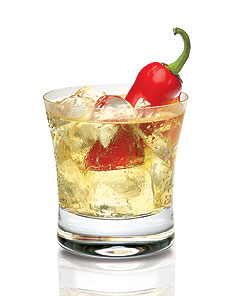
Turn up the heat with a spicy Cabo Jalapeño cocktail. Photo courtesy Cabo Wabo Tequila.
|
LEAH HANSEN is an Editorial Assistant for THE NIBBLE.
|
|
August 2009
Last Updated July 2018 |
|
Tequila Cocktail Recipes
Page 1: Tequila History, Tequila Types
The Margarita, while extremely popular, isn’t the only tequila cocktail in town. This article includes other tequila cocktail recipes for Cinco de Mayo, casual evenings or other times that call for something south of the border. And yes, there are Margarita recipes, too. This is Page 1 of a five-page article. Click on the black links below to visit other pages.
The History Of Tequila
Tequila is North America’s first indigenous distilled drink or spirit, a strong distilled alcoholic liquor. It’s made from the sweet juice of the blue agave plant, and is produced via double-distillation in the area around the city of Tequila, located in the western Mexico state of Jalisco.
The agave plant grows exceptionally well in the volcanic soil of the region, and Mexican law dictates that tequila can only be produced in Jalisco. Mezcal, the precursor of tequila, is a less refined spirit that can be made from five different varieties of agave. It is single-distilled, and is made mostly in the Mexican state of Oaxaca. (By the way, the agave plant is a succulent in the Agavaceae family, related to the lily family, and not a cactus. See another photo here.)
Before there was tequila or mezcal, there was pulque. Pulque, also called octli (“nectar of the gods”) was made by the Nahuatl Aztec tribe that migrated into the region. The first recorded cultivation of the blue agave dates to 1224 C.E. It is also recorded that in 1239, a very strong beverage called pulque was fermented from it.* The Aztecs called it the “a gift from the gods” and the agave was a sacred plant. (Note that they called chocolate the “food of the gods.”)
____________
*It is still made today.
The Conquistadors Arrive
The Conquistadors arrived in Mexico in 1519. After their brandy supply ran out, century they looked for a substitute. Finding the indigenous people drinking the fermented pulque, they taught them the art of distilling†: Mezcal was born. The village of Tequila, established in 1656, focused on the mezcal trade, with mezcals being called “tequila.” It was a bar drink, not a refined spirit that would be served at a restaurant.
___________
†Distillation was invented by Greek alchemists in Alexandria, Egypt, in the second century. The Arabs learned it from the Egyptians. Fractional distillation, a special type of distillation. was developed by Taddeo Alderotti, a Florentine who taught medicine in Bologona, Italy beginning in 1260. (One of the first writers of medical literature, he is also credited with introducing the practice of teaching medicine at the patient’s bedside.) Fractional distillation is the separation of a mixture into its component parts, or fractions, such as in separating chemical compounds by their boiling point by heating them to a temperature at which several fractions of the compound will evaporate.
|
|
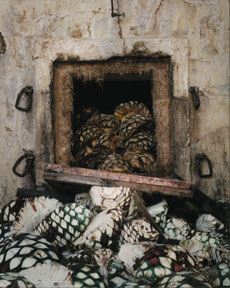
Agave piñas (pineapples, so-called because they look like pineapple fruit) roasting in the oven, or hornito. Photo courtesy of Casa Herradura Tequila. |
Modern Tequila
What we know as tequila was invented in the 19th century, with the introduction of above-ground, steam-heated ovens called hornitos (horno=oven, hornito=small oven; the word also refers to a volcano mound of lava, which has nothing to do with tequila).
To start at the beginning: Tequila is created from the piñas, or pineapples, of the agave. The piñas are cut away from the mother plant, then shredded; the juice is pressed out and put into vats and allow to ferment. A yeast is added to the vats to convert the sugar into alcohol. Different companies use their own distinctive (and often secret) yeasts.
The tequila can then be aged in oak barrels to become a reposado or añejo (see below), or bottled immediately as a blanco. The treatment of the oak wood, and what the barrels were previously used for (many from prior batches of blanco tequila) both affect the flavor of the finished spirit.
Blue Agave Is Declared The Best
In 1902, the German botanist Franz Weber studied the agave plant and determined that the sap of the blue agave had the ideal amount of sugar for distillation and fermentation. Its botanical name is the Agave tequilana Weber—Weber named it after himself.
In 2001, Mexico and the European Union ruled that tequila must be at least 51% Agave tequilana Weber, that it could be produced in Mexico only, and within only the five states of Guanajuato, Jalisco, Michoacan, Nayarit and Tamaulipas. Jalisco is considered to be the best overall agave-growing region.
Now, learn the five types of tequila.
Continue To Page 2: Tequila Types
Go To The Article Index Above
All materials
|