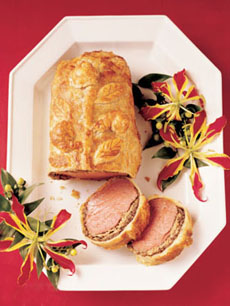
 Beef Wellington: a tenderloin covered with foie gras and wrapped in pastry. This delicious and regal beef presentation is available from Allen Brothers, a NIBBLE Top Pick Of The Week. Beef Wellington: a tenderloin covered with foie gras and wrapped in pastry. This delicious and regal beef presentation is available from Allen Brothers, a NIBBLE Top Pick Of The Week.
June 2005
Last Updated September 2015
|
|
Beef Glossary & Cuts Of Beef Diagram
Page 8: T, U, V, W, Y
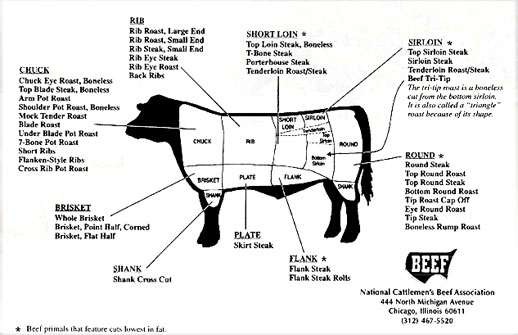
When looking up cuts of meat, it’s helpful to refer to the beef cut diagram, courtesy of the National Cattleman’s Beef Association. If you enjoy this Beef Glossary, we have a food glossary for almost every category of food.
Click on a letter to go to the appropriate glossary page.
a b c d e f g h i j k l m n o p q r s t u v w x y z
This glossary is protected by copyright and cannot be reproduced in whole or part.
You are welcome to link to it.
TARTAR STEAK
See steak tartare.
T-BONE STEAK
See porterhouse.
TENDERLOIN or SHORT LOIN or FILET MIGNON
The two main muscles in the short loin are the tenderloin and the top loin. The most tender area of beef, with the most mild flavor, is the tenderloin, in the middle of the back between the sirloin and the rib. The tenderloin can be cooked whole, in smaller sections like Chateaubriand or cut into individual filets mignon. The top loin can get cut into a club steak with the bone attached, a New York (or Kansas City) strip steak or Delmonico steak without the bone. When the bone is left in and portions of both the tenderloin and top loin muscles are included, the short loin is the source of porterhouse, a.k.a. T-bone, steaks. |
|
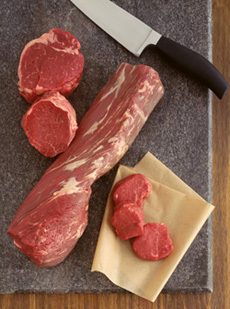
The tenderloin or short loin, with cuts of filet mignon. Photo courtesy Morton’s The Steakhouse. |
TOMAHAWK STEAK
The tomahawk steak, so-called because of its resemblance to a tomahawk, is a larger version of the bone-in Frenched rib eye steak. The bone is been left in to enhance the taste of this flavorful cut. The Frenched-style bone makes also for a dramatic and elegant presentation, perfect for impressing guests. This cut can be grilled or broiled.
|
|
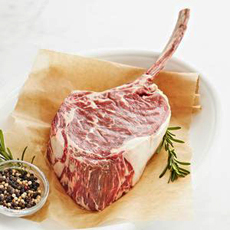
Tomahawk steak. Photo courtesy Sur La Table and Niman Ranch. |
TOP LOIN
See New York strip steak.
TOP ROUND ROAST
The round is the most tender of the four round cuts. See round.
TRI-TIP
Depending on region, this cut is known as a Newport steak (in the East), a triangle roast, a sirloin tip or a bottom sirloin but. A bargain cut, it is juicy with excellent beef flavor, and is typically found for less than $8/pound. See sirloin. |
|
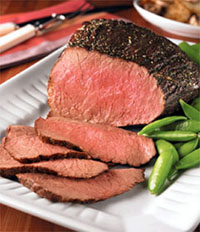
Top round roast. Photo courtesy Glacier Beef.
|
URMIS
URMIS, the Uniform Retail Meat Identity Standards, is a standardized nomenclature system that provides a uniform method for labeling meat throughout the U.S. The URMIS program, developed in the early 1970s, was updated in 1995.
USDA
The United States Department of Agriculture administers programs and services covering farmers and consumers. These include grading and inspection of meat and other products, and conducting research programs in animal and plant production and human nutrition. |
|

USDA logo. |
USDA PRIME and USDA CHOICE
All beef is not created equal. The quality depends on not only the stock but the animal’s environment, type of feed, slaughter technique, aging, butchering, packaging and other factors. The eight USDA grades are Prime, Choice, Select, Standard, Commercial, Utility, Cutter and Canner. USDA Prime is generally only available to restaurants and specialty butcher shops. The best quality sold at supermarkets is generally USDA Choice, although many markets sell only Select. If the grade is not indicated, ask. Only 2% to 3% of all beef produced is graded Prime. |
|

USDA Prime logo. |
Prime is at its best in both flavor and texture when it is aged 18 to 24 months. About 58% of all beef produced is graded USDA Choice. The grading is based on three factors: the proportion of meat to bone (conformation), the proportion of fat to lean (finish) and overall quality. Beef grade is largely determined by the nature of the steer, although the industry tries, through breeding and feeding practices, to raise cattle that will earn a Choice grade.
VACUUM AGING
Aging in vacuum packaging. Also referred to as wet aging, the beef is packed in a bag for several weeks to allow the enzymes to break down and tenderize the muscle tissue. This technique is used by some of the finest steak houses, such as Morton’s, Others prefer dry aging.
VACUUM PACKAGED
Refers to the process of encasing meat cuts in bags or pouches fabricated from laminated plastic, evacuating air from the bags and sealing them for extended refrigerated storage.
VEAL
Veal is the meat of a calf, in contrast to beef, which comes from
older cattle. It is very different in taste and texture; and since it is much costlier because calves have far less meat, it is often considered a luxury. According to Wikipedia, although veal can be produced from a calf of either sex and
any breed, most veal comes from male calves of dairy cattle breeds. Veal chops and cutlets are the cuts most frequently made. Veal Parmigiana is an Italian-American dish made with breaded veal cutlet topped with marinara sauce and mozzarella cheese. |
|

Veal cutlets, also called scallops. Photo courtesy Fresh Direct. |
VEGAS STRIP STEAK
A Vegas strip is marketed as tender and flavorful, comparable to a New York strip steak. It weighs about 14 ounces, but can be cut into portions from 4 to 12 ounces. However, according to THE NIBBLE’s chef Johnny Gnall, the cut is similar in shape to a flatiron steak, but smaller; very thin and lean, it can easily get tough if not cooked properly. He says the best way to deal with the toughness is marinating the steak and cooking it sous vide.
| |
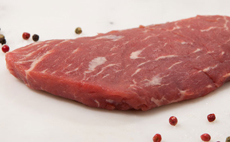
Photo courtesy VegasStripSteak.com. |
WAGYU
Wagyu refers to several beef breeds of cattle (Japanese Black, Japanese Brown, Japanese Polled, and Japanese Shorthorn), which are genetically predisposed to intense marbling, which provides enhanced flavor, tenderness and juiciness (and a high market price, up to $150/pound). The translation of Wagyu is “Japanese cattle”: wa means “Japanese,” and gyu means cattle.” Wagyu is also known as Kobe-style beef, although only beef raised in the Kobe prefecture of Japan can be called “Kobe”—it is a branded name, like Certified Angus®. |
|
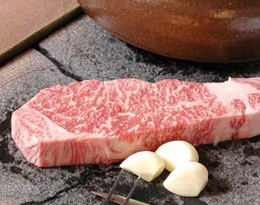
Wagyu strip steak available from TheWagyu.com. |
Wagyu cattle are raised in Japan, the U.S. and elsewhere. In Japan, each calf stays with its natural mother for about 10 months, then is fed hay, rice, straw, barley and corn for 24 months. Because of both the cattle’s genetic predisposition and this special diet, the beef contains a higher percentage of omega-3 and omega-6 fatty acids; the increased marbling provides a higher ratio of monounsaturated fats to saturated fats. Wagyu have about 70% monounsaturated fatty acids, specifically oleic and stearic acid, which make the beef “melt in your mouth.” As you can see in the photo above, the high percentage of fat to meat means a very mouth-watering experience. As with USDA grading, Wagyu is also graded; A5 is the highest grade, with the most marbling, snow-white fat and red-orange lean (the muscle, or meat). See also Kobe beef.
WET AGING
See vacuum aging.
YAK
Yak are Tibetan cattle—perhaps the world’s highest-altitude beef, from the Himalayan mountains. They are ranched domestically as specialty beef. See Himalayan beef.
YIELD GRADING
A system of grading that estimates the percentage of boneless and closely trimmed cuts that can be obtained from the round, loin, rib and chuck/shoulder. Yield grades are Y.G.1 (leanest) through Y.G.5 (fattest).
Go To Glossary Alphabet Index, Above
Go To The Beginning Of This Article
Lifestyle Direct, Inc. Some definitions were provided by the Cattlemen's Beef Board and are © Copyright 2005 Cattlemen’s Beef Board. All rights reserved. Images are the copyright of their respective owners.
|