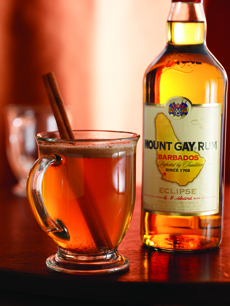
 Yo ho ho and a bottle of rum. Photo of hot toddy (photo © Mount Gay Rum).
March 2006
Last Updated August 2023
|
|
Product Reviews / Main Nibbles / Cocktails & Spirits
Whiskey Glossary
Page 4: Rum, Rye Whiskey, Scotch Whiskey & Other Terms Starting With P To S
This glossary is a companion piece to our overview article about whiskey, Whiskey 101. Please contact us if you’d like to suggest additional terms. The Whiskey Glossary is just one of many NIBBLE Food Glossaries. Take a look at the entire collection as you enjoy a glass of Scotch whiskey.
Click on a letter of the alphabet to get to the appropriate glossary page:
a b c d e f g h i j k l m n o p q r s t u v w x y z
This glossary is copyrighted and cannot be copied in whole or in part.
PEAT
Material formed by decaying matter found in bog land (also known as turf in Ireland). It is used as a fuel (among other purposes), and traditionally used in Scotland as the fuel for drying the malted barley. This gives Scotch whisky its distinctive smoky flavor, often called “peatiness.” The distiller can control the amount of peatiness in the flavor
POTEEN
An Irish term for an illicit spirit traditionally previously made from malted barley, occasionally from potatoes. Today it is more commonly made from molasses. The “illicit” factor is due to the operation of an illegal still, that has no license and does not pay taxes.
|
POT STILL
A copper container in which the distillation process takes place. The heating of the contents of the still produces vapors containing the alcohol, which is separated from the water.
POT STILL WHISKEY or PURE POT STILL WHISKEY
The traditional name for Irish whiskey that is produced from a mixture of malted and unmalted barley and distilled in a pot still.
RUM
Rum is not a whiskey, but a distilled spirit made from sugar cane. Whiskey is a sub-category of distilled spirits, made from fermented grain mash. Originating in the Caribbean, rum is a spirit made from sugar cane by-products: molasses and sugarcane juice. It is not a whiskey, which is distilled from barley, corn, and/or rye. The by-products are fermented and then distilled. Like all distillates, rum emerges from the still as a clear liquid and is then typically aged in oak barrels. Some scholars believe that the name derives from the last syllable of the Latin word for sugar, saccharum. Similar spirits from Asia are much older in origin, since sugar cane is native to the Pacific Rim, and its juices were distilled long before the grass was planted in the Caribbean in the 17th century. Slaves first discovered that molasses could be fermented into alcohol, and the origin of rum is believed to be Barbados.
|
|
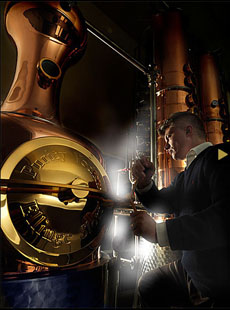
A beautiful modern pot still (photo © Purity Vodka).
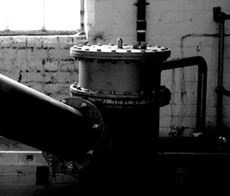
An older pot still (photo © Martin Miller’s Gin).
|
In 1655, the British fleet captured the island of Jamaica and discovered rum; the daily ration of liquor given to sailors was thereby changed from brandy to rum (a practice that continued into 1970). Grog is watered-down rum, initiated by the Navy to temper the spirit’s effects on the crew. A hot toddy is hot buttered rum—see the recipe.
RUN
The clear alcohol-rich liquid that is produced by the distilling process.
RYE WHISKEY
Rye whiskies are produced in both the U.S. and Canada. Ryes such as Jim Beam (U.S.) and Canadian Club are often quite assertive in flavor, with more than 51% rye in the mash. See also Bourbon.
|
SCOTCH or SCOTTISH WHISKEY
Whiskey from Scotland, informally known as Scotch, has a distinctive flavor attributed to the barley used in the mash. Scotland has internationally protected the term Scotch; for a whiskey to be labeled as such, it must be produced in Scotland. The process begins with malted barley dried over peat fires, which gives a smoky flavor. The barley is then usually aged for at least three years. There are more than 120 brands of Scotch comprising three main styles: Blended Scotch (normally mixed with soda, e.g. Johnnie Walker Red Label), Premium Scotch (drunk neat, e.g. Jonnie Walker Blue Label, Chivas Regal), and Single Malt Scotch (drunk neat—see more below). Within each style, each maker has a process and “recipe” that accounts for the variation in flavor: the type of water used, the char on the oak cask, how long the product is aged in oak casks before bottling, the temperature of the warehouse during aging, etc. Scotch whiskey types include blends, single grains, single malts, and vatted malts. A bottle simply labeled “Scotch Whisky” is likely to be a blend.
|
|
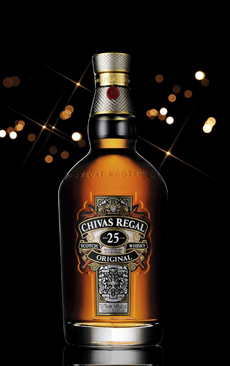
Chivas Regal is one of the most admired blended Scotch whiskeys (photo © Chivas).
|
SINGLE CASK SCOTCH
A single malt Scotch that contains whiskey from a single cask. If it is not designated “single cask,” the bottle will contain whiskey from many casks, so the blender can achieve a blended taste that fits the flavor profile of the distillery.
SINGLE GRAIN SCOTCH
There are two basic types of Scotch, malt and grain. Malt is made entirely from malted barley; Grain is made from malted and unmalted barley, along with other grains, and used in blends. However, now some “Single Grain” Scotch is being made from barley only.
|
SINGLE-MALT SCOTCH
A malt whiskey made by a single distillery and only from a malt mash, i.e., unmixed with either grain or pot still whiskeys. While by law single-malt Scotch must be at least three years old, malt whiskies don’t reach peak drinking until they are 10 years or older. Thus, distillers have to carry the inventory and don’t see their money for a decade or longer. Single malt Scotch grew to prominence after World War II. Each area produces a very discernable flavor profile, from highland mountain heather to peat and seaweed from the islands to earthiness in between. Single malts from the Scottish Lowland are relatively muted in flavor (e.g. Glenkinchie, MacLeods), the Highland malts are at the other end of the spectrum, assertive (Dalmore, Dalwhinnie), while Speyside is known for the most complex flavors—floral, fruity, grassy (e.g. Balvenie, Glenfiddich, Glenlivet). The island of Islay produces peaty whiskies (e.g. Bruichladdich, Laphroaig), and the smaller islands their own distinctive products (e.g. the island of Skye has only one single-malt distillery, Talisker, whose style is a bit peaty but largely peppery).
|
|
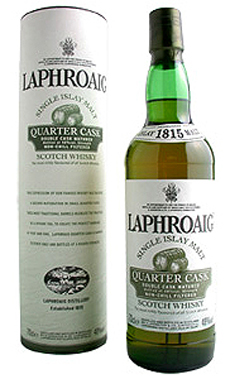
Laphroaig, a single malt from Islay, is known for its peaty flavors (photo © Laphroaig).
|
However, because the flavor so closely mirrors the distillery in which it was produced, even within the same region there is great variation in taste from brand to brand.
STRAIGHT WHISKEY
A whiskey aged in newly charred oak barrels for a minimum of two years. Only water is added to dilute the alcohol, which can only be reduced to 80 proof. Examples include Bourbon, Tennessee whiskey, and Rye.
Continue To Page 5: Terms Starting With T-Z
Go To The Article Index Above
© Copyright 2005- Lifestyle Direct, Inc. All rights reserved. Images are the copyright of their respective owners.
|