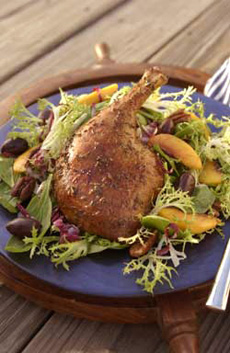
Maple Leaf Farms pre-cooked confit de canard (confit of duck), shown here on a mesclun salad with sautéed peaches, olives and candied walnuts. A feast!
|
CAREY POLIS is on the Editorial Staff of THE NIBBLE.
|
|
February 2008
|
 |
Maple Leaf Farms Duck
Quality Duck Products For Fast Cooking
CAPSULE REPORT: Maple Leaf Farms sells a variety of succulent Pekin duck products, some of which are pre-cooked and ready to eat in just two minutes! It’s some of the best pre-cooked duck we’ve ever tasted; the raw duck breasts we cooked from scratch were also superb. But we love being able to have duck more often, just heating and eating without the heavy aromatics of roasting duck from scratch.
History Of The Pekin Duck
The Pekin* duck, a domesticated duck that originated in China, is the most popular commercial duck breed—it comprises about 95% of U.S. duck consumption (nearly 26 million ducks were eaten in the U.S. in 2004, according to the USDA).
What is the provenance of most of these 26 million ducks? In 1873, nine Pekin ducks were brought to Long Island, New York from China (“Long Island Duckling” indicates a Pekin). All domestically-grown Pekin ducks are descended from those original nine. What you find in grocery stores and on restaurant menus, unless otherwise indicated, are Pekins.
*Don’t confuse Pekin duck, a breed of duck, with Peking Duck, a particular dish that can be made with a Pekin duck or other breed), and consists of the roasted, lacquered duck skin and meat rolled in thin pancakes with scallions and hoisin sauce.
The Pekin produces more meat than other duck breeds. The meat is mild and tender, and lends itself to different methods of preparation, which explains why this is such a popular commercial breed.
Six ounces of Pekin meat has 310 calories, 10g total fat, 183mg cholesterol, 51g protein and 0 carbs. It is a good source of iron, niacin (B4) and selenium.
Duck Breeds & Preparations
Besides the popular Pekin duck, America has other favorite eating ducks and duck parts. Many begin with an “M”—no wonder it’s confusing! Here’s a quick list to help you master the choices: |

A Pekin duck. Photo courtesy of Marin Winter and Wikipedia. It is believed that Donald Duck was modeled after a Pekin, as is the AFLAC mascot. |

Maple Leaf Farm’s confit de canard, in a classic preparation with heirloom beans. |
- Confit is the French word for “preserved.” Confit de canard is a duck leg that has been cured, partly or fully, in salt, and then marinated and poached in duck fat, seasoned with garlic and other herbs. This rich, and not very cardio-friendly dish is very popular among lovers of duck.
CONFIT: Think leg cooked in duck fat.
- Foie Gras, or “fat liver,” is a specially fattened and rich liver created by overfeeding ducks so that their liver grows to four times its normal size. Historically, this was done with goose liver, but the far more gentle ducks are used today. Foie gras can be served as a hot dish or at room temperature, whole or in a pâté (terrine) or mousse.
FOIE GRAS: Think liver, whole or as pâté.
|
- Magret is the breast of the Moulard duck (see below). The breast is larger than any other duck breast, and to appreciate its nuances, it must be cooked even rarer than Pekin duck. If you like your meat medium or well done, forget magret: according to our Wine Editor and consulting chef Kris Prasad, “a medium or well-done magret will be tough as shoe leather.” Enjoy this large duck breast in rare slices!
MAGRET: Think breast, served rare.
- Mallard is probably the most familiar breed of duck. It’s the duck with the green head, and is the ancestor of almost all domestic ducks. If your friend shot the duck you’re eating, ask if it’s a mallard.
MALLARD: Think duck shot by a hunter.
|

Take a gander at this gorgeous Pekin breast. If you don’t want to cook it yourself, Maple Leaf Farms offers sliced, cooked duck breast with three different seasonings. |

The Muscovy duck has exotic markings. This is a male; the female has a solid red face and a white comb with a white body. Photo courtesy of Alvesgaspar and Wikipedia. |
- Muscovy ducks are raised for their breast meat and liver. They comprise 3% to 4% of U.S. duck consumption, and are the only domestic duck breed not descended from the mallard (they are native to Latin America). They are named after the Muscovy Company, which began shipping the ducks to Europe in the mid 1500s; in England they are called Barbary ducks. The meat is leaner than the fatty Mallard. The foie gras industry in Israel reportedly uses a Muscovy-Mallard hybrid. There are wild Muscovy populations in parks in nearly every state in the U.S. and Canada, where their aggressive begging for food and their droppings cause problems.
MUSCOVY: Think breast and liver.
|
- Moulard is a sterile hybrid of the male Pekin and the female Muscovy, and is bred for breast meat and foie gras. Moulard ducks comprise 1% to 2% of domestic duck consumption.
MOULARD: Think breast (a.k.a. magret) and foie gras.
- Pekin, the most popular domestic duck breed, is discussed at the beginning of this article.
PEKIN: Think meat and eggs.
- Pressed Duck, canard à la presse or caneton à la presse, is an elaborate dish developed in the 19th century at La Tour d’Argent restaurant in Paris. In brief, the duck carcass is pressed in a device like a wine press to extract all of its juices, which are then cooked into a sauce with the minced liver and served with the breast. The legs are broiled and served separately.
Maple Leaf Farms Duck
Maple Leaf Farms has grown from 280,000 ducks in 1958 to processing more than 15 million animals today, most of which are raised on small family farms, often Amish or Mennonite. Donald Wentzel, who started the farm in Milford, Indiana, believed that the duck industry would blossom once more consumers were exposed to the succulent and versatile meat. Maple Leaf Farms continues as a family operation, managed today by the founder’s son-in-law and grandsons. The company produces a variety of quality duck products, both raw and pre-cooked.
The ducks live free-range in open barns, not cages. A poultry nutritionist formulates a natural, grain-based diet, so the ducks get no antibiotics, steroids or hormones. The company takes pride in the care given to its animals. Maple Leaf Farms became the first duck producer in North America to implement a set of care guidelines and a certification program, approved by university-level animal welfare specialists, for the staff and growers. Its operations are audited by an independent team of animal care experts.
Photo above: You can purchase whole or raw duck parts and cook them yourself, or purchase half roasted duck, roasted duck breasts and legs cooked by the pros.
Maple Leaf Farms Products
From the broad menu of Maple Leaf Farms products, we tasted the following:
“Simply Duck”
The “Simply Duck” line offers three flavors of fully-cooked, boneless, sliced duck breasts. The meat is ready in 2½ minutes in the microwave or 15 minutes in the oven. The microwave is great when you find yourself in a time crunch, although we recommend the oven for slightly crispier skin. A hybrid solution is to follow the microwave directions, reducing the time by 15 seconds; then placing the duck breast, skin side up, under the broiler to crisp the skin.
- Chipotle. This flavor is perfect for the spice lover. We enjoyed it, but recommend a tall glass of water or beer to counter the heat.
- Original (Salt & Pepper). This duck is juicy and flavorful. Sometimes the simplest recipe is the best—this was our favorite by far.
- Roasted Garlic. Expect a thick layer of skin with profound garlic flavors. If you’re a garlic lover, then this one is for you. Otherwise, the garlicky skin is easy enough to remove.
For people who want more duck in their life—with less fuss and less muss—“Simply Duck” is simply divine.
More Duck
- Duck Leg Confit: Making confit de canard is no easy task; we’re glad that Maple Leaf Farms did the work for us. We felt regal eating such a sumptuous and filling duck leg. There’s plenty of tender and juicy meat to enjoy; all we did was heat it in the microwave!
- Roast Half Duck. The Roast Half Duck is one of the company’s flagship products, and has become a regular on our dinner table. This ready-to-heat-and-eat duck is
the same product sold in many restaurants, where the chef dresses it with a sauce and serves it to you. We keep several of these half quackers in the freezer, thaw them a few hours in advance, and present our own duck dishes with a flourish (although here, too, Maple Leaf Farms has done 90% of the work). You can microwave, bake or grill the duck and enjoy it plain or with your favorite sauce (last night we had it with Chukar Cherries’ cherry barbecue sauce; last week with a Dijon mustard glaze). It’s available in two flavors: Original and Rotisserie Herb. If you love duck (as we do) but are relegated to eating it at restaurants because you find it too messy to cook from scratch (again, as we do), Maple Leaf Farms Roast Half Duck will be one of your favorite NIBBLE food finds.
- Raw Duck Breasts. The raw breasts from Maple Leaf Farms are far superior to the generic Pekin duck breasts we have purchased at our local supermarket. They are are plump and sweet, with an intense duck flavor. Even when we accidentally overcooked some of the breasts, they still were good—although we still strongly recommend that they be served rare or medium rare.
Cooking Duck: Tips & Recipe
Cooking duck does not take very long, since the meat should be rare. Kris Prasad, THE NIBBLE’s wine editor and consulting chef, recommends rolling two duck breasts in a paste made of:
- 1 teaspoon 5-spice powder
- 1 teaspoon honey
- A pinch chili powder
- 1 teaspoon sesame oil
- 2 tablespoons soy sauce
Preparation
|

A second, very different, recipe idea: Serve duck
breast with potato pancakes, crème fraîche and a
garnish of green and red apples.
|
- Heat a heavy-bottom pan until it is quite hot. If you wish, you can spray it with oil, but it's not necessary. Place the duck breasts skin side down and press on them until the skin sizzles. Maintain high heat and cook for about 5-6 minutes, or until the skin turns mahogany brown. Turn the breasts over and reduce the heat to medium-low; cook 3 minutes more (total cooking time 8-10 minutes).
- Remove duck from heat; cover with foil and let it rest for at least 5 minutes. While the duck is resting, add parboiled, coarsely chopped potatoes to the duck fat in the pan, along with 2-3 garlic cloves and 2-3 sprigs of fresh rosemary. Fry the potatoes and discard the rosemary.
- Slice the breasts lengthwise into 5-6 thin slices. Sauce them if you wish, but no sauce is needed.
If you prefer using an oven:
- Broil the breasts about 10 inches from the flame, skin-side up, until the skin is dark (about 5 minutes).
- Remove the meat and let it rest. If the duck is too rare, place it in oven for another minute. Do not microwave.
When cooking duck breasts, make sure the duck remains a bit pink—otherwise it may become too chewy.
Serve with a root vegetable purée (we like sweet potato purée) or a side of carrots. A fruit-based chutney is a nice condiment.
There are additional recipes on the company website. With Maple Leaf Farms, there’s no excuse for not enjoying duck more often.
Maple leaf farms
Duck Breasts, Duck Legs
- Simply Duck Grilled
Breast Filet
(Photo At Right)
$5.99-$9.99
- Roast Half Duck
$7.25
- Duck Leg Confit
$14.95
- More Selections On
Website
Purchase online* at MapleLeafFarms.com or 1.800.348.2812 x 26, 8 a.m. to 5 p.m. Monday through Friday, Eastern Time.
|

Pre-cooked duck breasts in three flavors. |
*Prices and product availability are verified at publication but are subject to change. Shipping is additional. THE NIBBLE does not sell products; these items are offered by a third party with and we have no financial relationship with respect to this sale. This link to purchase is provided as a reader convenience.
© Copyright 2005-
2009
Lifestyle Direct, Inc. All rights reserved. Other images are the copyright of their respective owners.

|
 |
|
|