KAFFIR LIME Citrus hystrix is also called kieffer lime, makrut and magrood. Native to Indonesia, the leaf of the kaffir lime is used in Thai, Malaysian and Indonesian cuisines.
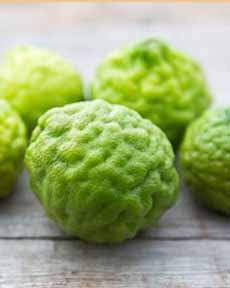
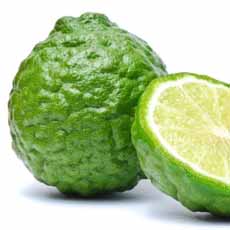
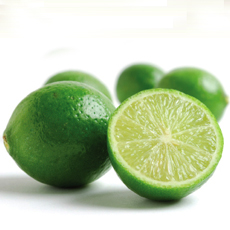
Kaffir looks like a round Persian lime, but the skin is bumpy instead of smooth and it has a slightly elongated neck.
The juice is strong and “deliciously tangy” rather than sour. The aroma from the aromatic oils, plus the intense flavor of the juice, produce a unique flavor profile.
Kaffir limes are delicious with savory dishes and add a tangy lift to spicy homemade chili, soup and stews.
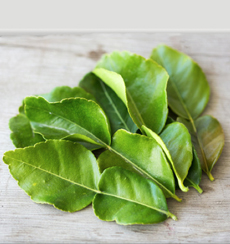
The dark green glossy leaves are extremely rich in lemon-lime fragrance, which is even more intense when the leaves are broken. The leaves imbue dishes with a delicate yet bold lemon-lime flavor, which is memorable in Thai curries, sauces and fish.
Above: The kaffir lime, recognizable by its bumpy skin. The juice is used in cooking (photo courtesy Good Eggs). Below: The leaves are also used to flavor dishes (photo courtesy Organic Facts.net).
KEY LIME
Citrus aurantifolia Swingle is also known as the Mexican lime, West Indies lime and bartender’s lime. The highly-aromatic Key lime is grown in the Florida Keys, Mexico and the West Indies. It is smaller and round, the size of a ping pong ball, and more fragrant and less acidic than the Bearss and Tahitian limes.
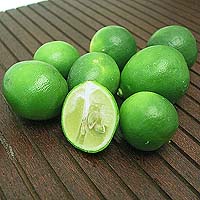
The color can range from a regular lime green to yellow in color, depending on ripeness. Those not familiar with it can mistake it for a lemon, but the skin is smooth, thin-skinned and full of small seeds. It also has a distinct, tart, but less acid, juice than the Persian lime. Both are the only two limes, acid or sour, that are commercially grown.
Key limes, smaller and rounder in shape (photo courtesy Melissa’s).
The term “Key” lime is an American retronym. This is the same lime brought back to Europe from the Crusades. Its name comes from the Persian, limu. It was later planted in Florida, Mexico and the Caribbean (see lime history). In addition to making Key lime pie (don’t buy juice in bottles—use fresh juice!), add slices to marinades, sauces, fruit salads, and pastries to enliven other flavors.
Citrus x Fortunella is a lime-kumquat hybrid originating in China. It is now grown around the world; in the U.S., it is found in the citrus-growing states of California and Florida.
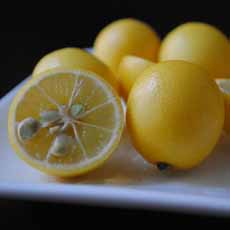
The fruit can be found during the fall and winter months. There are three distinct varieties, Eustis, Lakeland and Tavares. The fruit is small and oval like the kumquat, but greenish yellow instead of orange. (It can be green or yellow, depending on the degree of ripeness—the riper, the more yellow).
Like the kumquat, the fruit is entirely edible: It is eaten whole or used to flavor drinks and dishes. The rind is fragrant, sweet and fairly thin. The interior pulp is acidic, like a conventional Tahitian lime.
Although the limequat can be served fresh and added to salads, it is more commonly cooked and used to make syrups and preserves.