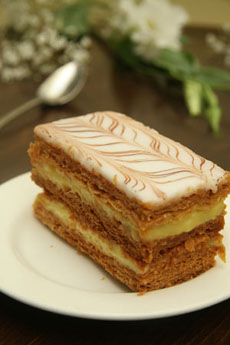
 A Napoleon—named not after the emperor but after the city of Naples. The pastry is also known as a mille-feuille. Photo courtesy FinancierPastries.com. A Napoleon—named not after the emperor but after the city of Naples. The pastry is also known as a mille-feuille. Photo courtesy FinancierPastries.com.
June 2009
Last Updated February 2026
|
|
Pastry Glossary: Different Types Of Pastry
Mille-Feuille & Other Types Of Pastry & Pies
Page 6: Definitions M ~ O
This page contains different types of pastries such as mille-feuille, Mississippi Mud Pie, and Napoleon. This is Page 6 of a ten-page glossary. Click the black link below to visit other pages. See many other food glossaries, each featuring a different favorite food.
MACAROON
A small round cookie with a crisp crust and a soft interior. The original version was made in Italy from almonds and was evolved by French pastry chefs into an almond-flavored meringue sandwich cookie that today is made in many flavors and colors. A coconut macaroon was developed and is popular in the U.S. See the history of macaroons.
MARJOLAINE
A long and rectangular form of the dacquoise: almond and hazelnut meringue layers with chocolate buttercream. Dacquoise is a dessert cake made with layers of almond and hazelnut meringue and whipped cream or buttercream. It takes its name from the feminine form of the French word dacquois, meaning “of Dax”; Dax is a town in southwestern France. It is usually served chilled and accompanied by fruit.
|
|
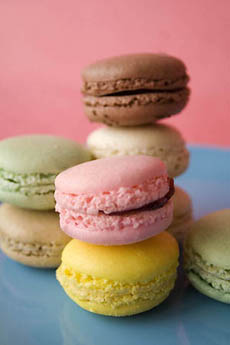
Macaroons from Mad Mac, a NIBBLE Top Pick of the Week. Photo by Claire Freierman | THE NIBBLE. |
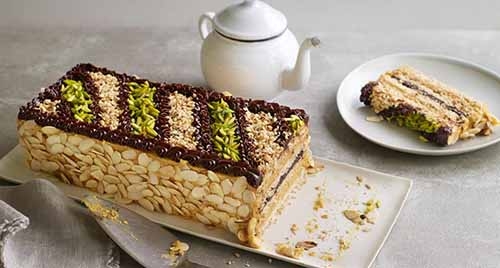
Here’s the recipe for this elegant marjolaine from BBC Food.
MARZIPAN
See almond paste.
MEAT PIE
A meat pie is a savory pie that can be filled with beef, lamb, pork, poultry, and even fish, plus vegetables and herbs. There are many kinds of meat pies, varying in size and pastry types. They can be made in a pie plate, a square, or a rectangular baking pan, or in individual ramekins or muffin pans. A pot pie is an example of a meat pie, as is a steak and kidney pie, and a shepherd’s pie, which is minced or ground beef or lamb with a top “crust” of mashed potatoes. Individual meat pies, which are sealed on all sides, include, among others, empanadas, pasties, Scotch pies, and turnovers. In the U.S., pot pies—meat or poultry with diced vegetables in a sauce—are popular (there are also vegetarian versions).
|
|
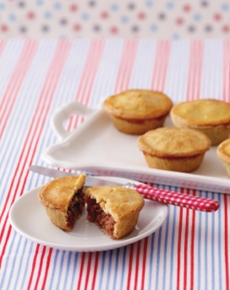
Mini meat pies. Photo courtesy The Gluten Free Cookbook. |
Meat pies date back to ancient times; they were a way to pull scraps together for a frugal dinner, while cooks in wealthier households prepared elaborate pastries filled with costly cuts.
Savory pies could include fruits as well as meats, along with spices, wine, fat, and mincemeat. Later, in England, chicken and veal pot pie were sometimes cooked with mashed potatoes and a rich sauce filling, a precursor of shepherd’s pie; on the coast, fish and seafood pies prevailed. See pie.
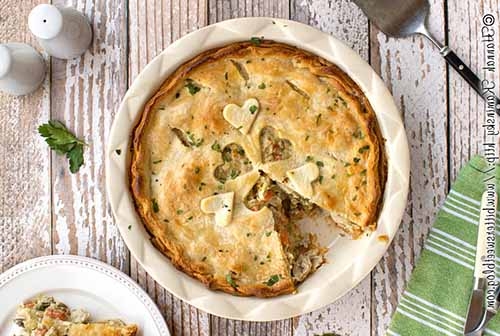
Chicken pot pie is perhaps the most popular American meat pie (photo © Bittersweet Blog).
MERINGUE
Meringue is a versatile substance made from beaten egg whites, to which sugar has been added to form stiff but airy peaks. The meringue can then (1) be folded in to lighten cake, mousse, and pastry cream, (2) used as a topping for pies (e.g., lemon meringue pie) and other desserts (e.g. Baked Alaska), (3) baked in a very low oven into cookies or cake layers, (4) baked into shells (vacherin) which are filled with custard, fruit, mousse or ice cream (see dacquoise).
|
|
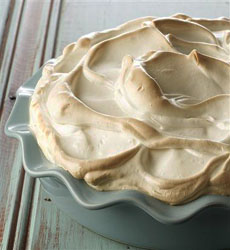
Lemon meringue pie. Photo courtesy McCormick’s. Find this and other delicious recipes at McCormick.com. |
MERVEILLEUX
Pronounced mair-vay-YUH, the word means “marvelous” in French. This delicate, airy pastry appeared in northern France and Flanders after the French Revolution, at the end of the 18th century.
Light meringue is topped with whipped cream and shaved chocolate. The modern French pâtissier Frédéric Vaucamps is credited with bringing back largely forgotten pastry in 1985. He reworked the recipe to make it lighter and created a variety of flavors. He named his business Aux Merveilleux de Fred.
Fred’s version of these melt-in-the-mouth pastries is composed of alternate layers of meringue and whipped cream, and available in a large selection of flavors.
|
|
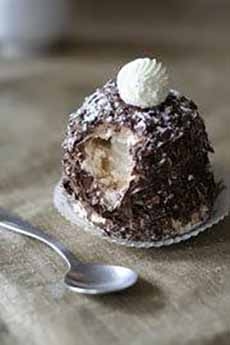
A Merveilleux in the original flavor, vanilla cream with shaved chocolate (photo © Aux Merveilleux de Fred). |
MILLE-FEUILLE or MILLE FOGLIE
Pronounced meal-FWEE in French and MEE-lay FOAL-yay in Italian, meaning “a thousand leaves,” this pastry is made as three rectangular sheets of puff pastry spread with two layers of Bavarian cream*, pastry cream, whipped cream, custard, jam, or fruit purée, often dusted with confectioner’s sugar. The pastry cream can be stabilized or flavored (chocolate, coffee, raspberry, etc.).
Made in a large pan, it’s cut into individual rectangular portions and can be iced with fondant (see photo below). The difference between mille-feuille and a Napoleon is that the latter is filled with almond cream. Savory versions are filled with cheese and served as appetizers. See also phyllo.
The mille-feuille and the mille foglie developed at about the same time. The difference is largely in the finishing touches.
- A classic French mille‑feuille uses three layers of puff pastry with pastry cream (crème pâtissière), often with fondant on top.
- A typical Italian mille foglie is filled with pastry cream, sometimes mixed with whipped cream, and topped with powdered sugar or fruit.
We don’t know which version came first. Laminated dough (puff pastry) seems to have developed in France, Italy, and Spain in overlapping ways from roughly the 17th century onward.
Both France and Italy have 18th- and 19th-century references to pastries that are recognizably mille‑feuille and mille foglie–like.
|
|
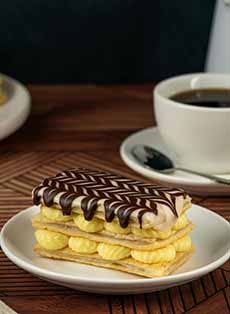
A mille-feuille with a classic fondant top. Note that the chef has piped the custard in balls: pretty, but it makes the pastry even “squishier” (photo © Skylar Ewing | Freepik).
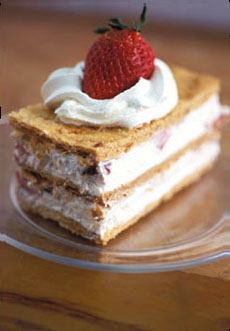
Millefoglie available from Venieros.com. |
Layered, flaky, cream-filled pastries evolved in parallel across Europe, influenced by shared techniques and trade, with each region naming and refining its own version.
The great French chef Antoine Carême (1784–1833) helped turn the mille‑feuille into a classic of French pastry, with defined structure and technique. But the underlying idea of layered, flaky pastry with cream was already present in European pastry traditions.
See how to eat a Mille-Feuille in the Napoleon section below.
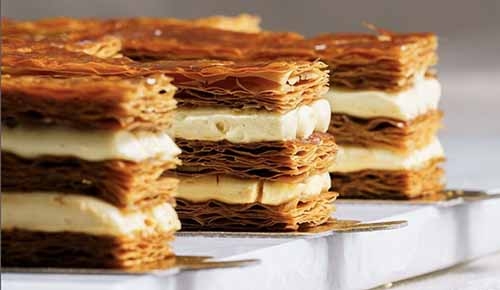
A mille-feuille with one layer of pastry cream and one of custard (photo © Birley Bakery).
__________
*Bavarian cream (crème bavaroise) is a rich, light dessert made from a cooked custard base (milk, eggs, sugar) stabilized with gelatin, into which whipped cream is folded. The result is a smooth, airy texture. It can be served chilled as a custard dessert or used as a filling in cakes and pastries.
See the different types of custard.
MINCE PIE or MINCEMEAT PIE
Mince pie dates back to Medieval times in Britain, when the recipe included venison, along with dried fruits, sugar, and spices. It was then known as mincemeat pie.
In the mid-nineteenth century, the meat began disappearing from the recipe, which evolved into the sweet and spicy mince pie we know today, served during the Christmas season, filled with candied and fresh fruits, nuts, sugar, spices, brandy or wine, and suet. Some updated recipes use a puff pastry shell instead of the traditional shortcrust,
Suet is raw beef fat [or mutton fat], particularly the hard fat found around the loins and kidneys. Vegetarian suet is made from palm oil and rice flour.
|
|
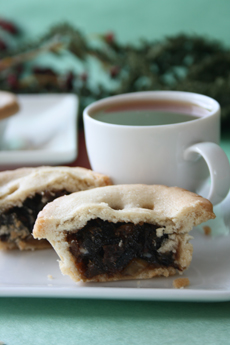
Mini mince pies. Photo by Hannah Kaminsky | THE NIBBLE. |
Vegetarian versions of the pie use butter, vegan versions use vegan butter or vegetable suet/shortening.
For sweet dishes, bakers prefer cow suet, which has a neutral flavor. Lamb/sheep suet can add “lamby” notes to a dish.
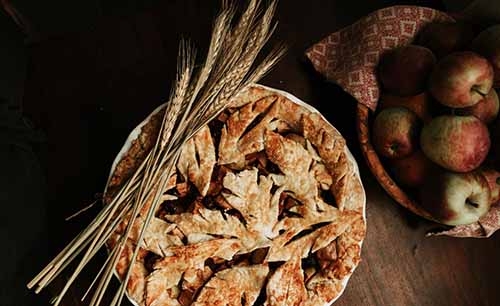
A mince pie doesn’t have to be homey. It can be glam, like this one (photo © Priscilla du Preez| Unsplash).
MISSISSIPPI MUD PIE or MUD PIE
An open pie consisting of a cooked chocolate filling in a crust made of chocolate or vanilla cookies or graham crackers. It is often topped with whipped cream and an optional garnish of chopped pecans. Some versions are made with coffee mousse or other coffee filling and a chocolate fudge sauce for the “mud.”
Mississippi Mud Pie is a specific, intensely rich, gooey Southern dessert featuring layers of chocolate custard, cake, or brownies over a cookie crust, often topped with whipped cream. Some recipes contain Bourbon.
As if it isn’t rich enough, it’s often served with ice cream, or optionally whipped cream, boiled custard, or vanilla yogurt.
Mississippi Mud Pie evolved from Mississippi Mud Cake (photo at right), popular during World War II—a chocolate sheet cake topped with marshmallows and frosting. It aimed to look like the muddy banks of the Mississippi River.
The pie version gained popularity in the 1970s. Its earliest known reference in print is in 1975.
Mississippi Mud Pie vs. Mud Pie
While the terms are often used interchangeably, a generic “mud pie” can refer to a variety of chocolate-based frozen pies, often using coffee ice cream with chocolate sauce.
|
|
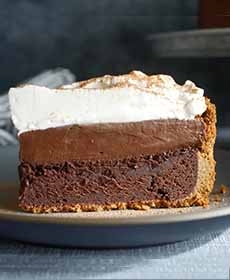
Pie: A tempting slice of Mississippi Mud Pies. Here’s the recipe from the New York Times.
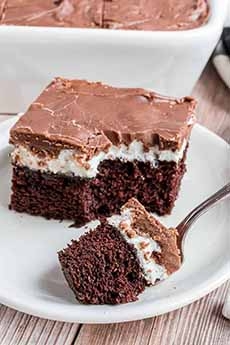
Cake: The predecessor, Mississippi Mud Cake. Here’s the recipe (photo © Shugary Sweets). |
So think Mississippi = goey, and Mud Pie = frozen.
Trivia: Scandinavia also has a mud cake, called kladdkaka (from Swedish kladdig, meaning sticky or messy). Made without baking soda, it’s a rich flat cake served with ice cream. It has its own food holiday, November 7th.
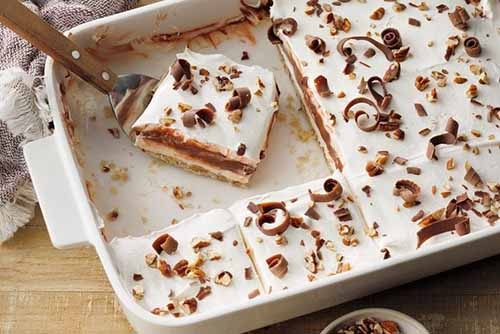
Making the gooey pie in a rectangular dish like the sheet cake makes it easier to cut and serve. Here’s the recipe (this photo and the photo below © Taste Of Home).
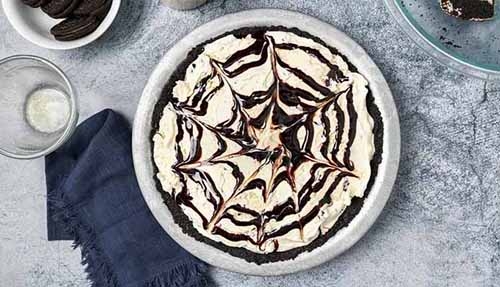
A frozen Mud Pie. Here’s the recipe.
MOCK APPLE PIE
Mock pies developed as far back as the Civil War, when war limited access to fresh fruit. The earliest recipe we have is from the Confederate Receipt Book of 1863. To ”mock the apples, soda crackers were soaked in water and mixed with sugar, lemon juice, and zest. This filling was baked in a pie shell. In 1935, Nabisco printed it on the box of Ritz Crackers, and the revival was an immediate hit.
NAPOLEON
The Napoleon pastry was not named after France’s famous general and emperor. The name is believed to be a corruption of the word “napolitain,” referring to a pastry made in the tradition of Naples, Italy (napolitano). This pastry originated as a millefoglie, or mille-feuille, using a leaf-thin pastry, most likely a descendant of phyllo.
The French mille-feuille and the Napoléon refer to the same pastry. Napoleon is simply the English (and sometimes Russian) name for a mille‑feuille.
It’s believed that the Napoleon and mille-feuille pastries were developed by the great chef Marie-Antoine Carême. Three layers of puff pastry (pâte feuilletée) are filled with almond cream and iced with fondant. In contrast, the mille-feuille (above) is filled with vanilla pastry cream or custard.
- An “American Napoleon” has a heavily marbled chocolate and vanilla fondant top, looking more like Jackson Pollock than the neat French style shown at the top of the page.
- An “Italian Napoleon” adds layers of rum-soaked sponge cake. Some variations layer fruit, such as raspberries, in the pastry cream.
How to eat a Mille-Feuille or Napoleon without crushing it:
|
|
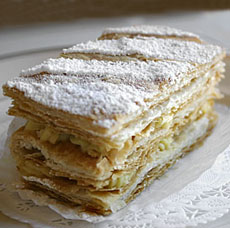
A Napoleon topped with confectioners’ sugar instead of fondant. Photo courtesy CafeBlanc.us.

A fondant-iced Napoleon (photo © Alina Matveycheva | Pexels). |
The vertical pressure of a fork almost always causes the filling to squish out the sides. Here are the three best ways to eat it:
- The Side Method: First, gently tip the pastry onto its side before you start. This way, a fork or knife cuts across the layers of pastry rather than pushing down into the soft filling. It better keeps the structure intact.
- The Sawing Method: Use a sharp, serrated steak knife and a very gentle sawing motion.
- The Deconstruction Method: Some people lift the top layer off, eat it with a bit of the filling, and then work their way down. Others may find this less elegant, but this is not a pastry meant to be eaten elegantly.
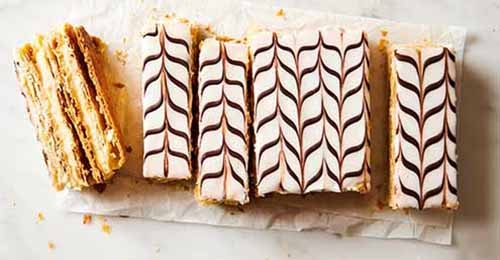
How Napoleons are made (photo © King Arthur Baking).
NESSELRODE PIE
Nesselrode pie is a classic Bavarian cream pie (i.e., a custard with added gelatin for stability and egg whites for volume and lightness), flavored with candied chestnuts and rum. It is named after Count Karl von Nesselrode, a 19th-century Russian diplomat who negotiated the Treaty of Paris after the Crimean War. The recipe began as Nesselrode pudding, a pink custard pudding enhanced with chestnut purée and maraschino cherry liqueur, plus maraschino-soaked fruits (candied lemon peel, currants, and raisins, whipped cream, and stiffly beaten egg whites. The original Nesselrode was chilled in a pineapple shape and is said to have been created for the count by his chef, a Monsieur Mouy, Mony, or Monie.
As a pie, Nesselrode was popularized by Hortense Spier, who had a brownstone restaurant in New York City on 94th Street between Columbus Avenue and Central Park West in the 1930s and 1940s. The restaurant closed before World War II; thereafter, Mrs. Spier baked pies for other restaurants (Nesselrode pie as well as banana cream pie, coconut custard pie, and lemon meringue pie). These pies became standards at New York restaurants.
A product called “Nesselro,” made by G.B. Raffetto, was used by home bakers through the 1970s but was discontinued when the pie went out of style. Containing candied chestnuts and fruits, it’s not difficult to recreate.
|
|
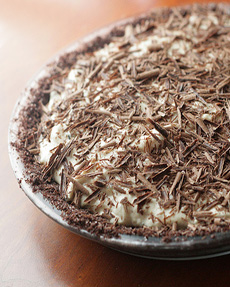
Nesselrode pie. Photo courtesy Savour Fare [since closed]. |
NOCCIOLA TART
An Italian tart with chocolate hazelnut filling, topped with chopped hazelnuts. Nocciola is the Italian word for hazelnut.
NUT PASTRY or NUT CRUST
This is plain pastry where 1/2 cup of finely ground nuts is substituted for 1/2 cup of flour. Ideal with cream pies. Here’s a recipe courtesy of the American Egg Board. Ingredients: 1 cup all-purpose flour, 1/2 cup (2 ounces) ground pecans or other nuts (such as almonds, hazelnuts, or walnuts), 1/2 teaspoon salt, 1/2 cup vegetable shortening (cold), 1 egg yolk, 3 to 4 tablespoons ice water (divided), 2 teaspoons fresh lemon juice. Preparation: (1) Mix flour, nuts, and salt in a large bowl. (2) Cut in the shortening with a pastry blender until pieces are the size of small peas. (3) Mix in egg yolk, 3 tablespoons of ice water, and the lemon juice in a small bowl. |
|
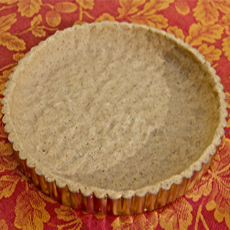
A tart crust made with ground pecans. Photo courtesy PaleoSpirit.com. |
(4) Add to flour mixture, 1 tablespoon at a time, stirring lightly and tossing with a fork until moistened, and the dough just holds together. (5) Add remaining ice water, if needed. (6) Gather the dough and shape it into a 1-inch thick disk. Refrigerate, wrapped in plastic wrap, 1 hour or overnight. (7) Heat oven to 425°F. Roll out dough on a lightly floured surface, rolling from center to edge, to form a 12-inch circle. (8) Fold into quarters; ease and unfold into a 9-inch pie plate. (9) Press pastry gently against the bottom and sides of the pie plate, easing out any air. Trim the edge, leaving a 1/2-inch overhang. Fold overhang under; flute edge. (10) Refrigerate, covered, at least 30 minutes. (11) Line piecrust with aluminum foil; fill with pie weights. Bake ina 425°F oven until pastry is set, 8 to 10 minutes. (12) Remove foil and weights; pierce pastry all over with a fork. Bake until pastry is golden brown, 5 to 7 minutes longer. Cool completely on a wire rack.
OPEN PIE
A single-crust pie, i.e., one with no pastry covering or other top crust.
Continue To Next Page: Terms With Pa
Go To The Article Index Above
|