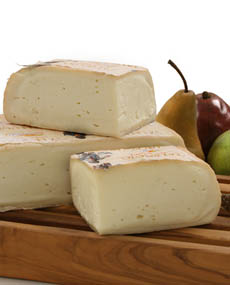
Taleggio, a cousin of Bel Paese, is the softest, creamiest member of the famous Italian Stracchino family of cheeses. It was first made in the Taleggio Valley in the province of Bergamo. It is D.O.P.-protected. Photo courtesy iGourmet.
May 2005
Last Updated October 2025
|
|
Cheese Information
Types Of Cheese, Information, Terms & Definitions Every Cheese Lover Should Know
Page 4: Cheese Terms Beginning With D & E
This is Page 4 of a 12-page glossary of cheese information. Click on the letters below to find terms of interest. When you’re finished with cheese, visit our many other food glossaries.
Click on a letter to go to the appropriate glossary section:
a b c d e f g h i j k l m n o p q r s t u v w x y z
This glossary is protected by copyright and cannot be reproduced in whole or in part.
You are welcome to link to it.
D.O. or DENOMINACIÓN DE ORIGEN
|
In Spain, the Denomination of Origin is a regulated and controlled qualification managed by a council that is responsible for controlling the characteristics and authenticity of food products to protect their agricultural heritage: wines, cheeses, olive oils, and other products. It reports to the Ministry of Agriculture. There are analogous bureaus in France (A.O.C.) and Italy (D.O.P.).
D.O.P. or DENOMINAZIONE
d’ORIGINE PROTETTA
Denominazione d’Origine Protetta is the Italian certification of authenticity of origin. Some other countries in the European Union also use D.O.P. now, including Portugal. See also A.O.C. and D.O.
|
|
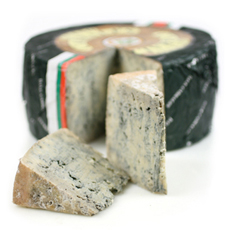
Cabrales, from Asturias in northern Spain, is a P.O. cheese, specifically a P.D.O.(Protected Designation of Origin) cheese (photo © iGourmet). |
DOUBLE GLOUCESTER
|
First made in the 16th century, this Cheddar-style cheese from Gloucestershire in southwest England has a mellow-to-bold orange paste (from annatto) and a sharp flavor. The milk comes from the Gloucester cow, a handsome black animal with a broad white stripe running down her back and the ability to produce the creamy, rich milk from which this cheese is made. “Double” refers to a traditional British recipe that uses cow’s milk from both the morning and evening milkings. Double Gloucester is the cheese used for the annual spring Cooper’s Hill Cheese Rolling and Wake on Gloucestershire’s Cooper’s Hill. Competitors chase a wheel of Double Gloucester down a hillside; the winner is expected to catch the 80-pound wheel. However, as the wheel rolls in excess of 70mph, it might not be possible (or advisable).
|
|
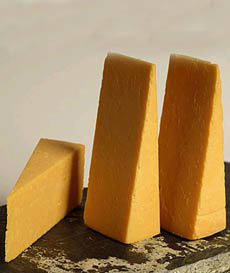
Butler’s Farmhouse Double Gloucester. Photo courtesy iGourmet.com. |
D.P.O.
The English translation of DOP (see above), Designated Protected Origin.
DRAINING
|
The stage of cheesemaking when the whey is drained from the curd. This can take 24 to 48 hours, depending on the size of the cheese. This stage is followed by further drying procedures, such as scalding. These two stages are critical to successful maturation.
|
|
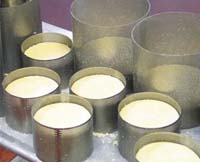
Cheese wheels rest in molds overnight to drain excess whey and become firmer. Photo courtesy of SproutCreekFarm.org. |
DRYING
|
The stage of cheesemaking when lactic cheeses are left for one to three days in a well-ventilated room to allow the water to evaporate.
DRY MATTER
The part of the cheese that remains after all moisture is removed. Soft cheeses, such as Brie and Camembert, will contain, on average, about 50% dry matter and 50% water. Aged cheeses like Parmigiano-Reggiano are mostly dry matter with very little water.
|
|
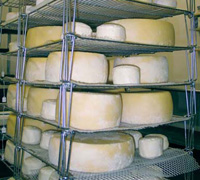 New cheese begins to form a rind within a day of drying. Photo courtesy of SproutCreekFarm.org. New cheese begins to form a rind within a day of drying. Photo courtesy of SproutCreekFarm.org. |
EARTHY
A descriptive term often used to describe the nature of monastery cheeses.
EMMENTAL or EMMENTALER
What most Americans think of as “Swiss cheese,” Emmentaler is one of the major Swiss cheeses—the one with the large eyes, as they are called in the cheese industry, or “holes” as they are called by American consumers. (There is no cheese named “Swiss cheese in Switzerland, just as there is no cheese named “French cheese” in France, “Italian cheese” in Italy, and so forth. Only Americans thought of cheese so generically as to have a product called “American cheese.”) Emmentaler is a pressed cheese—the curds are cooked before they are pressed to provide a more “milky” aroma and flavor than unpressed curds. See the photo below and the descriptors for pressed curd cheese. Also, see Swiss cheese.
Here’s the difference between
Emmental and Gruyère, both hearty mountain cheeses, but with some key differences.
|
|

Emmental, the most famous of the Swiss “mountain cheeses,” is immediately recognizable for its “eyes,” the industry term for the holes created by carbon dioxide gas produced by a specific bacterium (Propionibacterium freudenreichii). during the aging process (photo © De Laurenti). |
What’s the right spelling?
The different spellings reflect language variations and naming conventions for this famous Swiss cheese. Internationally, you’ll find all three spellings depending on the country, manufacturer, and tradition. The spellings are essentially interchangeable and refer to the same cheese.
- Emmental. The cheese originates from the Emmental region (the valley of the River Emme) in the canton of Bern, Switzerland. In German. “Emmental” means Emme valley (tal = valley). Thus, the name of the region itself, Emmental, is the most straightforward form
- Emmentaler. This means “from or of Emmental.” It is the primary modern spelling. The -er suffix in German is just like “New Yorker” or “Southerner.” This is the most common spelling for the cheese. The official protected name is Emmentaler Switzerland AOP, the Swiss equivalent of the European Union’s PDO (Protected Designation of Origin); Emmentaler Switzerland AOC (Appellation d’Origine Contrôlée).
- Emmenthaler. The “th” is an older or alternate German spelling. It still appears on some traditional Swiss labels and in some English-speaking countries.
EYES (HOLES)
The openings in the paste of Swiss-type cheeses such as Emmentaler and Gruyère. The holes are spherical and can be small like the head of a pin, or about the size of cherry pits. The eyes are caused by bacterial activity which generates prioponic acid, causing gas to expand within the curd and create the pockets. See Swiss cheese.
Continue To Page 5: Terms Beginning
With F & G
Return To The Article Index Above
|
|
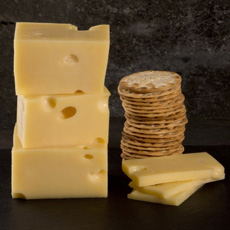
Emmentaler with the familiar “eyes.” Photo courtesy Murray’s Cheese. |
|