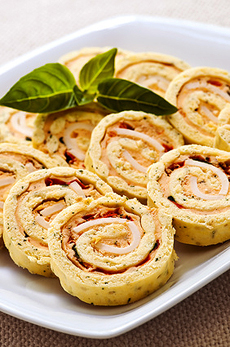
Pinwheel sandwiches are a treat for special occasions. Photo © Elena Thewise | Fotolia.
September 2009
Last Updated February 2026
|
|
Sandwich Glossary
Page 4: Muffaletta Sandwich & Other Sandwich Types M ~ P
This is Page 4 of a five-page glossary, including terms such as Monte Cristo Sandwich, muffaletta, panini, pinwheel sandwich, and po’ boy. Click on the black links below to visit other pages. Also see our Bread Glossary and many other food glossaries.
MELT SANDWICH
A melt sandwich has a filling plus melted cheese; otherwise stated, it’s a grilled cheese sandwich with added ingredients. The sandwich is grilled or fried until the cheese is melted. One common filling is tuna, with or without mayonnaise, the so-called tuna melt. Ham with melted cheese is a ham melt. A melt may be served as a traditional sandwich or an open-face sandwich.
MIGA SANDWICH
See sandwiches de miga.
MIXTO
See Cuban sandwich.
|
|
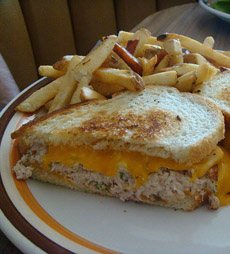
Tuna melt. Photo courtesy Wikimedia. |
MONTE CRISTO SANDWICH
A fried ham or turkey sandwich with cheese that’s an American variation of the French croque monsieur. Traditionally, it is dipped in batter and deep-fried, but there are regional variations. In some regions of the U.S., it’s just grilled; in others, French toast is used as a base, with cheese melted under a broiler. Monte Cristo sandwiches originated in Southern California; the earliest reference is printed on a 1941 menu from Gordon’s restaurant in Los Angeles, and a recipe was published in the 1949 The Brown Derby Cookbook. The sandwich became very popular in the 1950s-1970s.
|
|
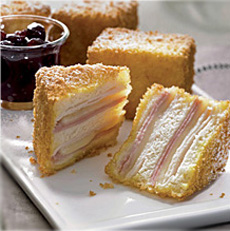
An updated Monte Cristo sandwich recipe with panko, Japanese bread crumbs. Photo courtesy Kikkoman. |
MOTHER-IN-LAW SANDWICH
A Chicago fast food item: a corn-roll tamale nestled in a poppyseed hot dog bun (there is no hot dog) and smothered with chili. The tamale is stuffed in a hotdog bun and smothered in chili, along with sport peppers and a bright green relish. There are different origin stories for the sandwich, but Chicago sources say that the Mother-In-Law first appeared in the 1950s as South Side street food. Its roots are likely tied to African-American migrants from the Mississippi Delta who brought hot tamales to the area (to which they had been introduced by Mexican laborers in the Delta). The sandwich was jokingly named because it can cause heartburn, just like a mother-in-law.
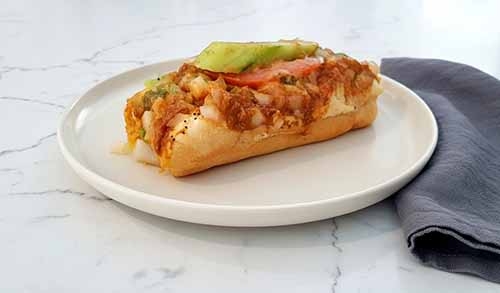
Mother-In-Law Sandwich (Abacus Photo).
MUFFALETTA or MUFFULETTA
SANDWICH
A classic sandwich of New Orleans, muffaletta is actually the name of the Sicilian bread on which the sandwich is traditionally served—a large, round loaf with a texture somewhat similar to focaccia (any sturdy French or Italian loaf can be substituted). To make the sandwich, the loaf is split, then covered with a marinated olive salad and layers of Italian cold cuts (capicola, mortadella, salami) and cheese (Provolone, Swiss). Sometimes the muffaletta is warmed to melt the cheese. The olive salad is considered the key ingredient, and is made from olives, celery, cauliflower, carrot, seasonings, and olive oil, and marinated for at least 24 hours.
|
|
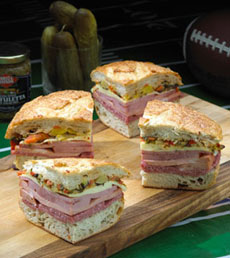
Muffaletta Sandwich. Here’s the recipe for the olive salad and muffaletta sandwich, from Mezzetta. |
The muffaletta sandwich was invented in 1906 by Sicilian immigrant Salvatore Lupo at Central Grocery in New Orleans’ French Market. It was created for Italian laborers who bought round, sesame-crusted loaves, cheese, and meats separately, merging them into a portable sandwich topped with tangy olive salad.
The sandwich is named after the bread itself, muffuletto, a spongy, round, sesame-seeded loaf brought to New Orleans by Sicilian immigrants.
Original Ingredients:
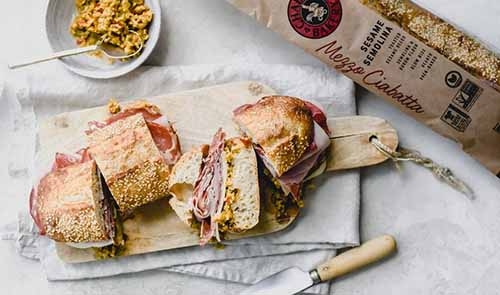
Muffaletta made with a loaf of sesame semolina bread. Here’s the recipe (photo © Chabaso Bakery).
OPEN-FACE SANDWICH
A sandwich served with only the bottom slice of bread. It is eaten with a knife and fork. While it has passed out of style somewhat because of the convenience of eating close-face sandwiches, at one time open-face beef, chicken, and turkey sandwiches were popular. The original grilled cheese sandwich was open-faced. Open-face sandwiches, or smorrebrod, still rule in Scandinavia; they have been called the “national dish of Denmark.” Smorrebrod usually uses buttered rye bread as a base for any variety of creative and delicious ingredients: smoked fish, eggs, vegetables, sausage, and other meats.
|
|
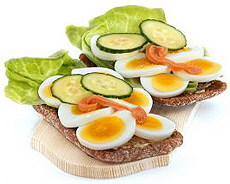
Scandinavian-style open-face sandwiches. Photo by Ove Topfer | SXC. |
PANINI
In Italy, a panino is a sandwich made on a small roll, ciabatta, or other small loaf cut horizontally, like a hero roll. Sometimes, it is pressed in a grill and served hot. This type of sandwich originated in Italian sandwich shops in the 1960s, although there are earlier references to “panini” that were not necessarily grilled. Ham (prosciutto) and cheese are favorite fillings. In the U.S., the category of Italian sandwiches, called panini in plural, has been Americanized so that a single sandwich is called a “panini” instead of, correctly, “panino.” Panini can be made with a panini press, a panini pan, or a do-it-yourself pan and pressing tool. See panini recipes.
|
|
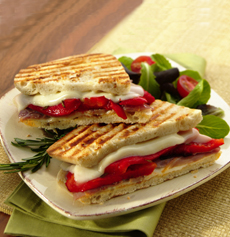
Panini. Photo courtesy Sargento. |
PASTRAMI SANDWICH
A popular deli sandwich introduced to America by Jewish immigrants in New York City in the latter half of the 19th century. Pastrami is made from brisket of beef, which is brined, partly dried, seasoned with herbs and spices, smoked, steamed, and sliced. (Pickling a brisket in seasoned brine produces corned beef; smoking corned beef with added spices produces pastrami.) It is usually served warm on rye bread with deli mustard and accompanied by cole slaw and dill pickles. See also Reuben sandwich.
PATTY MELT
A hamburger on bread with melted cheese. It’s different from a cheeseburger, which would be on a hamburger roll.
|
|
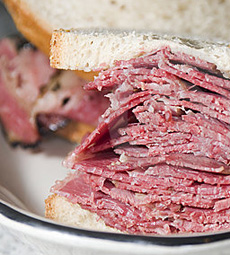
Pastrami sandwich: pass the mustard! Photo courtesy Dietz & Watson. |
|
PEANUT BUTTER SANDWICH
Peanut butter was invented in 1890, but wasn’t marketed broadly until 1922, when a new churning process achieved stability and longer shelf life (see the history of peanut butter). At the same time, in the late 1920s, Gustav Papendick invented a process for slicing and wrapping bread. Pre-sliced bread meant that children could make their own sandwiches without having to slice a loaf with a dangerous knife. There was no tastier, easier sandwich to make than a PB&J. Popular variations on the sandwich include sliced banana and bacon (Elvis’ favorite sandwich). In the South, a batter-dipped and fried PB sandwich is popular.
|
|
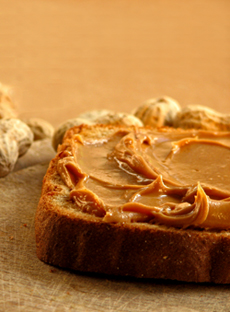
Creamy peanut butter sandwich. Photo by Elke Dennis | IST. |
PEANUT BUTTER & JELLY SANDWICH
This sandwich was purportedly invented by GIs during World War II, who combined their rations—the jelly was said to make the sticky peanut butter easier to eat. PB&J has been a big hit in America ever since; at the end of the war, with the end of sugar rationing, Welch’s Grape Jelly became the favorite pairing. It is estimated that the average kid eats 1,500 PB&Js before he graduates from high school.
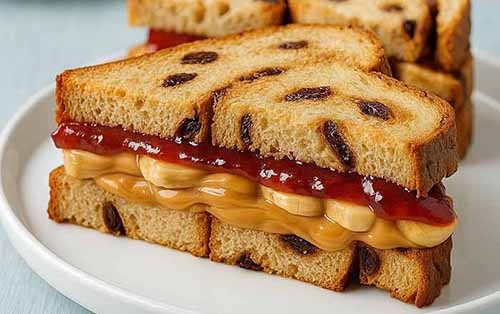
This fancy PB&J, on cinnamon-raisin bread, also has a layer of sliced bananas (ChatGPT Photo).
PHILADELPHIA CHEESESTEAK
See cheesesteak.
|
PINWHEEL SANDWICH
Festive party sandwiches, made like a jelly roll on specially-baked thin strips of bread. Salads—chicken, egg, tuna, shrimp—are spread on the bread and rolled up, often with gherkins at the center of the “pinwheel”; then the roll is cut into individual “pinwheel” slices.
The pinwheel sandwich has roots in early British, Greek, and Turkish culinary traditions, using lavash. The ancestor of the one we enjoy today is believed to have originated in England as early as the 10th century, where it was developed as a tea-time snack using flattened bread. The bread was filled with various ingredients, rolled, and sliced.
|
|
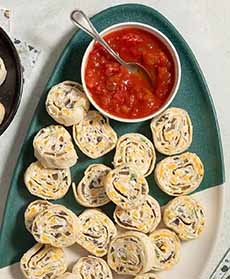
These pinwheel sandwiches use tortillas instead of bread. Here’s the recipe (photo © Taste Of Home). |
Pinwheels gained popularity in the 1900s as a refined, bite-sized appetizer, often served as a tea sandwich.
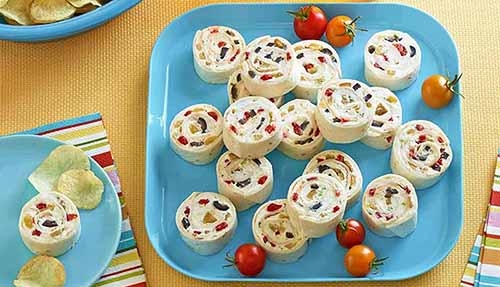
“Ranch” pinwheel sandwiches. Here’s the recipe (photo © Hidden Valley).
PO’ BOY or POOR BOY SANDWICH
A Louisiana classic, this submarine-style sandwich typically consists of fried seafood—oysters, crawfish, shrimp, soft-shell crab, or catfish—although hot roast beef or ham po’ boys are also served. The sandwich uses Louisiana French bread, which is like a baguette, but lighter and airier with a crispy crust. A “dressed” po’ boy has lettuce, tomatoes, pickles, onions, and mayo; sometimes shredded cabbage is substituted for the shredded lettuce. A meat po’ boy comes with hot mustard (coarse-grained Creole mustard) or “regular” mustard (American-style yellow mustard). One story says that the name was coined during a 1929 streetcar strike:
|
|
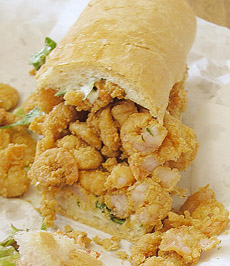
Got carbs? Photo of fried shrimp po’ boy courtesy Wikimedia Commons. |
One restaurant served free sandwiches to the strikers, and the restaurant workers jokingly referred to the strikers as “poor boys”; soon the sandwiches themselves took on the name. In the Louisiana dialect, this was shortened to po’ boy.
PRIMANTI BROS.
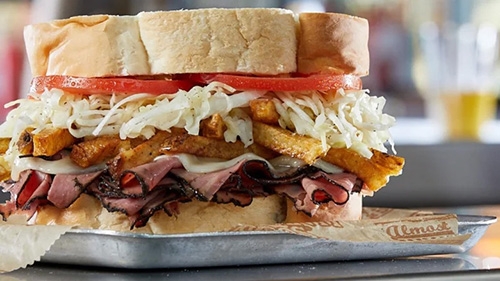
A regional specialty, Pittsburgh’s answer to the Philly cheesesteak was invented at Primanti Bros. The historic sandwich shop has been making its trademark fried-potatoes-and-coleslaw-topped sandwich since 1933. The sandwich is said to have been created for the steelworkers, who needed a hearty, quick meal that didn’t require a plate and utensils. It puts the sides (vinegar-based cole slaw and fries) right into the spiced ham (capicola) and melted provolone sandwich, made on soft Italian bread spread with mayonnaise. Add sliced tomato and, for authenticity, serve it on wax paper.
PULLED PORK SANDWICH
Pulled pork can be served on the plate with a side of rice or mashed potatoes and corn bread, but it is beloved as a pulled pork sandwich. To make it, a shoulder cut (butt) of pork, or mixed cuts, is barbecued over low-heat for a number of hours, to tenderize the meat so that it can be “pulled” into individual strips. Although typically cooked in a barbecue pit, which makes it smoky-flavored, pulled pork can be made at home in a slow cooker or oven. As with all barbecue, the recipe differs from region to region. North Carolinians use a vinegar-based sauce; Tennesseeans use a tomato-based sauce, and so on (here are the different types of barbecue). Try this recipe for traditional pulled pork and this recipe for pulled pork with cherry-cayenne sauce.
|
|
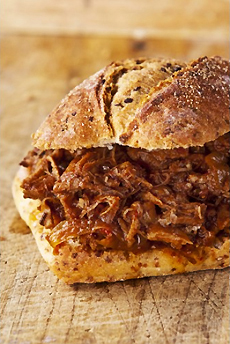
A pulled pork sandwich. Photo courtesy PigOfTheMonthClub.com. They sell the pulled pork ready to heat and eat on your bread of choice. |
Continue To Next Page: Sandwich Types R ~ Z
Go To The Article Index Above
Lifestyle Direct, Inc. All rights reserved. Photographs are the copyright of their respective owners.
|