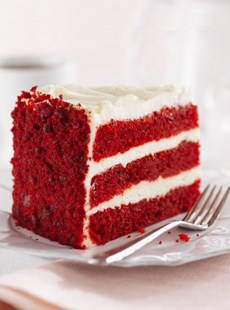
 Originally a Southern favorite, velvet cake has become very popular nationwide. Is it the bright red food color? This cake, from chef Art Smith, is available at AllenBrothers.com. Originally a Southern favorite, velvet cake has become very popular nationwide. Is it the bright red food color? This cake, from chef Art Smith, is available at AllenBrothers.com.
June 2008
Last Updated November 2025
|
|
Types Of Cake
Cake Glossary Page 6: Red Velvet Cake & Other Terms With N To R
There are thousands of different types of cakes in the world today; each culture has its specialties, most of which never reach our shores. Here, we present some of the more popular types one is likely to encounter—or at least hear about—in the U.S. If your favorite isn’t represented, use the Contact Us link on this page to tell us about it. After you’ve checked out the cakes, take a look at our many other food glossaries—an easy way to get up to speed on more than fifty different food categories. Most related to this Cake Glossary are our Chocolate Glossary, Custard Glossary, Dessert Sauce Glossary, Ice Cream & Frozen Desserts Glossary, and Sugar Glossary.
Click on a letter to go to the appropriate section of the glossary.
a b c d e f g h i j k l m n o p q r s t u v w x y z
This glossary is protected by copyright and cannot be reproduced in whole or in part.
You are welcome to link to it.
NUAGE, GÂTEAU NUAGE, or CLOUD CAKE
A nuage (NOO-azh) or cloud cake (nuage is French for cloud) is a dressed-up angel food cake, light and fluffy with cream filling and frosting. The basic ingredients are egg whites, flour, and sugar—no eggs or butter. A whipping agent, such as cream of tartar, is commonly added. The light, fluffy, aerated texture comes from whipped egg whites. Unlike angel cake, which is typically served plain or with a side of fruit sauce and fresh fruit, a nuage can also be decorated with coconut, chocolate shavings, fruit, etc. The different flavors of cream, frosting, and toppings enable an expansive number of options.
|
|
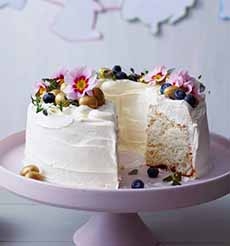
Here’s the recipe for this cloud cake (phogo © Sainsbury’s Magazine). |
Some bakers call cakes that look like the one below a nuage. It doesn’t look like a cloud.

In the case of this pumpkin nuage, the filling is light and airy (like angel or chiffon cake), so the name was “borrowed” from the original cloud-designed cake (photo © Lady M).
NOUGAT
Nougat is a confection made from ground hazelnuts, sugar, and chocolate. Depending on the recipe, cocoa butter, milk powder, powdered sugar, and vanilla may also be added. Like marzipan, nougat is eaten as candy as well as a filling for cakes, cookies, and pastries.
OPERA CAKE
A layered cake of chocolate, espresso, and almonds. Thin layers of a delicate almond sponge called joconde are sandwiched with layers of chocolate ganache and coffee buttercream and topped with a chocolate glaze. The recipe was created by pâtissier Louis Clichy, who called it the Clichy, but it was later popularized by the Parisian pâtissèrie Dalloyau as the Opera Cake. There are many variations of the recipe, some having seven or more layers (14 total of cake and ganache), some far fewer (including Dalloyau’s). Modern versions include pistachio and green tea riffs.
|
|
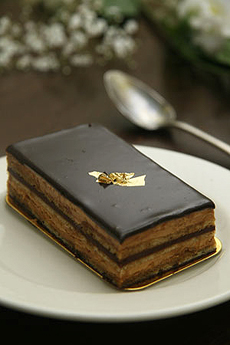
Espresso lovers should check out an Opera Cake. This one can be purchased from Financier Pastries. |
PANDORO
Pandoro is a sweet yeast bread from the Verona area of Italy, typically baked in a star-shaped mold with eight points and dusted with powdered sugar. Unlike panettone, it is a simpler bread, not filled with candied fruits. The name, pan d’oro or “golden bread,” refers to the yellow color achieved from white flour, butter, and eggs. Originally, such delicacies were enjoyed only by the wealthy; the poor could only afford black bread, made from unrefined flour.
In the photo below, you can see how lovely the star shape is if you cut the pandoro horizontally, e.g., for French toast, or á la mode dessert, etc.
|
|

Star-shaped pandoro (both photos © Bauli). |

> The history of pandoro.
PANETTONE
Panettone is a medieval Italian Christmas yeast bread, filled with candied fruits and raisins. Panettone, a Milanese specialty, is tall, dome-shaped, and airy, in contrast to the other famous Christmas bread, panforte, which is short and dense (although there is a less common, flat version of panettone). The name means “large loaf” in Italian.
While the origins of a sweet leavened bread date back to Roman times, and a tall, leavened fruitcake can be seen in a 16th-century painting by Pieter Bruegel the Elder*, the first known mention of panettone with Christmas is found in the 18th-century writings of Pietro Verri, who refers to it as “pane di tono” (luxury bread).
|
|

Panettone, a yeast bread filled with candied fruits and raisins. See what’s inside in the photo below (photo © Viki F | iStock Photo). |
The dough is cured for several days (like sourdough), giving the cake its distinctive fluffiness. Raisins, candied orange peel, citron, and lemon zest are added dry; some modern versions add chocolate (which was not available when the recipe originated); others are plain. The classic Panettone accompaniment is a sweet hot beverage or a sweet wine such as spumante or moscato, but any dessert wine will do. Some Italians add a side of crema di mascarpone, a cream made from mascarpone cheese, eggs, and amaretto (or you can substitute zabaglione). The other popular Italian Christmas bread is panforte, below.

We could eat this yeasty, sweet bread at every meal of the day, plus snacks (photo © Bella Italia Food Store).
> The history of panettone.
*We looked and looked but couldn’t find any of his paintings with a tall cake. Lots of pies, though.
PANFORTE
Panforte, or “strong bread” in Italian (so-called due to the strong spices—it was originally called spiced bread with honey), originated as a holiday bread in 12th-century Siena, Italy, baked by nuns. A large, round, flat torte with a dense, sticky texture, panforte is a mixture of candied fruit, almonds, spices, and sometimes cocoa, bound with a sugar and honey boiled syrup. The pan is lined with communion wafers. The result is an Italian version of English fruitcake. It is enjoyed by the family and given as gifts, like panettone (see above), and is now enjoyed year-round as dessert, with a glass of vin santo, a sweet dessert wine. Read more about panforte in our review of Sophia’s Gluten-Free Panforte.
|
|
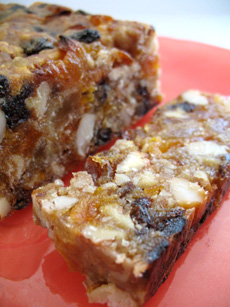
Panforte, an Italian fruitcake. Photo by Melody Lan | THE NIBBLE. |
PARADISE CAKE
A lady finger and vanilla genoise cake topped with a variety of fresh tropical fruits.
PAVLOVA
A dessert originating in New Zealand or Australia (both claim credit), named after the ballerina Anna Pavlova. Based on Austrian and German cake traditions, a meringue circle is filled with fresh fruit and topped with whipped cream.
The dessert was named for the ballerina Anna Pavlova upon her visit to Australia. One story says that the dessert was designed after a tutu worn by Pavlova, the meringue being the skirt with kiwi and strawberry representing a rose decoration. Today, a variety of berries and fresh fruits are used, and some recipes include chocolate decor as well. Read more about the Pavlova in our review of Pav Lites Pavlovas.
|
|
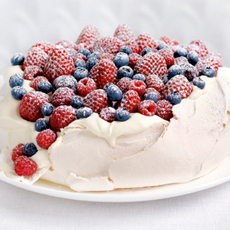 A pavlova can be individual-sized or a multi-portion “cake.” Photo courtesy Taste.com.au. A pavlova can be individual-sized or a multi-portion “cake.” Photo courtesy Taste.com.au. |
Actually, Pavlova is not a cake, nor is it a pastry. It is in a unique category called meringue desserts, which also includes Schaum Torte and Vacherin. See the explanation under Vacherin.
Pavlova is gluten-free and fat-free, not to mention beautiful. Here are different ways to serve it.
Plus, the history of the Pavlova.

Talk about creativity: At the Musket Room in New York City, instead of whipped cream and fruit on a circle of meringue, there’s whipped cream and fruit topped with disks of meringue. It’s a “deconstructed” Pavlova (photo © The Musket Room)!
|
|
PEAR WILLIAM CAKE
Alternating layers of vanilla génoise and sliced poached pears, typically without Pear William eau de vie. The version in the photo is layered with pear Bavarian mousse and pear chunks, topped with a caramel glaze and sliced toasted almonds. The correct name is Pear William, not Pear Williams. It is named for the Williams pear, known as the Bartlett pear in the U.S.
|
|
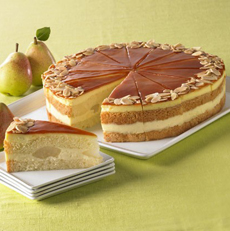
Pear William cake. Photo courtesy VieDeFrance.com. |
|
PENUCHE
Pronounced pen-OO-chay after the Italian panucci, penuche is a confection based on brown sugar. There is penuche fudge, and for cakes, penuche frosting. To make it, melt 1/2 cup butter; stir in 1 cup brown sugar and heat to boiling, stirring constantly. Cook until the mixture pulls away from the sides and bottom of the pan, then boil for two minutes. Stir in 1/4 cup milk; heat to boiling and remove from heat. Stir in 2-1/4 cups confectioner’s sugar. Beat smooth with electric beaters. Spread quickly onto the cake; the frosting will set immediately.
|
|
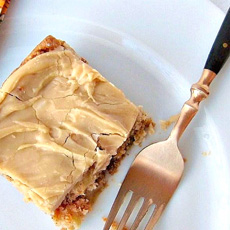
Apple cake with penuche frosting. Get the recipe at Une Gamin Dans La Cuisine.com. |
|
PERSIPAN
Persipan is a less expensive substitute for marzipan, made from ground apricot and/or peach kernels. The word is a combination of persicus, Latin for peach, and marzipan. Persipan may also have some ground almonds, the traditional ingredient of marzipan, in the recipe. The sugar content is higher than that of marzipan (up to 60%) to offset the bitterness of the ingredients. Persipan is somewhat stiffer than marzipan and is used almost exclusively in baking.
|
|
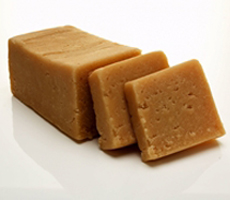
Persipan. Photo courtesy Moll-Marzipan.com. |
PETIT FOUR
A petit four (pronounced petty-fore) is a tiny cake served at the end of a meal with coffee—often after other desserts. The words are French for “small oven” but mean “small baked pastries.” There are many varieties of petit four; the most familiar in the U.S. is a one-inch-square layered sponge cake, filled with butter cream and iced in a variety of colored fondants, often with tiny roses or other piped embellishments. In France, this style is not common, and there are confections that can be included on a petit fours plate that are not baked at all (e.g., glazed or chocolate-dipped fruit, marzipan, chocolates, and nut clusters).
|
|
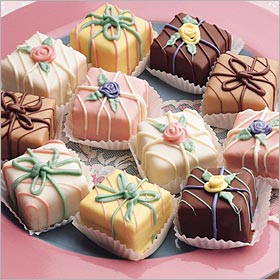
Typical American-style petit-fours from DivineDelights.com. |
There are two styles of petit-fours: glacée (iced) and sec (dry). Petit-fours glacées or frais (fresh) include filled and/or iced petit-fours, miniature babas, miniature éclairs, tiny iced cakes, and tartlets. Petit fours secs include small cookies, macaroons, madeleines, meringues, palmiers, and tuiles. The words mignardises (min-yar-DEEZ), from the French for “preciousness,” and friandises (free-yon-DEEZ), from the French for “delicate,” are often used instead of petit fours.
PIÑATA CAKE
Piñata cake, a concept that originated in the U.K. and is also popular in Australia. We also found it in Germany, called a surprise cake. When you cut into what appears to be a conventional layer cake, candies spill out. A four-layer cake is recommended to have enough room for lots of candy to tumble out. Here’s more about piñata cake.
|
|

A piñata cake from Dr. Oetker. |
POVITICA or POTICA
Pronounced poe-VEET-suh, povitica is a traditional Eastern European cake popular in Croatia, Hungary, Serbia, Poland, Slovenia, and Slovakia; it is also called potica (poh-TEET-sah), depending on the country. It is a variation of Russian-origin babka, a delightful yeast cake. Povitica has more butter (and in some recipes, cream cheese), making it more rich and denser than babka.
|
|

Chocolate povitica, a Top Pick Of The Week (read the review). Photo courtesy Strawberry Hill Farms. |
POUND CAKE
The rich, dense, buttery pound cake was developed in England in the 1700s. The name comes from the simple fact that the recipe contained one pound each of butter, eggs, flour, and sugar. Today, different extracts, liqueurs, flavorings such as chocolate, and additives such as chocolate chips and candied fruits are used to make many varieties of pound cake. Beyond the early flavorings—almond, lemon, orange, and vanilla—pound cakes can be found today in cappuccino, chocolate, key lime, raspberry, and anything else that appeals to the public. Read our review of Pound Cakes By Jane.
|
|
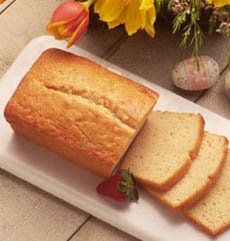
Pound cake. Photo courtesy American Egg Board. Get the recipe. |
POWDERED SUGAR
See confectioners’ sugar.
PRINCESS CAKE
The Princess Cake has a unique construction: a dome-shaped cake,\ consisting of layers of airy sponge cake (genoise), raspberry jam (an element not part of the original but added over time), vanilla pastry cream (custard), and a thick, domed layer of whipped cream, and topped with a smooth blanket of green-tinted marzipan, often topped with a single pink marzipan rose and powdered sugar.
The cake was invented by Jenny Åkerström (1867–1957), a renowned Swedish home economics teacher and cookbook author. The recipe first appeared in one of Åkerström's cookbooks, Prinsessornas kokbok (The Princesses' Cookbook), published in the 1930s.
|
|
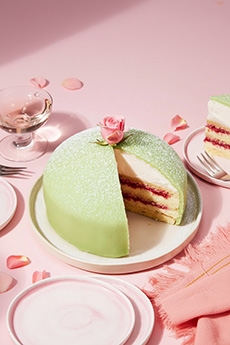
Princess Cake. Here’s the recipe (photo © King Arthur Baking). |
The original recipe for the cake was simply called Grön Tårta (Green Cake), a reference to its distinctive green marzipan covering.
The cake was renamed Prinsesstårta (Princess Cake) because it became the favorite cake of the three young daughters of Prince Carl, Duke of Västergötland (the brother of King Gustaf V): Margaretha, Märtha, and Astrid.
The Princess Cake is a staple for celebrations in Sweden, particularly birthdays and graduations. It is so beloved that the country even has a dedicated “Prinsesstårtans vecka” (Princess Cake Week) the last week of September, with proceeds from sales often going to charity (most commonly to the Crown Princess Victoria’s Fund, which supports children and young people with disabilities or chronic illnesses).
QUEEN CAKE
A white layer cake with caramel frosting.
RED VELVET CAKE
A cake with roots in the Southern U.S. Originally made from beets or beet juice and cocoa (and the best recipes still are), the cake yields a reddish brown color with a mild chocolate flavor. Today’s recipes made with red food coloring can be a florid red. A thick white frosting is traditional. Today, many recipes use red food color instead of beets, which leaves a rosy red and arresting color but a more bland flavor and texture. A light-textured chocolate layer-type cake with a deep reddish brown color.
|
|
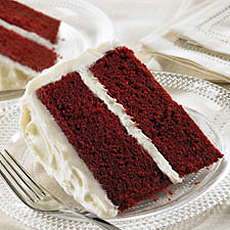
The recipe for this Red Velvet Cake with a coconut pecan icing can be found in Southern Cakes: Sweet and Irresistible Recipes for Everyday Celebrations, by Nancie McDermott. |
ROULADE or SWISS ROLL
The French word for what some Americans call a “jelly roll,” but much more. Baked in a sheet pan (jelly roll pan), this light and delicate sponge cake is rolled with and filled with buttercream, fruit or fruit puree, ganache, jam, lemon curd, nuts, whipped cream, etc. The bûche de Noël is a roulade.
The French bûche de Noël, or yule log, is a roulade. Here’s the recipe for the one below (photo © Japanese Food 101).
|
|
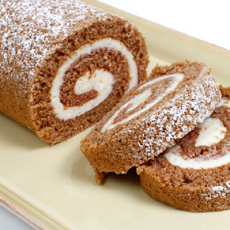
Pumpkin roulade. Photo courtesy Golden Blossom Honey. |

ROBERT E. LEE CAKE or GENERAL ROBERT E. LEE CAKE
A cake of the American South, this sponge cake is made with 10 to 12 eggs in jelly roll pans. The layers are filled and frosted with a frosting flavored with orange and lemon juices (and in some recipes, the zest).
ROYAL ICING
A pure white, hard icing made from egg whites and confectioner’s sugar; sometimes lemon juice is added. Royal icing hardens to a thin, flat, smooth layer and is used on gingerbread, large, decorated cookies, and a variety of cakes, including wedding cakes. The hard matte surface is preferred for complicated lettering and decorations on cookies, but it does not offer much flavor beyond sugary sweetness.
|
|
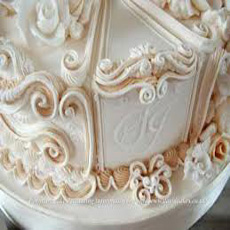
Royal icing on a wedding cake. Photo courtesy David Cakes Of Distinction. |
RUM CAKE
A rum-soaked sponge cake or pound cake. There are numerous recipes for the cake assembly; it can be filled with buttercream, whipped cream, or custard; fruit, such as sliced strawberries, can be added. Or, it can be a plain loaf or a Bundt. One of our favorite recipes uses a boiled chocolate icing with pressed sliced almonds around the sides. The only constant is the rum-soaked sponge, which makes it a cake cousin to baba au rhum. Some bakers use a rum-flavored sugar syrup for a milder effect.
The king of rum cakes is this gourmet version by The Great Spirits Baking Company (read our review), a NIBBLE Top Pick Of The Week. It uses Pyrat rum, one of the finest brands of sipping rum, instead of an average or below-average rum.
|
|
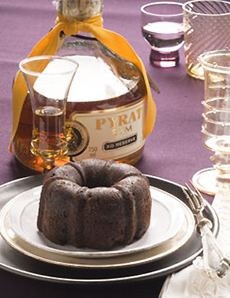
Rum bundt cake. Photo courtesy of Great Spirits Baking Company. |
Go To Next Page: Terms With S
Go To The Article Index Above
Lifestyle Direct, Inc. All rights reserved. Images are the copyright of their individual owners.
|