We love this delicious Cornmeal Crusted Scallops With Heirloom Bean-and-Oregano Succotash. Here’s the recipe. Recipe and photo courtesy McCormick.
June 2005
Last Updated July 2018
|
|
Different Types Of Grains & Beans
Beans & Grains Glossary Page 3: Terms With D ~ J
Here are terms including farina and grits, fava and garbanzo beans. If you’d like to suggest additional words, use the Contact Us link on this page. See our many other food glossaries.
Click on a letter to go to the appropriate glossary section:
a b c d e f g h i j k l m n o p q r s t u v w x y z
This material is copyrighted and cannot be reproduced in whole or in part.
You are welcome to link to it.
DURUM WHEAT
Indigenous to North Africa, durum serves as a main cereal grain for many of the food preparations in these countries. A hard variety of wheat, it is used to manufacture pasta because its texture enables the pasta to be cooked to an al dente state where other varieties of wheat would become overly soft. Semolina is milled durum.
EDAMAME
The cooked green soybean is very popular as a snack, squeezed from the pod. It is also served as a side dish and used as an accent in casseroles, salads, soups, rice and pasta dishes.
|
|
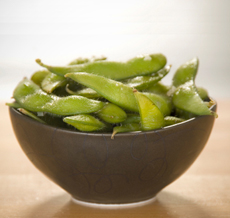
Edamame photo by Hilary Brodey | IST.
|
EINKORN
Einkorn (Triticum monococcum) is the first species of wheat to have been domesticated by man, more than 12,000 years ago, from the seeds of wild wheat (Triticum boeoticum). The word is German for “single grain.” It is very different from modern wheat. When, it was first planted, during the Neolithic Revolution, was the time that mankind was transitioning from hunter-gatherer to farmer. Agriculture and settled communities were born. Einkorn was cultivated through the Bronze Age (500 BCE to 1200 BCE) and then diminished over time. Today considered a relict crop,* einkorn fell from use both because of its low yield (fewer grains per stalk) and the fact that its particular type of gluten is not conducive to making bread. Now it is being revived by artisan producers such as Jovial Foods. Emmer wheat, or farro, is the second earliest cultivated wheat.
|
|
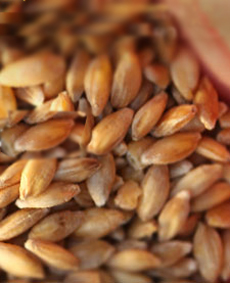
Einkorn is not corn, but the earliest species of wheat cultivated by man. Photo courtesy JovialFoods.com.
|
Einkorn can be tolerated by many of those with gluten sensitivity; in fact, einkorn wheat can be digested better than most foods. It is also a very nutritious wheat, containing high levels of protein, essential fatty acids, phosphorous, potassium, pyridoxine (B6), lutein and beta-carotene (lutein); and a high level of carotenoids, the red, yellow or orange antioxidant pigments that are found in many vegetables and fruits, and in a few grains.
________________
*A relict crop is one that was previously grown extensively, but is now only used in one or a few limited regions of the world. Einkorn still grows wild in Turkey.
EMMER WHEAT
See farro, below.
FARINA or SOOJI or CREAM OF WHEAT or WHEAT MEAL
A fine meal prepared from cereal grain and various other plant products. The texture is almost like coarse grains of sand. It is used in everything from hot breakfast cereals to exotic Indian desserts. Farina is ground into a fine consistency (farina is the Italian word for flour), and is best known in the U.S. as the branded Cream of Wheat and Cream of Rice porridges. As a hot cereal, farina has been compared to grits; however, farina is finely ground, while grits, made only from corn, are of a coarser texture. Wheatena, a brand of toasted wheat porridge, also is of a coarser texture than farina cereals.
|
|
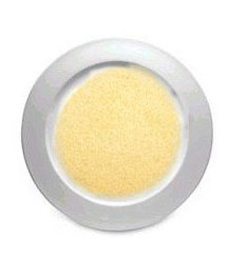
Uncooked farina. Photo courtesy Ajika Foods.
|
FARRO or EMMER WHEAT
Emmer wheat (Triticum dicoccum, synonym Triticum turgidum L. subsp. dicoccon), called farro in Italian, was one of the first crops domesticated in the Near East and the second wheat after einkorn (see above). It was widely cultivated into the Bronze Age, but is now a relict crop—one that was previously grown extensively, but is now only used in one or a few limited regions of the world, because of low yield and other reasons (farro continues to be grown in the mountainous regions of Europe and Asia.) Once the staple of the poor, today it is enjoyed as a “gourmet” grain. Farro is high in fiber, protein, magnesium and vitamins. It is nutty with a chewy texture. Think of it as a substitute for rice: top it with a mushroom ragout, add it to soups, serve it with casseroles and as a side dish, make cold farro salads (or mix it with greens).
|
|
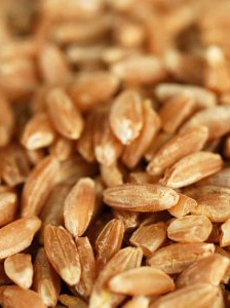
Farro, an ancient grain. If you can’t find it locally, it’s available on Amazon.com.
|
When combined with legumes, farro is a complete protein source.
Farro is often confused with spelt (Triticum aestivum L. subsp. spelta), a different species. Do not substitute one for the other in recipes.
FAVA BEAN or BROAD BEAN or
FABA or HORSE BEAN
The fava bean (Vica faba) is a flat, oval bean, 3/4 to 1 inch in length, housed in a large, green, inedible pod. It has an assertive, almost bitter earthy flavor and granular texture. Fava beans originated in ancient Egypt and spread throughout the Mediterranean, where they were cultivated as both human and animal food (and were a staple in the diet of the pyramid builders); cultivation can be traced back to the Bronze Age in Switzerland and the Iron Age in Great Britain. The fava was the only bean known to Europeans until the discovery of America.
|
|
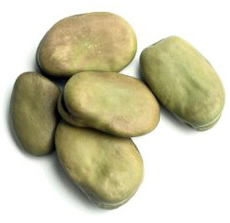
Fava beans, above, are available dried from Amazon.com.
|
In ancient Greece, Pythagoras forbade his followers to eat them because, according to legend, fava beans were said to contain the souls of the dead. More likely, Pythagoras discerned the connection between eating undercooked fava beans and the anemic blood disorder now called favism. Traces of the fava’s cultivation have been found in Bronze Age sites in Switzerland and in Iron Age sites in England. Until Spanish explorers brought Phaseolus vulgaris to Europe in the 15th century, fava beans were the only bean in town. And then, of course, it was Hannibal Lecter, in “Silence of the Lambs,” who claimed to have eaten the liver of a census taker “with some fava beans and a nice Chianti.” These fat broad beans can now be found fresh in ethnic groceries, distinctive in their long, tough pods; unshelled, they look like larger, flatter, squared-off lima beans. They are enjoyed as side dishes and in stews. Other names include English, Scotch, Windsor and field rounded bean.
FLAGEOLET BEANS
Small beans that can be found in black, green, red, white and yellow varieties. Flageolets, about a half inch in length, are often mistaken for small kidney beans.
FONIO
|
Fonio is an ancient grain, gluten-free and low glycemic. It is the smallest member of the millet family: Some call it “micro-couscous.” It is believed to have originated in Mali, in West Africa; and is a notable grain in that section of the continent. The seed was commonly found in the ancient It grows well in semi-arid regions. Countries like Senegal adopting it as an alternative source of food. In a reverse, it has come to the U.S. as a “foodie” grain, to be enjoyed by the affluent. The grains are small, but packed with protein, plus methionine and cysteine, two amino acids that are deficient in most other major grains, including barley, rice and wheat. The grains are are fast-growing, and are used as porridge and couscous, for bread and for beer. The delicate texture and mouthfeel make it a good candidate for tabbouleh and other grain salads.
|
|
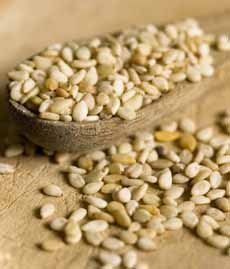
Fonio, an ancient grain from Africa (photo courtesy Health Benefits Times.
|
FLAX SEED
Flax seed has a delicious, nutty flavor that is enjoyed sprinkled directly onto salads, added to baked goods or mixed into oatmeal. This ancient crop is a modern healer’s darling. It is rich in fiber and alpha linolenic acid, a plant-derived omega 3 fatty acid, similar to that found in salmon. Studies show that flax seed lowers total cholesterol and LDL (bad) cholesterol while maintaining HDL (good) cholesterol levels. Flax seed may also help lower blood triglyceride and blood pressure, and keep platelets from becoming sticky, therefore reducing the risk of a heart attack Rich in the phytoestrogen and antioxidant lingan, flax seed shows promise in fighting breast cancer and other diseases, including Crohn’s Disease and colitis.
|
|
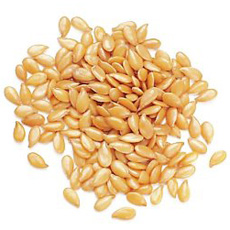
Flax seed is available at natural food stores and from Amazon.com.
|
GARBANZO BEAN or CECI or
CHANNA or CHICKPEA
One of the oldest cultivated legume species known, garbanzo beans (Cicer arietinum) go back as far as 5400 B.C.E. in Mesopotamia. They are small, hard, knobby beans, a rich beige-yellow color, about 3/8 inch round. While high in carbohydrate, their nutty flavor, minimal fat, nutrition (they are a good source of calcium, B Vitamins, protein and iron) and versatile culinary qualities have pushed garbanzos to the forefront in American cooking over the past 30 years—not just in hummus, minestrone and salads but in the ever-expanding vegetarian cuisine.
|
|
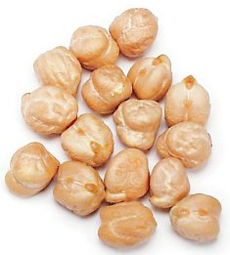
Garbanzo beans, above, are available dried from Amazon.com.
|
They are pale and light brown and are used whole, popular in North Indian, Mediterranean and Middle Eastern cuisine. In North India they are made into the popular chola/channa masala (chili) dish and are made into fritters. In the Middle East they are made into hummus, falafel, and added to pilafs. In North Africa they are added to couscous. Now they have found their way into Mexican, Cuban and other Latin American cuisines. Garbanzo is also available as chickpea powder. Other names include cheechee, cici, gran, kabuli, pois chiche and safaid beans. Ground garbanzo beans are sold as chickpea flour or cici flour.
GREAT NORTHERN BEAN
A mild, white, oval bean, similar to the white kidney bean.
GRITS
Grits are corn kernels, soaked to remove the casing (at which point it is known as hominy—hence the term, hominy grits). The hominy is left to harden and then is ground to the texture of tiny pellets, the “grits.” These are boiled with water, into a cereal similar to cream of wheat. See also polenta.
GROATS
Hulled and crushed grains of various cereals. Common groats are oats, wheat and buckwheat (roasted buckwheat groats are known as kasha and are a popular dish in eastern Europe and Eurasia). Because groats are hard to chew, they need to be soaked and cooked for a long period. See also kasha.
Continue To Next Page: Terms With K ~ L
Go To The Article Index Above
|
|
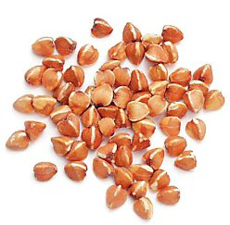
Groats, also called kasha, are available on Amazon.com.
|
|