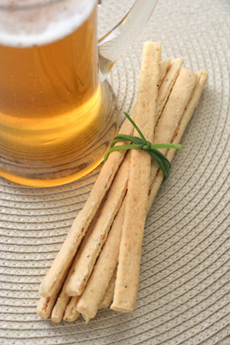
Artisan breadsticks replace chips as an elegant snack with beer. Photo by Michael Steele | THE NIBBLE.
August 2008
Last Updated March 2026
|
|
Different Types Of Bread
Page 2: Glossary Of Bread Types ~ A & B
This is page 2 of a 9-page glossary of the many different types of bread. Here, discover breads including arepas, bialys, and brioche. Click on the links below to visit other pages. You can also return to the overview and the history of bread or select from many other food glossaries featuring your favorite foods.
Click on a letter to get to the appropriate glossary section:
a b c d e f g h i j k l m n o p q r s t u v w x y z
This glossary is protected by copyright and cannot be reproduced in whole or part.
You are welcome to link to it.
AREPAA flatbread popular in Colombia and Venezuela, it is a thicker version of a tortilla. Arepas are made of maize flour—essentially, a cornmeal patty. They are split in half and filled with cheese, deli meats, chicken salad, and/or other fillings. An arepa may be eaten closed like a sandwich or dressed with toppings and eaten open-faced. Although similar to a sandwich in its presentation, it can also be eaten as a side dish, in lieu of bread. See flatbread.
|
|
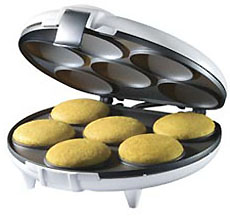 It’s easy to make arepas with an electric arepa maker. Photo courtesy Oster. It’s easy to make arepas with an electric arepa maker. Photo courtesy Oster. |
BAGEL
A bagel is a round circle of yeast dough the size of a large roll, which is first boiled and then baked. It originated among the Jewish population of Central Europe. A traditional bagel is dense and chewy, although versions have evolved that are not much more than bread in a circle. The original bagels were made of wheat flour; early versions were plain or topped with poppy seeds. Today, dozens of varieties can be found, including pumpernickel, seven-grain, and whole-wheat, and regular wheat bagels are made in dozens of flavors, from blueberry to spinach. Bagels have evolved from breakfast bread to serve as a sandwich bread as well.
|
|
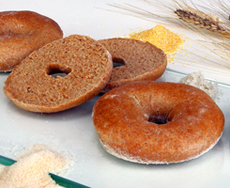
Read our review of Bake 'mmm Bagels, the best frozen bagels we’ve come across. They’re organic and kosher, too. Shown above are Bake ‘mmm’s whole wheat bagels. |
BAGUETTE
A long, narrow loaf with a very crusty, amber-colored outside and a delicate, tender inside. In France and elsewhere, it is used as a multipurpose bread, including for sandwiches; slices are used as the base for canapés. The name means “a small rod” in French. The baguette is three or four inches in diameter and can be up to a yard long, although it is most likely about two feet in length. It is not the most slender of the French loaves; see ficelle. Sandwich-sized baguettes are called demi-baguettes. While it is closely identified with France, the prototype was developed in Vienna in the mid-19th century, when the first steam ovens made possible the crisp crust and the porous (with holes) white crumb. See a comparison photo of baguettes, bâtards, ficelles and bâtons.
|
|
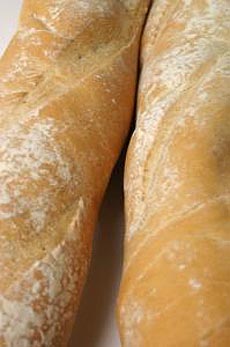
Baguettes. Photo by Aniko Gaspar | SXC. |
BÁNH MÌ
Bánh mì is a Vietnamese baguette made with wheat and rice flour; the term also refers to a sandwich traditionally made with the baguette. Bánh mì can be vegetable sandwiches—pickled carrots, daikon, onions, e.g.—or include tofu or meat. Here’s the recipe.
BARA BRITH
Bara brith is a Welsh bread with dried fruits, similar to Irish soda bread. It is typically served buttered with a cup of tea.
BÂTARD
A long, wide, crusty French loaf—similar in crust and crumb, but wider than a baguette—that can be sliced for sandwiches. It can be made with wheat, rye, or other grains. See a photo.
|
|
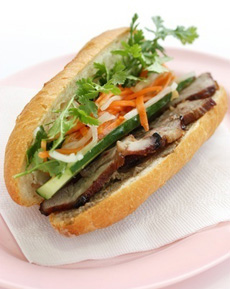
Bánh-mi, a Vietnamese submarine sandwich on a baguette. Photo ©
Ppy2010ha | Dreamstime. |
|
BÂTON
A bâton is similar to a baguette in crust and crumb, but shorter and narrower.
BATTER BREAD
A batter bread is one that requires no kneading. An example is yeast bread: After the batter is mixed, it is allowed to rise and then is baked.
BEER BREAD
A bread with beer in the batter. There are many recipes for beer-batter bread; different types of beer can be used to provide lighter or heartier flavors. See photo at right.
|
|
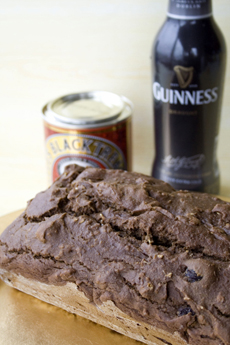
Bread made with Guinness beer. This bread was made from a mix—BYOB. Read our review. Photo by Claire Freierman | THE NIBBLE.
|
BIALYThe bialy was developed in Bialystok, Poland; the name is short for bialystoker kuchen (Bialystok cake). It is a large, flat, chewy yeast roll, up to six inches in diameter. Although it is likened to a bagel, they are distant cousins. A bagel is boiled before baking; a bialy is just baked. A bagel has a hole in the middle; a bialy has a depression that is typically filled with chopped onions and poppy seeds prior to baking. A bagel is generally sliced and spread and can be made into a sandwich; a bialy, which is flat, is most often eaten as is or spread with butter. Bagels have evolved into dozens of flavors; the bialy is still the bialy.
|
|
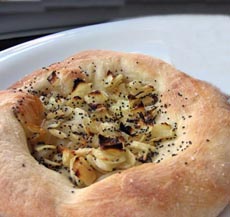
A bialy from Kenny and Zuke’s Delicatessen in Portland, Oregon. |
BISCUIT
In the U.S., a biscuit is a small, individually-portioned bread made with baking powder or baking soda as a leavening agent rather than yeast. There are numerous varieties: Beaten biscuits, buttermilk biscuits, and cheese biscuits are popular recipes. Biscuits are very soft and without a traditional crust; in this way, they are similar to scones, which are generally harder and drier. There are savory and sweet biscuits; sweet biscuits can be served with butter and jam; or split and served with berries and whipped cream as a shortcake. In the U.S., “tea biscuits” are cookies; in the U.K., biscuit is the term for cookie.
BLACK BREAD or BLACK RUSSIAN
BREAD
See pumpernickel.
BLOOMER BREAD
Bloomer bread was originally popularized in London as a loaf for sandwiches and toast. It typically has a thick, crispy crust and a soft crumb. The name “bloomer” refers to the shape of the bread, which is rounded at the ends and on the top, with a flat bottom. It rises (blooms) and is baked without a bread pan. A bloomer loaf commonly has diagonal slashes on its top, which are applied to the dough before its final rise to help direct the spring and shape of the bread [source]. It is sometimes dusted with flour. It’s a good loaf for starting bakers. Here’s a recipe.
|
|
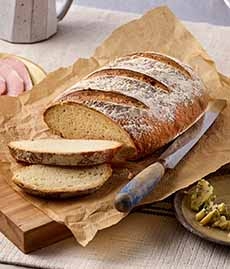
Bloomer bread (photo © Doves Farm).
|
BOULE
A round, crusty French loaf, similar to a peasant bread (photo at right). Boule is the French word for ball or round. In the U.K., this shape is known as a cob.
|
|
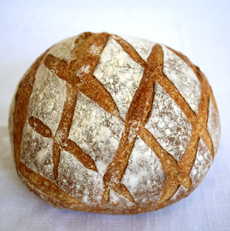
A boule. Photo courtesy JacquesBakery.com.
|
BOLILLO
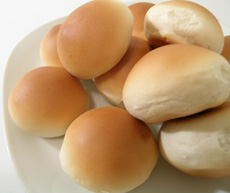
Bolillo is a Mexican roll inspired by the baguette, but wider, ovoid, and six inches long. It is often baked in a stone oven. It is the roll used for tortas and molletes (Mexican sandwiches). The telera is a similar but softer roll, with a more rounded shape. Modern variations include bolillos made of alternate ingredients such as whole wheat, wheat germ, or flax.
|
|
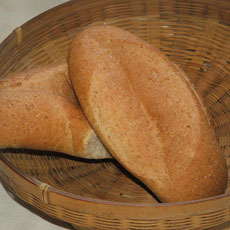
A bolillo. Photo courtesy JacquesBakery.com.
|
BREAD
A staple food in many of the world’s cultures, bread is made from flour or meal mixed with other dry ingredients and a liquid, usually water (but beer and other liquids are used in specialty recipes). There is usually a leavening agent to make the bread rise. A typical bread is kneaded, shaped into loaves, and baked. The word bread, which comes to us from Old English, is related to the term in other Germanic languages, including brood (Dutch), Brot (German), bröd (Swedish), and brød (Danish and Norwegian). The Latin term is crustum. See also loaf.
|
BREAD BOWL
A festive method of serving individual portions of food that also pair well with the bread (chili, stew) or starters such as dips and spreads, in a scooped-out round loaf of bread. Bread bowls can be made from any type of bread, although rye, sourdough, and wheat are common; rolls including ciabatta rolls are used for individual portions.
BREAD DIPPING OIL
Olive oil or other culinary oil which has been seasoned with spices and herbs. Other ingredients, such as grated cheese, can also be added. While “bread dippers” have become a popular casual hors d’oeuvre and a growing commercial enterprise, they are simple to make: Just add your favorite spices and herbs to olive oil. See the photo below.
|
|
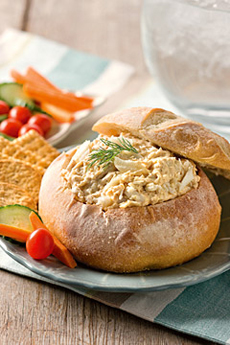
Use a bread bowl for soup, stew, or chili, or to serve dips with crudités, crackers, or...slices of bread! Bowl filled with crab dip available at CBCrabcakes.com. |
BREAD FLOUR
Enriched white flour with a higher gluten content. All-purpose flour has a medium amount of gluten that is suitable for most purposes but not for bread machines.
BREAD KNIFE
A knife with a serrated edge, which easily cuts through both the hard crust and the soft crumb, without condensing it.
|
|
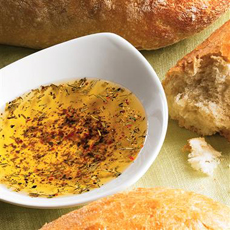
Bread dipping oil is also called a bread dipper. Photo of bread dipping oil courtesy of McCormick. This recipe and others are available at McCormick.com. |
BREADCRUMBS or BREAD CRUMBS
Also known as breading, these small pieces of dry bread are used for breading, poultry stuffing, topping casseroles, ingredients (e.g. meatloaf, stuffed fish), etc. Bread crumbs can be purchased commercially, plain or seasoned; or can be homemade from bread that is several days old (or has been dried in the oven). Italian-style breadcrumbs are generally larger. Panko, or Japanese breadcrumbs, are made from bread without crusts and are crisper, lighter, and more elegant in texture.
|
BREADING
A dry coating, often seasoned flour, in which foods are dredged prior to frying. They may first be dipped in a beaten egg mixture to enable the breading to adhere.
BREAD PUDDING
Originally a way to use stale bread, cubes or slices of bread are drenched (similar to French toast) with a mixture of milk, eggs, sugar, vanilla, and spices. It can be baked plain or with any combination of fruits and/or nuts. The dish can be served hot or cold, with or without whipped cream or a sauce, such as hard sauce or custard sauce.
|
|
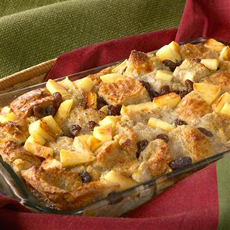
An apple raisin bread pudding. Photo courtesy of McCormick. This recipe and others are available at McCormick.com. |
|
BREAD & BUTTER PUDDING
Very similar to bread pudding (see above), except that the bread slices are buttered and placed in the baking dish; then the liquid mixture is added.
BREADSTICK or BREAD STICK
The breadstick originated in Italy. Bread strips were baked so they became very dry and crisp and could be stored for longer periods. Though it may have originated as a digestif or a snack, today it is often served as part of an antipasto. The archetypical bread sticks, grissini, are plain, slender, and long, although there are numerous other shapes, lengths, and flavors of breadsticks to be found, including thick, knobby bread sticks the length of bakers’ arms (think of a French ficelle, but a dry bread stick, not a soft bread). Also, see the photo at the top of the page.
|
|
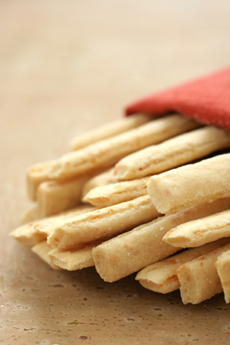
Breadsticks. Photo by Michael Steele | THE NIBBLE. |
|
BREAD SALAD
Bread salad, like French toast and croutons, is one of those delicious recipes invented by necessity: Poor people needed to get another meal from leftover bread that had gone stale. The dish is a popular first course in Italy. Panzanella is a Tuscan-style bread salad made with a loaf of day-old (or older) Italian bread, cubed into large croutons and soaked in vinaigrette to soften it. Chopped salad vegetables are added. The translation we have found for “panzanella” is “bread in a swamp,” the swamp being the water or vinaigrette in which it was soaked. While today’s recipes are rich in ingredients, the original preparers foraged to pull together vegetables from the garden—cucumber, onion, and tomato—and possibly purslane, a salad green that grows wild. Early recipes were heavy on onions, the cheapest ingredient to pair with the bread. When there wasn’t enough oil to spare, the bread was moistened in water. Here’s a recipe.
BREAD STUFFING
See stuffing.
|
|
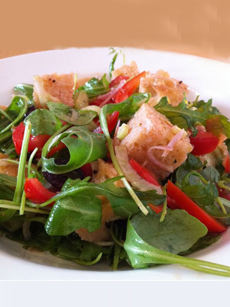
Panzanella, Tuscan bread salad. Photo by Jerry Keith | Wikimedia. |
|
BREAKFAST BREAD or BREAKFAST
PASTRY
A breakfast bread is a bread traditionally reserved for the morning meal. It can be sweet or savory; a savory bread, such as a croissant, is typically served with a sweet embellishment such as preserves. Other examples include almond croissants, pain au chocolate, and other Viennoiserie, Danish, diplomats, and financiers. The difference between a pastry and a “breakfast pastry” is that the latter contains far less sugar and less rich embellishments.
|
|
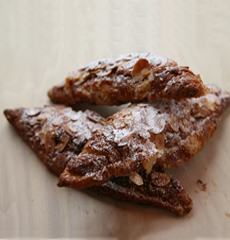
Almond croissants from Tisserie.com. |
BRIOCHEA light, slightly sweet loaf or roll made with eggs, yeast, and butter, and glazed with an egg wash. Richer than a standard loaf, brioche is used as a breakfast bread, for French toast and in combination with luxury ingredients such as foie gras and smoked salmon. The rolls baked in fluted tins with a small ball of dough crowning the top are called brioche à tête (see photo at left). A standard brioche loaf is called brioche Nanterre. The word comes from Old French, broyer, to knead. The expression, “If they have no bread, let them eat cake,” commonly misattributed to Queen Marie-Antoinette,* is a translation of the phrase, “S’ils n’ont plus de pain, qu’ils mangent de la brioche.” The quotation was attributed by Jean-Jacques Rousseau to “a great princess,” possibly Maria Theresa of Spain.
|
|
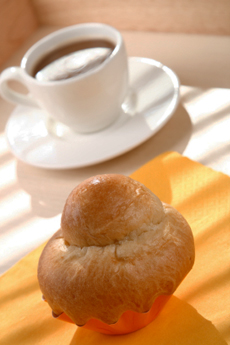
A brioche roll. Photo by Elena Moiseeva | IST. |
Brioche is also made shaped like gingerbread men and topped with sugar. Almond brioche is sliced from a loaf of brioche, cooked so it looks like French toast, and topped with frangipane (crème pâtissière flavored with ground almonds), sliced almonds and powdered sugar. Orange brioche is filled with orange cream, and topped with sugar.
|
BROWN BREAD
Brown bread is generally any bread made with significant amounts of whole grain flours, such as whole wheat, rye, or cornmeal, which give it a darker color and denser texture than refined white bread. However, its exact meaning depends heavily on regional culinary traditions.
- Irish brown bread is made with Irish wholemeal flour, which is more coarse than typical whole wheat flour. The large, visible flecks of bran in wholemeal flour give the bread its characteristic hearty flavor and texture. Here’s a recipe.
- In New England, “brown bread” typically refers to a specific, colonial-era classic, a dense, slightly sweet steamed bread traditionally made from a mix of cornmeal, rye flour, and whole wheat, and sweetened with molasses. It is traditionally steamed inside an old coffee or baked bean can and is served alongside baked beans or fried in butter.
- The slightly sweet brown loaves served at The Cheesecake Factory and other restaurants are typically German-inspired multi-grain breads that get their color and flavor from ingredients like molasses, cocoa powder, and dark rye. Here’s a recipe.
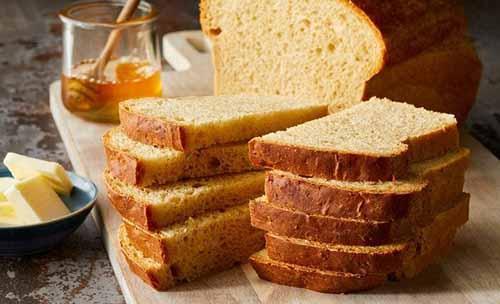
Made with oats and molasses, slightly sweet bread is delicious as toast, on sandwiches, with soup—i.e., anywhere you need a slice of bread. Here’s the recipe (photo © Taste Of Home).
|
|