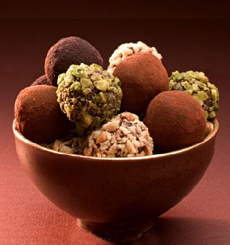
A bowl of classic French truffles—rolled balls of ganache, coated in cocoa powder and chopped nuts. Truffles from DeBrand.com.
|
KAREN HOCHMAN is Editorial Director of THE NIBBLE.
|
|
April 2007
Updated February 2008
|
 |
Understanding Truffles & Ganache
One Person’s Truffle Is Another Person’s Praline
Overview
What is a truffle? It’s different things to different people. We’re going to explain it here today. And to understand truffles, you’ve got to understand ganache—so there’s a little lesson on that, too.
Truffles
The word truffle has several meanings in the world of candy. Generally, when you hear the word, you have to clarify what is being discussed. That’s because the same word can have a different meaning in different countries, and America, the great melting pot, absorbs them all. This can be confusing, as we’ll see in a moment.
- A French invention, the original chocolate truffle was a ball of ganache (guh-NOSH), often flavored and rolled in cocoa. It was named after the precious black truffle fungus because of its physical resemblance. Sometimes the ganache was rolled in white confectioner’s sugar or finely chopped nuts instead of cocoa. Modern truffles can be rolled in pink peppercorns, sweet curry, paprika and other spices.
- In 1912, the Belgian chocolatier Jean Neuhaus invented the first hard chocolate shell*, enabling fillings of any kind and consistency—creme, whipped cream, soft caramel, light ganache, liqueurs, etc. Previously, only solid centers like caramels and nut pastes could be enrobed in chocolate—anything else would have leaked out.
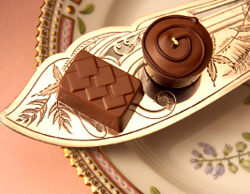
- The invention also allowed for pretty, molded shapes: hearts, crowns, fleurs-de-lis, strawberries, butterflies, flowers, leaves, diamonds, the geometric designs in the photos at the right—plus pianos, violins, cameos, artist’s palettes and anything else that creative chocolatiers could wish for to make the consumption of chocolate even more delightful. See our review of Martine’s Chocolates for more examples.
|

Molded chocolates: The centers are in a hard chocolate shell. See the photo of enrobed (dipped) chocolates below. These chocolates are from Woodhouse Chocolates, a NIBBLE Top Pick Of The Week. The company also makes the dipped chocolates shown in the photo below. |
*To add more confusion to the confusion, this hard chocolate shell is called couverture, the same word used for the blocks of chocolate melted down to make the shell, enrobe chocolate, make chocolate bars, pastry, etc.
Now come the layers of confusion:
- Jean Neuhaus called these new filled chocolates pralines, the same word used to describe the caramelized almonds that had been made by the French (and known to the Belgians) since 1636.
- The French call filled chocolates chocolats fourrés (show-coe-LAHT foo-RAY). They call chocolates in general bonbons de chocolat (bone bone day show-coe-LAHT) or chocolats assortis (show-coe-LAHT ah-soar-TEE).
- Some chocolatiers subsequently enrobed their ganache centers (i.e., the original truffles), either by hand dipping (the way all chocolates were coated prior to Neuhaus’ invention) or in hard chocolate shells. In France or America, these enrobed ganaches would be called truffles. In Belgium, they are still pralines.Thus, when chocolatiers immigrated to the U.S., they might be selling pralines, truffles, bonbons or assorted chocolates, depending on their nationality. And, although the name of what they sold differed, the product might be the same.
- In the interest of clarity, it would be ideal to stick with “filled chocolates,” use “pralines” for the nuts and reserve the term “truffles” for the balls of ganache. But given all the imported candy, we can’t escape our chocolate Tower of Babel. If you receive a box of candy from Germany or Switzerland labeled “pralines,” e.g., will it be filled chocolates or caramelized nuts?
|

These caramels enrobed, not molded. It means that the caramel centers are dipped in liquid chocolate. In the old days, chocolates were hand-dipped. Today, the centers are put on small conveyer belts and go through a tunnel where they are showered with liquid chocolate (think of a car wash of chocolate). |
We know we haven’t ended the confusion, but we hope we’ve explained it.
Ganache
Ganache is a velvety smooth blend of chocolate and cream, often with butter added, that is usually rolled in cocoa powder and sugar or other coatings to make a truffle. It is often used as a center for filled chocolates.
- Ganache can be made from dark, milk, or white chocolate (some chocolatiers blend dark and milk chocolate) and flavored with coffee, liqueurs, extracts—virtually any flavor that inspires the chocolatier. Using more chocolate than cream yields a firmer ganache; more cream than chocolate yields a softer, more velvety ganache.
- Ganache can be beaten with butter and used to fill and frost cakes and pastries (then it is known as ganache beurre or ganache soufflé). In its liquid state, ganache can be poured over cakes and pastries as a glaze.
French-language speakers know that the literal translation of ganache is “imbecile.” Why is something so tasty called by such a rude name?
As legend has it, a 19th century apprentice in a Parisian patisserie accidentally dropped scalded cream meant for another purpose into a bowl of chocolate. His superior called him un ganache—an imbecile—but upon tasting the “ruined” result realized that something salvageable—and wonderful—had been created.†
†Along similar lines, the English fool, a dessert of stewed fruit mixed with cream, has been served since the 16th century. We presume that another apprentice foolishly dropped the stewed fruit into the cream.
|

Mixing up a ganache at Recchiuti Confections, a NIBBLE Top Pick Of The Week. |
Now that any mystery has been clarified, go forth and enjoy your truffles and ganaches.
© Copyright 2005-2008 Lifestyle Direct, Inc. All rights reserved. Images are the copyright of their respective owners.

|
 |
|
|