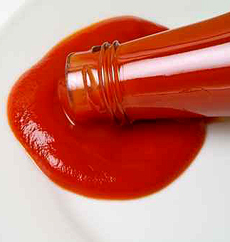
All ketchups are hardly created equal, as you’ll see in our review of 42 different brands. Photo © Claudio Beldini |Fotolia.
|
STEPHANIE ZONIS is a Contributing Editor at THE NIBBLE.
|
|
October 2007
Last Updated August 2010
|
|
A Fresh Look At Ketchup
Both Tomato Ketchup & Non-Tomato Ketchup (Cranberry, Mushroom, Plum...Banana Ketchup, Anyone?)
CAPSULE REPORT: In perhaps the most exhaustive tasting of ketchups you’ll find, intrepid food writer Stephanie Zonis tasted 42 ketchups, 32 tomato-based and 10 others ranging from banana to mushroom (as you’ll read, the original ketchups were not made from tomatoes). We subsequently tasted nine more, for a total of 41 tomato-based ketchups! The results may surprise you. In the tomato ketchup category, some of the best-known names in specialty food were bested by little-known companies such as Appledore Cove, Catsup à la Tomate (from France), Happy Girl (organic), June Taylor (organic ingredients) and Tracklements (from the U.K.). The good news is that one of our favorites, Muir Glen, is one of the least expensive, the most widely available at retail (at most stores that sell natural and organic foods) and is both organic and kosher. There were clear favorites in the non-tomato category as well. These top ketchups are worthy stocking-stuffers and house gifts; and if you put together a collection, you’ll make your favorite ketchup lover very happy. This is Page 1 of a nine-page article. Click on the black links below to visit other pages.
You Say Tomato, I Say Banana: A Fresh Look At Ketchup
Upon hearing that I’d been assigned an article on ketchup, a friend expressed astonishment. She thought I only wrote about upscale specialty foods. Why was I writing about an inexpensive condiment available in any convenience store? And there are only two or three brands, so what’s the point?
The point is that none of the common ideas about ketchup are necessarily true. If you live in the U.S., most likely, the ketchup you’ve been exposed to is tomato-based, relatively cheap, and easy to find anywhere. It lends color and a salty-sweet-vinegary flavor to hamburgers and French fries. You might use it on meatloaf or scrambled eggs. And most people think that’s about it. As it turns out, though, there can be a lot more to ketchup.
What’s In a Name: Ketchup, Catsup Or Catchup?
Perhaps a good place to start would be with the product’s name. FDA standards allow any of the above as legal names for this condiment. But which is really correct?
The term entered the English language around 1705; Portuguese traders returned from Asia with new products and ideas that spread throughout Europe.
According to Andrew Smith, author of Pure Ketchup: A History of America’s National Condiment there is a great etymological confusion over the origin of this condiment’s name. Suggestions have ranged from corruptions of the French term escaveche, meaning “food in sauce,” to a variation of the Malay (Indonesian) word kecap, to the claim by the editors of the Oxford English Dictionary that the origin is ke-tsiap (“the brine of pickled fish,” referring to fish sauce, a popular Asian condiment) from the Xiamen/Chinese language was the forefather. Each of these etymologies has its supporters and detractors, and, like much food history, the true past of our modern term is shrouded in the mists of time. |
|
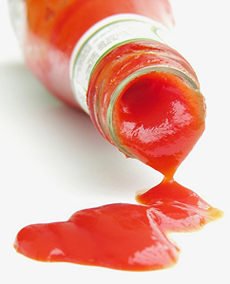
Photo © J.L. Hennaux | Fotolia. |
All three words are used to describe the product today. But the proper spelling in the U.S. is ketchup. In 1981, The U.S. Food and Drug Administration revised its standards, using the spelling “ketchup” instead of “catsup.” At the time, two of the three largest producers in the U.S., Heinz and Hunt’s, spelled their condiment “ketchup.” Del Monte had been using the “catsup” spelling. To conform to the regulations, Del Monte changed the spelling of its “catsup” to “ketchup.”
Because “ketchup” is the approved spelling for domestic products, it will be used throughout this article, except where particular product names are spelled differently.
Continue To Page 2: The History Of Ketchup
|