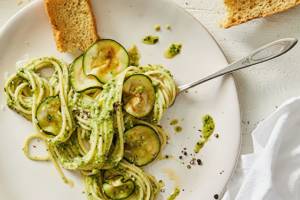
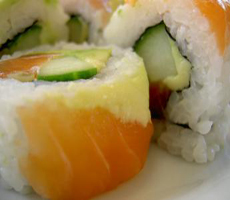
 Don’t these delicious morsels deserve the real thing? Photo by Lotus Head.
|
CAITLIN BARRETT is a member of THE NIBBLE editorial staff, and she rejects all forms of wasabi wannabe.
|
|
October 2005
Updated September 2008
|
|
Real Wasabi Q & A
Know The Difference Between Real Wasabi & Imitation Wasabi
CAPSULE REPORT: Most of the wasabi you’ve eaten in your life isn’t real wasabi at all. It’s fake wasabi—just like “sea leg” is fake crab, made from cheaper pollock, flavored and colored to look like crab. And imitation wasabi tastes as good as...imitation crab. So if you like the fake stuff, get yourself some of the real stuff. Unlike crab, you can afford to eat real wasabi at every meal.
It came as a shock to us that bright green mound decorating our sushi trays wasn’t wasabi at all. The truth wasn’t thrilling:
horseradish, mustard, corn starch and food coloring. Not an exotic condiment, just another fabricated foodstuff foisted on the American public. Now you know why waiters at Japanese restaurants often refer to it as “mustard” or “horseradish.” Tubes and powders at Asian markets that are labeled “wasabi” are likely the imitation product—read the ingredients label!
“So where do we get the real thing?” we asked. For a long time the answer was “Japan,” and a handful of very pricey restaurants that grate their own from fresh wasabi root (see illustration below). But now, thanks to the pioneering efforts of wasabi-loving American Doug Lambrecht, you can buy as much Real Wasabi as you want—and bring it with you to the sushi bar—in a powder that you can easily mix into paste with water, as the restaurants do with their imitation wasabi, or in fresh root form with a grater.
Before we tell you about it, we’ll share some of the questions we had when we first made discovery of condiment deception.
- Q. Why do my favorite sushi bars serve fake wasabi?
A.
The truth is that real wasabi (scientific name Wasabia japonica) is very expensive. It’s tricky to grow. There are few successful producers worldwide, making it hard to get. An error in translation decades ago led people to believe that the Japanese wasabi root was essentially the same thing as common horseradish (a cousin, Amoracia rusticana), and sushi bars serve their “wasabi wannabe paste” as because it mimics the hot and spicy experience of real wasabi (although like an inexpensive glass of wine compares to a complex and exciting glass of great wine).
- Q. Then what is wasabi?
A.
The Wasabia Japonica plant has grown wild for millennia, but was first cultivated centuries ago in a remote Japanese mountain village. It can take three years to reach maturity, and during that time, changes in temperature, light, soil conditions or handling can disrupt its growing process—unlike the much heartier and faster-growing horseradish. Wasabi has been grown successfully in northern Japan, parts of China, Taiwan, Korea and New Zealand. In North America, parts of the Oregon Coast and the Blue Ridge Mountains in North Carolina and Tennessee have successfully grown wasabi on a commercial level.
- Q. I’ve been eating the fake green stuff for years, and I like it. Why should I care?
A.
We like “wasabi wannabe” too, but after trying real wasabi, you won’t want to switch back. Beyond amazing flavor, real wasabi has a great number of reported health benefits. It contains antioxidants and has anti-bacterial, anti-microbial, and anti-carcinogenic properties. It also aids digestion.
|
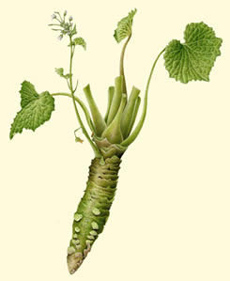
Real wasabi root, above. You can see its resemblance to its cousin, the common horseradish root. |
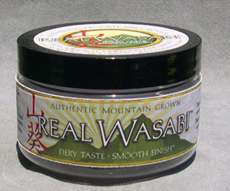
This canister contains the real deal: authentic mountain-grown wasabi sold by RealWasabi.com. |
Continue to Page 2 for more great questions, including:
- How is Wasabia japonica different from “Wasabi wannabe?”
- How can you use Real Wasabi, besides with sushi and sashimi?
- Is it acceptable to bring your own container of wasabi powder to a sushi bar?
|