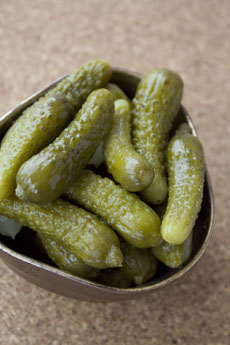
 Cornichons from France. While they look like gherkins, cornichons are European pickles picked at two inches in length. Photo by Claire Freierman | THE NIBBLE.
May 2008
Last Updated November 2025
|
|
Pickle Glossary
Types Of Pickles & Pickled Vegetables
Page 1: Pickle Terms Beginning With Letters A ~ C
If you like pickles, you’re in luck: They’re low in calories, have no fat, and have probiotic benefits. Cucumbers were probably first pickled 4,500 years ago in Mesopotamia and spread around the world across trade routes. Today, there are thousands of different types of pickles in the world’s cuisines, as appetizers, side dishes, garnishes, and snacks. Asia consumes more pickles per capita than any other region. This glossary addresses the types of pickles you’re most likely to encounter in the U.S.
In the U.S., “pickles” refers to pickled cucumbers. Other pickled vegetables are referred to by vegetable or fruit: pickled carrots, pickled mango, etc. In the rest of the world, all pickled produce is referred to as “pickles”: If you want an American “pickle,” you’ve got to specify “pickled cucumber.”
After you’ve peeked at the pickles, take a look at our other food glossaries—an easy way to get up to speed on more than 100 different food categories.
Here’s the history of pickles.
The year’s 9 pickle holidays.
Why Are Pickles Classified As Condiments?
Pickles are categorized as condiments—the same category as chutney, ketchup, mayonnaise, mustard, relish, salad dressings, and so on.
But unlike these condiments, pickles are a stand-alone food. Whether eaten alone as a snack or from a plate with a sandwich, they are a separate food. No one eats ketchup and mustard as a separate food!
Pickles are often eaten on their own as a snack, much like olives or carrot sticks; or as a side dish like pickled beets or pickled apples. In this context, they’re not a condiment at all, but a stand-alone food.
The reason given by food technologists is that the primary role of pickles is to enhance the flavor of other dishes. Their primary jobs are:
- To add a tangy, salty, or sweet-and-sour kick to sandwiches, burgers, hot dogs, and salads.
- To provide a contrasting flavor and texture that complements the main dish.
The Nibble doesn’t buy this argument. We’d put pickles in the category of preserved foods.
Click on the letter to go to the appropriate glossary section:
a b c d e f g h i j k l m n o p q r s t u v w x y z
This glossary is protected by copyright and cannot be reproduced in whole or in part. You are welcome to link to it.
ACIDIFICATION
See refrigerated pickle.
|
BALL JAR
See Mason jar.
BANANA PEPPERS
Long, shiny, and yellow, pickled banana peppers are a popular garnish for burgers, crab cakes, pizzas, and salads. They are available in hot and mild varieties, whole and rings. See pickled peppers.
BARREL FERMENTED
Pickles made in a classic large, wooden pickle barrel (or more modern container), fermented with vinegar, salt, and water.
|
|
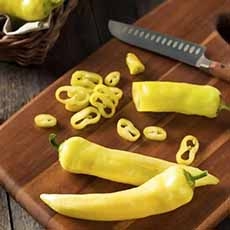
Banana peppers. Here are 15 recipes that use banana peppers (photo © Food Lovin’ Family). |
|
BREAD & BUTTER PICKLE
A type of sweet pickle with a sweet-and-tangy profile. Cut into thin slices (often with waffle-cut edges) for easy addition to sandwiches, burgers, and potato salad, the cucumbers are pickled with onions and chopped bell peppers. They have a distinct, slightly tangy taste.
BRINE
The pickling liquid. Originally, the brine was salt water; vinegar was subsequently added. (Polish-style pickles use salt water only, no vinegar.) The brine can be seasoned with any variety of herbs and spices. Pickle brine should never be thrown out. It can be used as a marinade, in salad dressing or cole slaw, to make dirty martinis, to re-pickle other vegetables, and can be frozen in ice pop molds to make an unusually delicious ice pop.
|
|
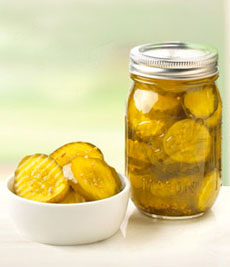
Bread and butter pickles, in a shape known as pickle chips. Photo courtesy Heinz. |
BURR CUCUMBER
See gherkin.
CANDIED PICKLE
A type of sweet pickle that is packed in an extra-sweetened (syrupy) liquid.
|
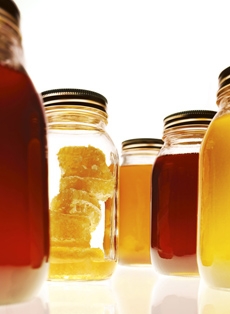
CANNING JAR
Canning jars were used in prior centuries to preserve all types of foods. The process and the jar create a hermetic seal that prevents the growth of bacteria. The process has been commercially supplanted by other production methods (including tin cans), but canning jars are still used in home canning. Ball and Mason are two well-known brands. Here’s the history of canning.
The history of canning.
|
|
Bread and butter pickles, in a shape known as pickle chips. Photo courtesy Heinz.
|
|
CAPERS & CAPERBERRIES
Capers are the green, unripe, unopened edible flower buds of the caper bush, Capparis spinosa, also called the Flinders rose. The unopened flower buds of this shrub are preserved in salt or pickled in vinegar. Their pungent flavor enhances a large number of foods: compound butter, fish and seafood, hors d’oeuvres, meat, pasta, pizza, salads, sauces, and more. Chicken Piccata, Eggplant Caponata, Remoulade Sauce, Spaghetti Puttanesca, and Steak Tartare are just some of the well-known dishes that include capers.
Caperberries, much larger, crunchier, equally tangy, and stronger in flavor. They are packed with their stems and are used as more of an ornamental garnish rather than stirred into recipes. Caperberries are the fruit of the caper bush. They form when the bud (i.e., the caper) is allowed to develop into a flower. That flower will subsequently fruit, and the caperberry is that fruit, an oblong, multi-seeded berry.
The leaves are also pickled. They have a milder flavor than either capers or caperberries, and are nicely ornamental.
|
|
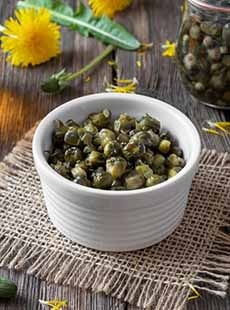
Above, capers. Caperberries, whole and halved are in the photo below (photos © Sanniti).
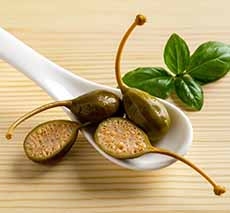 |
|
CHERRY PEPPERS
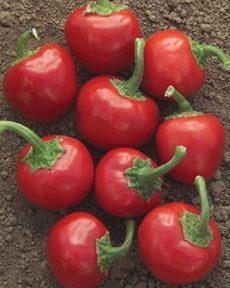
Cherry peppers are pickled hot peppers. They are small, round, and red, resembling a cherry, and typically measure 1 to 2 inches in diameter. While they are chile peppers, they are very mild in terms of heat, typically ranging from 500 to 2,500 SHU on the Scoville Scale. That’s comparable to a poblano chile and significantly milder than a jalapeño. Some varieties can be even milder, almost without any heat.
Cherry peppers are a popular, edible garnish and are a mainstay of antipasto platters. They add a bit of heat, chopped into casseroles and meatloaf. They are available in both hot and sweet versions, whole and in rings.
|
|
Bread and butter pickles, in a shape known as pickle chips. Photo courtesy Heinz. |
|
CHOW-CHOW
Chow-chow (the hyphen is essential to distinguish it from the dog breed of the same name) is a mustard-pickle relish made from a combination of vegetables. Popular choices include asparagus, beans, cabbage, carrots, cauliflower, chayote, green tomato, onions, peas, and red tomato. It is less sweet than piccalilli, and may also be spicy.
CORNICHON
The French word for gherkin. These are not necessarily the West Indian gherkin, but European cucumbers harvested at one to two inches in length. Cornichons pickled in wine vinegar with garlic (and often, pearl onions) are traditionally served with pâté. See the photo at the top of the page.
|
|
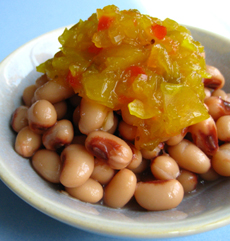
Chow-chow, a Southern specialty. Photo courtesy Peta.org. Here’s the recipe. |
|