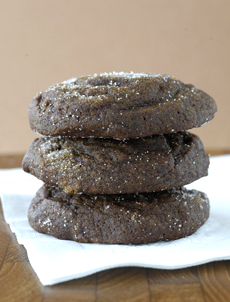
Molasses cookies—homey and historic, from the days when sugar was unaffordable to most households—from This Little Cookie. Photo by Dhanraj Emanuel.
November 2007
Updated October 2008
|
|
The History Of Cookies
A Favorite Comfort Food Began As A Kitchen Test
Page 1: The Origin Of The Cookie
CAPSULE REPORT: Who doesn’t love a cookie. Just think: Without ovens, we wouldn’t have these delightful treats. In fact, the cookie was invented in the days before thermostats, as a test to see if primitive ovens were the right temperature to bake cakes. Rather than ruin an entire cake, a “little cake,” or cookie, was tested first. At the time, no one thought the “test cake” would become a treat with charms of its own. This is Page 1 of a three-page article. Click on the black links below to visit other pages.
Introduction
Cookies are small, sweet, flat, dry cakes—single-serving finger food. They are generally flour based, but they can be flourless—made from egg whites and/or almonds like macaroons, for example—or made from gluten-free flour, like rice flour. Cookies can be soft, chewy or crisp. They can be big or small, plain or fancy. They can be simple—butter and sugar—or complex, with a multitude of ingredients, or fashioned into cookie sandwiches, two layers and filling. But they started out long ago, not as a treat or a comfort food, but as an oven regulator!
Origin Of The Cookie
Lavish cakes were well-known in the Persian Empire. According to What’s Cooking America, a food history website, the earliest cookie-style cakes are thought to date back to Persia (modern Iran) in the 7th century C.E., toward the end of its glory.*
*Begun around 550 B.C.E., Islam's former territorial unity, Persia was conquered numerous times, most famously when Alexander the Great defeated Darius III at Gaugamela (331 B.C.E.). But in 913 C.E., conquered by the Buwayhid from the shores of the Caspian Sea, the united Muslim empire was destroyed and Iran became one nation in an increasingly diverse Islamic world.
While Europeans had honey, due to the ancient migration of bees, sugar came much later. It originated in the lowlands of Bengal or elsewhere in Southeast Asia, and was brought to Persia and cultivated there, spreading to the eastern Mediterranean. Bakers made luxurious cakes and pastries for the wealthy. With the Muslim invasion of Iberia in the 8th century, followed by the Crusades (1095 to 1291) and the developing spice trade, the cooking techniques and ingredients of Arabia spread to Northern Europe. Cookbooks of the Renaissance, which began in Italy in the 14th century and spread to the rest of Europe, are filled with cookie recipes. By the end of the 14th century, one could buy little filled wafers on the streets of Paris.
But during the centuries before, while cakes of were being baked to the delight of all, what has evolved into our cookie was not originally made to please the sweet tooth. According to culinary historians, the first historic record of cookies was used as test cakes. A small amount of cake batter was dropped onto baking pans to test the temperature of the oven before the cake was baked (remember, early ovens didn’t have thermostats like ours do, and were fueled by burning wood).
Each language has its own word for cookie. In The Netherlands, the little test cake was called a koekje, “little cake” in Dutch (a cake is koek). The concept evolved to small, individual portions, which were baked to create the dry, hard-textured cookies we know today. With the moisture removed, they stayed fresh much longer than cake. The British word for cookie, biscuit, comes from the Latin bis coctum, meaning “twice baked” (also the origin of the Italian biscotti). According to The Oxford Companion to Food, the term “cookie” first appeared in print around 1703.†
†The Oxford Companion to Food, Oxford University Press:Oxford, 1999 (page 212).
Continue To Page 2: The Cookie Comes To America
Go To The Article Index Above
|