Advertisement
THE NIBBLE (TM) - Great Finds for Foodies (tm)
  Sign Up | Contact Us | Email To A Friend  
       
RSS feed What’s This?


whitefish caviar
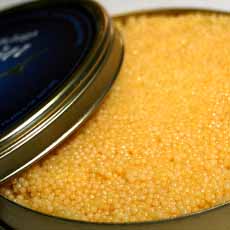
Infused whitefish caviar in wasabi, ginger, truffle and beet-saffron flavors from Tsar Nicoulai Caviar.
MENU


Caviar

Category Main Page
Articles & Reviews


Fish, Seafood, Caviar

Category Main Page
Articles & Reviews


Main Nibbles

Main Page
Articles & Reviews Of Foods From A To Z


Product Reviews

Main Page
Food, Beverages, Books,
News & More


May 2005
Updated November 2007

Product Reviews / Main Nibbles / Fish, Seafood & Caviar

Caviar Glossary


If you had trouble understanding the differences among Beluga, Osetra and Sevruga in the old days...the world of caviar has gotten much more complex. Here’s some help to figure it out. If you’d like to suggest additional words for inclusion, or think we should consider other definitions than those we have provided, click here. You may also enjoy one of our 50 other food glossaries.

You can click on the letter of the alphabet in the bar below to get to a term
without having to scroll manually.

a b c d e f g h i j k l m n o p q r s t u v w x y z

This material is copyrighted and cannot be reproduced in whole or in part
without written permission. Write to Editors at TheNibble.com.

BEYOND CAVIAR, THERE ARE 50 OTHER FOOD GLOSSARIES.
SEE THEM HERE.


ALGAE
See Flavor.

AMERICAN CAVIARS
In the 19th century America, with several indigenous species of sturgeon, was one of the world’s largest caviar producers. Over-fishing depleted the supply, and the government wisely ended commercial fishing. American caviar has again risen to fill the increasing void created by overfishing in the Caspian, which has put the Beluga, Sevruga and Osetra on the Endangered Species list. Today, white and hackleback sturgeon farmed and harvested in freshwater lakes or tanks in the Pacific Northwest, California and the South—using environmentally conscious and sustainable practices—have made the U.S. a player again. American caviar or roe species can include sturgeon caviar, hackleback caviar, paddlefish caviar, salmon caviar trout caviar, whitefish caviar, and lumpfish caviar. Some consider American sturgeon caviar close to the Russian and Iranian Osetra caviars in taste and texture, although others rank it closer to Sevruga caviar. Whatever, it’s an approximation: Nothing equals splendor of the greatest Caspian caviar, although we’ve had some farmed white sturgeon from Idaho (Transmontanus rex), Israeli osetra and Uruguayan Baerii that get pretty close.

AMERICAN GOLDEN CAVIAR
See Golden Whitefish Caviar.

AMERICAN STURGEON CAVIAR or CALIFORNIA OSETRA
Several species of sturgeon are native to the United States, including the Wild Atlantic Sturgeon found along the Southeast Atlantic coast (the fishing of which is regulated), the Lake Sturgeon of the Midwest, the Hackleback of the Tennessee River, and the White of the Pacific Northwest, which is farmed extensively in California. The eggs of the Wild Atlantic tend to be less firm than Caspian or American farmed caviar. The American White Sturgeon is most comparable in taste to Osetra, and is sometimes called California Osetra. It take four years to determine the sex of a sturgeon, and eight years until the sturgeon begins to produce roe. The two largest sturgeon farmers in the U.S. are Stolt Sea Farms in Elverta, California, which is owned by the Stolt Sea Farm Group of Norway and markets its caviar under the Sterling name; and Tsar Nicoulai, a family-run operation in San Francisco that sells its California Estate Osetra brand as well as other products. Petrossian sells a private brand, Transmontanus (after the Latin for white sturgeon), which is packed for them by Stolt.

ANADROMOUS
A saltwater fish that moves to freshwater to spawn. The sturgeon is anadromous, moving to freshwater rivers to spawn. One of the reasons for the near extinction of the Caspian sturgeon is the damming of the rivers leading into the Caspian Sea, depriving the sturgeon of their spawning grounds.

AQUACULTURE
The farming of fish. This can take place in indoor or outdoor pools, or in penned areas of rivers.

ASETRA or GOLDEN IRANIAN ASETRA CAVIAR
Golden Iranian Asetra (the Iranian variation of the spelling of Osetra), typically from the south Caspian Sea in Iran, is traditionally reserved for the Shahs of Iran. Iranian Asetra has a deep and complex flavor: it is very sophisticated caviar. It is dark to light gray with a large bead. It can also be golden in hue: then, it is known as Golden Iranian Asetra. It deep and complex flavor adds to its allure. It is even more valuable due to the pristine environment along the Iranian coastline. The water and air are still as clean and pure, and the sturgeon finds ideal living conditions and ecological balance prevails. This is in stark contrast to conditions in the Soviet coastal regions of the Caspian Sea 1,200 kilometers away.

Golden Asetra
Golden Iranian Asetra. Photo
courtesy Tsar Nicoulai.
AVRUGA CAVIAR or AVRUGA ROE
The roe of the herring. Smoky flavor. An unpasteurized caviar with a smoky flavor and pearly black color, some find it to comparable to pricier sturgeon caviars. A product of Spain.

BAERII CAVIAR
Siberian sturgeon (Acipenser baerii baerii), a member of the osetra family (Acipenser Osetra) is farmed in southwest France (in the Aquitaine) and in Uruguay, producing roe that is beautiful and flavorful and slightly smaller in size than osetra. The French product has classic osetra characteristics, ranging in color from grey to golden brown with a delicate nutty flavor. It can be found for $990 for 16 ounces. The Uruguayan product has smaller grains and ranges from $1100 to $1,300 for 16 ounces. The product we have tasted has an impressively robust, meaty flavor. Flavor will depend upon what the sturgeon has eaten.

BEADS
The caviar eggs are called beads or pearls in the trade.

BELUGA
BelugaThe largest species of sturgeon, the white Beluga (genus and species: Huso husobeluga means white in Russian) can grow up to 30 feet long and weigh up to 3,300 pounds. The beluga is a predator: it feeds on smaller fish. Up to 15% of its body weight can be roe. Despite that, the caviar is rare: the species is not plentiful and the female does not mature to produce roe for 18 to 20 years (although it can live for 100 years). Its scarcity makes it the most expensive caviar. Its eggs are also the most fragile. Harvested from Caspian Sea fisheries in Russia and Iran and Black Sea fisheries in Russia and Romania, the large eggs (3mm to 4mm diameter) are soft in texture, heavy and ripe, and range from pale silver to pearl gray to black in color. The taste is soft, buttery and delicate. Beluga is graded 000 for the lightest silvery gray, to 0 for the blackest (although color is purely aesthetic and has no bearing on taste). While Beluga is the most expensive and thus most prestigious, many connoisseurs find it too bland and delicate and prefer the nuttier Osetra. Beluga is always packaged with a blue lid.

JANUARY 2006 UPDATE: While the U.S. banned import of Caspian caviar (beluga, osetra and sevruga) in October 2005 because the fish are on the Endangered Species List, the Convention on International Trade in Endangered Species told ten nations that actively export caviar to halt export. Iran, which has maintained better conservation of its waters and better legal practices (i.e., control over poachers) still exports its caviar. For more information, click here.


Blini
Blini with three caviars. Photo courtesy of Petrossian.

BLINI or BLIN
Small, thin, yeast-raised buckwheat pancakes, usually served with caviar, smoked salmon, and crème fraîche or sour cream. The Russians originally created blini with buckwheat specifically to complement the flavors of Caspian caviar, but they are wonderful with salmon caviar as well and can be served in any way you’d enjoy a pancake. Caviar can be rolled or folded in large blini (4" diameter), or eaten like canapes on small blini (2" diameter).

BOTTARGA
A specialty of southern Italy once referred to as “poor man’s caviar,” bottarga is the salted, pressed and dried roe of tuna (it also can be made from mullet). After the roe is harvested, it is then salted and massaged by hand for several weeks; then pressed and sun dried for up to two months. Bottarga has a salty flavor that reminds one instantly of the sea. It is grated, and a little can goes a long way. A traditional use is to sprinkle some grated bottarga over spaghetti and toss with olive oil and red pepper flakes. It is also used as a bread topping, salad ingredient and in rice dishes.

Bottarga
Bottarga: pressed and grated.

BOWFIN CAVIAR
The bowfin, also called swampfish, mudfish, cypress trout, and by the Cajun name, “choupique,” is an ancient fish that lived over 180 million years ago. In the American South it has been generally discarded as a “trash fish,” the flesh used in fish cakes. Bowfin roe is called “Cajun Caviar” in some parts of the South. The roe is glistening black like sturgeon caviar, firm, and very flavorful.

Bowfin caviar
Photo courtesy CollinsCaviar.com.

CALIFORNIA OSETRA
See American Sturgeon Caviar.

CALIFORNIA WHITE STURGEON
See White Sturgeon.

CAPELIN ROE or MASAGO
Also called masago caviar: roe from the smelt fish, used in sushi and sashimi dishes. The eggs are small, fluorescent, and mild in flavor. Similar in appearance and taste to tobiko, flying fish roe; but they are smaller, more orange, can have a stronger flavor, and are less expense. As a result, they are often used on the outside of reverse roles, whereas the more flavorful tobiko is used in a nigiri sushi.

CASPIAN CAVIAR
Refers to the roe of the three species of Caspian Sea sturgeon: the Beluga, Osetra and Sevruga.

CASPIAN SEA
A large saltwater lake between Russia and Iran, fed by the River Volga; the major source of Sturgeon caviar. The sea bed descends to several hundred meters offering the bottom-dwelling sturgeon vast areas of rich nutrition, as well as the sandy bottom and steady current the species prefers.

Tsar Imperial
Tsar Imperial Caviar from the rare Beluga. Photograph courtesy of Petrossian.

CAVIAR
Caviar, when the term is used by itself, refers to eggs harvested from any species of sturgeon, although traditionally it referred to Beluga, Osetra, and Sevruga and sturgeon roe from the Caspian Sea in Russia and Iran. However, the rising popularity of other types of fish roe in modern cuisine and the growth of the American hackleback and white sturgeon farming, have caused the definition to broaden. Today, the term “roe” is rarely used and basically any fish egg is referred to as caviar; although in the U.S. only sturgeon caviar can be labeled simply “caviar” and non-sturgeon caviars must be modified with the name of the fish (salmon caviar, whitefish caviar, etc.).

Caviar was originally prepared in ancient times by the Chinese, from carp roe. The technique was learned from them by the Persians (antecedents of modern Iran), who were the first to use the technique on their supply of sturgeon. The word “caviar” comes from the Persian khavyar, from khayah, egg. While Western Europeans and Americans use the word caviar (it came into the English language in the 16th century), the Russians do not: They refer to fish roe of all kinds as ikroj (pronounced EEK-ruh with a rolled “r”—the Japanese adapted the word to ikura).

CHOUPIQUE
The Cajun name for bowfin caviar.

CITES
The United Nations’ Convention on International Trade in Endangered Species. CITES is an international treaty drawn up in 1973 to protect wildlife against over-exploitation, and to prevent international trade from threatening species. CITES responded to high levels of poaching and illegal trade in 2001 by halting the caviar trade by Azerbaijan, Kazakhstan, Russia and Turkmenistan. It proposed the ban on exporting Caspian caviar by the Russian states that border the Caspian Sea.

CRÈME FRAÎCHE
French for “fresh cream.” Cultured, thickened whole cream. In France it is unpasteurized; U.S. laws do not allow fresh, unpasteurized products to be sold (pasteurization kills good, flavor-enhancing bacteria as well as potentially bad bacteria). When crème fraîche is unavailable, sour cream can be substituted; although sour cream is thicker, heavier and has a more pronounced flavor.

Creme Fraiche

CULTURED CAVIAR
Farmed caviar. See Aquaculture and Sustainable Caviar.

EGGPLANT CAVIAR
A dip or spread made with eggplant, tomatoes, onions, green and red bell peppers and parsley. It contains no caviar. Also called poor man’s caviar.

FARMED CAVIAR
See Aquaculture and Sustainable Caviar.

FLAVOR
The taste of most animal food products is highly determined by the environment and what foods those animals eat—the grasses that cattle graze on, the water that oysters grow in, the foods that fish eat.  Sturgeon caviar may taste more buttery or more nutty depending on what the fish ate: Sturgeon are omnivores and their diet varies widely by species and location. Paddlefish are filter feeders that skim algae and small shrimp (zooplankton) off the water’s surface.  Some farmed caviar can acquire a “muddy” or “pondy” taste; whether from diet or culture environment is not clear, and studies are underway to determine this. In general, this flavor comes from farmed fish, not from the wild. Aquaculturists believe that algae in artificial ponds produces an off-flavor in farmed fish. Tanks that cycle water slowly, or are in areas that become very hot in the summer, can grow higher levels of algae. Some sturgeon are deliberately farmed in warmer water, to achieve maturity in 8 years rather than in the 12 to 14 year natural cycle; warmer water will produce more algae. Some farms use recirculated water that builds up algae, others use a raceway system that doesn’t. According to one expert we consulted, some farms will purge their fish in clean water for days or weeks without food to try to remove the off-flavor; but the best caviar never introduces it in the first place.

FLYING FISH ROE
See Tobiko.


GOLDEN OSETRA CAVIAR
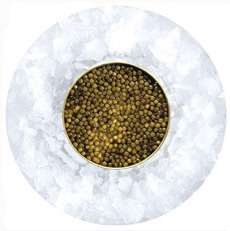
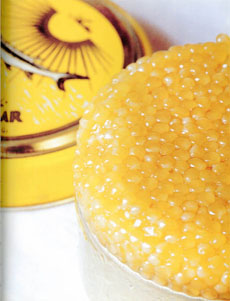
Golden Osetra or Golden Imperial caviar is yellow roe from the most rare, most mature Osetra sturgeons. This type of caviar is highly coveted by connoisseurs, for its firm golden grains that deliver an earthy, nutty and fruity flavor. The color can vary from golden to greenish. Due to its rarity, it is very expensive.

Golden Caviar
Photo courtesy TsarNicoulai.com.

GOLDEN WHITEFISH CAVIAR or WHITEFISH CAVIAR or AMERICAN GOLDEN CAVIAR or WHITEFISH ROE
An American caviar from whitefish native to the northern Great Lakes. Originally from a European fish species, this is now a hallmark of the American caviar industry. The roe is small, very firm and crisp with great “pop,” and a natural golden color. The flavor is less complex than other roe, making them easy to infuse with other flavors.

HACKLEBACK STURGEON or SHOVELNOSE
The fish that produces the most sophisticated wild American sturgeon caviar. The hackleback sturgeon (Scaphirhynchus platorynchus) roams wild in the Mississippi and Missouri Rivers and their tributaries, and is found in Tennessee and Illinois. The caviar is small, a glistening jet-black (unfortunately, it resembles dyed lumpfish roes). Some find it has a sweet, nutty flavor, others find it bland and insufficiently salty with a short finish.

Hackleback
Photo courtesy
CollinsCaviar.com.
Beet and Saffron Caviar
Beet and saffron-infused whitefish caviar from TsarNicoulai.com.

IKROJ
Pronounced EEK-ruh (with a rolld “r”), the Russian word for caviar or roe of any kind.

IKURA
The Japanese word for caviar. In Japanese restaurants it refers to salmon caviar.

INFUSED CAVIAR
Some caviar producers infuse whitefish roe with a variety of flavors, including beet, Cajun spices, citron, ginger, jalapeño, mango, saffron, and wasabi. Tsar Nicoulai of San Francisco and Collins Caviar of Chicago are two such producers.

IRANIAN CAVIAR
Caviar harvested and fished from sturgeon species off the coast of Iran in the Caspian Sea, primarily the southwest shores, where the water is cooler and possibly cleaner. It is of equal quality as Russian caviar, as both are produced from the same species of sturgeon from the same waters. Iranian sturgeon species are Beluga, Osetra, Asetra and Sevruga.

KETA ROE or KETA RED CAVIAR
The roe of the Keta salmon. The eggs are slightly larger than the sturgeon, and the color is very bright, ranging from red to pale orange. This caviar originated in Russia in the early 1800s.

KOSHER CAVIAR
Caviar that is prepared in conformance with Jewish dietary laws and certified kosher.

LUMPFISH or LUMP CAVIAR or LUMPFISH ROE
Lumpfish is a North Atlantic Ocean fish. The caviar is largely produced in Iceland. The roe is small, hard, and crunchy. The eggs are dyed black, red or gold. The food coloring is not stable, however and when used to garnish foods, the colored tends to bleed (especially into moist foods like sour cream). It is readily available, and is generally used when one is seeking an inexpensive solution.


Lumpfish
Photo courtesy of CharlestonSeafood.com.
MALOSSOL
Roe does not officially become caviar until it is salted. The Russian term for “little salt,” referring to a method of delicately salting fine caviar. The less salt, the better the caviar; similarly, better-quality caviar requires less salting, so malossol indicates the best caviar. Less salt also makes the caviar more perishable. Malossol is as little as 3.5% salt (by weight), up to 5%; compared to 10% for commercial barrel-salted caviar or 11% for supermarket lumpfish caviar. Salt preserves the freshness and also enhances the flavor.
Sushi

MASAGO or MASSAGO CAVIAR or MASAGO ROE
Also called capelin caviar: roe from the smelt fish, used in sushi and sashimi dishes. The eggs are small, fluorescent and mild in flavor.

OSETRA

Osetr SturgeonThe Osetra sturgeon or Russian Sturgeon (Acipenser gueldenstaedtii) is a migratory fish which spawns in rivers each spring. It is a medium-size sturgeon, and can weigh up to 440 pounds. The female does not mature to produce eggs for 12 to 15 years. Osetra caviar is harvested mainly in Russian and Iran. Many caviar connoisseurs prefer it to Beluga. It is intensely nutty (hazelnut), and has an oilier, silkier, melts-in-your-mouth texture. The eggs can be golden yellow (see Golden Osetra) to brownish in color, and are of medium size (about 3mm diameter). It is packaged with a yellow lid. The name is spelled ascietra, asetra, osietra, ossetra and other variations, after the Russian osiotr. [See note under Beluga about the 2006 ban on export of Russian caviar.] With the ban on Caspian caviar, the Russian Sturgeon is being cultured indoors in Germany as a sustainable alternative to wild Caspian osetra. (It is available at TheLittlePearl.com.) The species is native to Germany’s major rivers, and the sturgeon was a banquet fish for royalty throughout the Middle Ages. The roe have a gentle pop and a light, nutty flavor that pairs well with Champagne, Grüner Veltliner and Riesling.

PACIFIC STURGEON
See White Sturgeon.

Paddlefish  Caviar
Photo courtesy TsarNicoulai.com.

PADDLEFISH STURGEON or SPOONBILL
Providing what some consider to be the best substitute for the more expensive sturgeon caviars, the North American Paddlefish (Polyodon spathula) is a close relative of the sturgeon. It lives more than 50 years, grows to five feet in length and weighs 60 to 100 pounds. Its long, thin nose protrudes some 15 inches, like a swordfish’s. The caviar flavor is rich, complex, and comparable to Sevruga in taste: the texture is smooth and silky; it is slightly saltier and more understated than Caspian sturgeon caviar. The smallish eggs come in many shades of gray from pale to dark steel, and are also found in golden brown tones. Paddlefish caviar can taste “muddy”; as with any product, some are better than others.

Paddlefish caviar is more affordable than Sevruga; however the paddlefish population is also facing a decline. Ironically—since paddlefish caviar is now in great demand, initially due to placement of the three Caspian sturgeon on the Endangered Species List and a ban of the import of their roe by the U.S. government and now to a greater worldwide band by CITES—after years of overfishing and habitat damage from dams, the wild paddlefish itself was declared an endangered species by the U.S. several years ago. It is found in the Mississippi River and its tributaries especially in Tennessee and Kentucky, and is called spoonfish is Kentucky; spoonbill or spoonies elsewhere. Two major producers are Osage Catfisheries, in Osage Beach, MO, which markets its product under the L’Osage brand, and Shuckman’s Fish Co. & Smokery Louisville Kentucky, which markets Kentucky Spoonfish Caviar. Paddlefish meat has a texture similar to swordfish and is sold smoked or in steaks. Although not popular in the West, it is considered a delicacy in Asia. I find that caviar from the indoor farm in Germany and from some paddlefish can have an off-flavor.  Often, that caviar has a greenish hue and has a muddy, pondy or briny taste.  Currently, farmed paddlefish caviar can have a muddy, off flavor (green-cast eggs are a giveaway). This should change over the next 10 years as farm technologies improve. Today, look for wild-caught, sustainable paddlefish caviar that is light gray to dark gray in color, with no green hue.

PASTEURIZED CAVIAR
Caviar is sterilized at high temperatures to removed harmful microorganisms so that it has a longer shelf life (it may or may not require refrigeration, depending on the particular product). Pasteurization semi-cooks the caviar and makes it slightly saltier. It also changes the mouth feel, making it slightly harder, although the quality and price remain the same. Regular caviar should be stored at 28 degrees to 32 degrees; unopened jars can be stored for four weeks. Pasteurized caviar will keep in the refrigerator unopened for several months. Once opened, all caviars should be consumed within two to three days.

PEARLS
The caviar eggs are also called pearls or beads in the trade.

PERSIAN CAVIAR
Caviar from Iran, the present-day name for Persia.

Pike Roe CaviarPIKE ROE
Small-grained pike roe is pale gold in color with a mild, delicate taste. It is best used for hors d’oeuvres, garnishes, or on blini or toast points with crème fraîche, as shown in the photo at right.
Pike roe is available at Petrossian.com.

POOR MAN’S CAVIAR
Another term for eggplant caviar, a dip or spread made with eggplant, tomatoes, onions, green and red bell peppers and parsley. It contains no caviar.

PRESSED CAVIAR
Also called payusnaya or pajusnaya. The eggs that are broken in the sieving process intact, or are otherwise weak or damaged, are made into pressed caviar. While pressed caviar is made from the ripest beluga, osetra and sevruga eggs, the product is completely different from fresh caviar; it is much oilier, saltier and more pungent. The eggs are cleaned, combined, packed in linen bags and hung to drain. As salt and moisture drain away, the eggs are pressed into a spreadable, jam-like consistency. Approximately three pounds of roe produce one pound of pressed caviar.

RAINBOW TROUT CAVIAR
See Trout Caviar.

Pressed Caviar
Caspian pressed caviar from CaviarRusse.com.

RED CAVIAR
A term sometimes used for salmon caviar, although other fish roes are also red in color.

ROE
The eggs of a fish, also called berries, pearls, and grains. In addition to sturgeon roe, roe from several different species of fish is enjoyed by consumers: keta roe from the keta salmon; masago from the smelt, tobiko from the Icelandic flying fish, avruga from the Spanish herring, plus American caviars (roes) from the bowfin, paddlefish, whitefish, lumpfish and trout.

RUSSIAN CAVIAR
While the Russians developed the caviar industry that we know today, perfecting methods through generations, the Russian caviar industry is currently in a huge decline due to drastic over-fishing of sturgeon in the Caspian Sea, abetted by internal political turmoil. Russian caviar, especially Beluga, is now much harder to come by, and much more expensive.

Salmon Caviar
Alaskan salmon caviar. Photo courtesy CaviarRusse.com.

SALMON CAVIAR or SALMON ROE
North American Salmon caviar usually comes from the Chum and Silver Salmon salmon of Alaska and the Pacific Northwest, or the Chinook (King) salmon of the Great Lakes. It is bright, pearlescent, natural orange to red-orange in color; the eggs are popularly referred to as “pearls.” It is larger, juicier, and much saltier than other caviars. The eggs are a very popular garnish and are tasty as a dish in of themselves (it is a popular sushi bar item, known is ikura in Japanese).

Sevruga SturgeonSEVRUGA CAVIAR
The smallest of the Caspian and Black Sea sturgeons (it has also been sighted in the Adriatic, the Danube, and as far as Bratislava), the Sevruga (Acipenser stellatus) can grow to 6.5 feet and 175 pounds, although typically weighs in at about 80. It feeds on plankton. Sevruga is the smallest and also the most common species of sturgeon. It has the most distinctive shape, with a long pointed muzzle in the shape of a scythe. It is less expensive not only because it is more available, but because it reproduces faster that the other species (it begins to bear eggs at 7 or 8 years). Sevruga caviar is the smallest in grain (2 to 2.5mm diameter), and the color is slightly greenish to medium gray to steel gray. It has the strongest flavor among sturgeon caviars, the crunchiest texture, and traditionally is the least expensive of the three Russian/Iranian caviars. Sevruga has caught up to Osetra in price because of a pull-up effect: the shortage of Beluga has created a run on Osetra, making Sevruga more in demand. It is sealed by a red-colored lid. Its name comes from the Russian sevryuga.  [See note under Beluga about the 2006 ban on export of Russian caviar.]

SHOVELNOSE
See Hackleback Sturgeon.

Siberian Osetra

SIBERIAN OSETRA CAVIAR
This Osetra Sturgeon originates in the cold waters of Siberia, producing a crisp caviar that is only slightly smaller than its Caspian cousin. The roe is brown to jet black in color with a small to medium sized Osetra bead. The flavor is creamy and slightly briny. Due to pollution and other factors, this same sturgeon is farmed in the immaculate waters of Uruguay and also sold under the name Siberian Osetra.

SMELT ROE
See Masago.

Photo courtesy TsarNicoulai.com.

SMOKED CAVIAR
Some caviar producers smoke whitefish, gravlax, and other roes for added nuance. They can be further seasoned with dill, lemon, and pepper. Collins Caviar of Chicago is one producer of such specialty caviars.

Golden Osetra CaviarSPOONBILL STURGEON
See Paddlefish Sturgeon.

STERLET STURGEON
Now largely extinct, the Sterlet supplied what was called Imperial Caviar to the Royal Family. The name Imperial Caviar is now given to Golden Osetra.
The Golden Osetra shown at right is available at
GourmetStore.com.

STURGEON
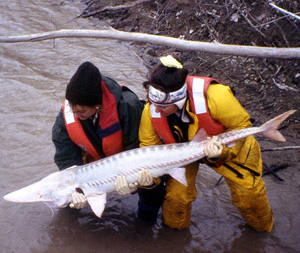
A large migratory fish found mainly in the Caspian Sea and the Black Sea, some parts of the Pacific Northwest, Midwest, and South Atlantic regions of North America, and the big lakes and rivers in Europe. The sturgeon is an ancient fish that has roamed the cold waters of the northern hemisphere for more than 250 million years. Although it is a saltwater fish, it spawns each fall and spring in freshwater rivers, and it is there that it is caught for harvesting. The roe is highly prized and known as caviar. Its meat is delicate yet firm and contains virtually no bones. The fillets are rather large, with a taste prized by gourmets. The meat can be prepared in many different ways: It is served both fresh and smoked. There are 27 species of sturgeon in the world; all are endangered. Sturgeon belong to the family Acipenseriformes, an Sturgeonorder of primitive ray-finned fishes that includes paddlefish as well as some extinct families. Their subfamily is Acipenserinae. Within the subfamily there are two genuses: Acipenser, to which the osetra, sevruga, Siberian sturgeon and white sturgeon belong (as well as the majority of the other species); and Huso, which has two members, the beluga and the kaluga. There is one other subfamily: Scaphirhynchinae, of which the Shovelnose (paddlefish) sturgeon, a significant source of caviar, is a member.
Sturgeon photo © Coldfusion | Dreamstime.

STURGEON CAVIAR
The roe of the sturgeon. The caviar is classified according to the sturgeon species and the roe’s size and color. While a few years ago these caviars would have included Beluga, Osetra, Sevruga and Pressed Caviar, today the American caviar market has grown to include several fine farmed sturgeon caviars, and there is a ban on the export of Caspian caviars.

SUSTAINABLE CAVIAR
Caviar that is farmed or fished in a responsible manner that does not deplete the resource.

TARAMA
Carp roe. The tiny orange eggs make a very popular Greek dip, taramasalata, which is pink in color.

TEXAS CAVIAR
A dip made with black-eyed peas, tomato, onions, chiles and cilantro, served with tortilla chips. It contains no caviar.

TOBIKO or FLYING FISH ROE
A popular sushi ingredient, tobiko caviar comes from the flying fish of Iceland. It ranges from black to bright red. Flavors vary, since it can spiced and flavored. Tobiko capelin caviar is a variety of tobiko that is made in a wide variety of colors and flavors. Pale green wasabi-flavored tobiko can often be found in specialty food stores.

Photo courtesy of CollinsCaviar.com.

Tobiko

000 or TRIPLE ZERO CAVIAR or ROYAL CAVIAR
Caspian caviar is graded by color on a scale from 000 to 0. In this system 000 is the lightest, silvery pale gray; 00 is medium gray; and 0 is black. Although the taste is the same regardless of hue, the lighter caviars are more highly prized and priced than the darker ones. Thus, the rarest and most expensive caviar one could buy is Beluga 000 (assuming one were in one of the Caspian Sea border countries, since export is currently banned). While not established scientifically, industry feedback is that younger sturgeons produce the lighter eggs. They would also weigh less and have less roe, which could account for the higher price.

Trout Roe
Photograph courtesy TsarNicoulai.com.

TROUT CAVIAR or TROUT ROE
From the Great Lakes of North America, trout caviar is an inexpensive caviar option. It yellow or orange, with a salty flavor and a somewhat a sticky texture. A major producer is Sunburst Trout Farm in Canton, North Carolina, which cultures bright orange rainbow trout.

WHITEFISH CAVIAR or WHITEFISH ROE
See Golden Whitefish Caviar.

WHITE STURGEON CAVIAR
The white sturgeon (Acipenser transmontanus, “sturgeon beyond the mountains”) is also known as the California white sturgeon, Columbia sturgeon, Oregon sturgeon, Pacific sturgeon and Sacramento sturgeon, after the many locales where it is found. It lives wild along the west coast of North America from the Aleutian Islands to Central California, and was originally found as far south as Mexico. It is being farmed in California, Idaho, France, Israel and other locations. The fish is related to the Caspian osetra sturgeon (Acipenser gueldenstaedtii), and the caviar is similar; depending on its origin and terroir, flavors will vary. See American Sturgeon Caviar/California Osetra Caviar. The Israeli caviar we have tried has had the closest similarity to Caspian osetra, and the Transmontanus Rex from Idaho has hints of beluga. While a record 2,000 pound, 20-foot “T-Rex” was found in Idaho’s Columbia River, the fish in the farms tend to range from 100 to 200  pounds at caviar harvest.


© Copyright 2005- 2008 Lifestyle Direct, Inc.  All rights reserved.  Images are the copyright of their individual owners.


.