
October 2005
Updated October 2009
|
|
Fish & Seafood Glossary
Page 5: Seafood Types Beginning With F
This is Page 5 of a 13-page glossary featuring different types of fish and seafood. Here, seafood types beginning with F, such as fish, flounder, flying fish and fugu. Click on the links below to visit other pages. See our 60+ other food glossaries, each featuring a different favorite food.
Click on a letter to get to another section of the glossary.
a b c d e f g h i j k l m n o p q r s t u v w x y z
This glossary is protected by copyright and cannot be reproduced in whole or part.
FINNAN HADDIE
Finnan haddie is not a species of fish, but a preparation of smoked haddock, named after the fishing village of Findon (or Finnan) near Aberdeen, Scotland where the cure was originally cold-smoked over peat (see photo above). Finnan haddie is often served poached in milk for breakfast, and was thus immortalized in the song, “My Heart Belongs To Daddy”:* “When I invite some boy some night to dine on my fine finnan haddie....” implies that he’ll be around for breakfast.
*Written by Cole Porter for the 1938 musical, “Leave It to Me!”
FISH
|
Water-borne animals are broken down into two very broad categories: fish and shellfish. In the most general terms, fish are vertebrates with fins and gills; while shellfish are invertebrates, either having shells of one sort or another, or having evolved past the need for one. (For more details, see shellfish.)
- Fish are further separated into freshwater and saltwater fish. Because fresh water provides less buoyancy than salt water, freshwater fish have hundreds of tiny, light bones in a network throughout the flesh. Saltwater fish, on the other hand, have thicker, fewer bones, making them more attractive for eating.
- Fish are divided into three broad categories based on the fat content of their flesh: lean, moderate-fat and high-fat fish. In lean fish (e.g. flounder), the fat is concentrated in the liver rather than the flesh. The meat tends to be mild and lightly colored. Moderate-fat fish have darker color, firmer texture and more assertive flavor than lean fish. High-fat fish (e.g. tuna) can average 12 percent fat, but some have fat contents up to 30 percent. These fish have the darkest color, firmest texture and most distinctive flavor.
- Fish are also categorized as flatfish or roundfish. Flatfish are adapted to swimming long the bottom of the sea or ocean. They are oval-shaped, with both eyes on the topside of the body, and are usually dark on the top and pale or white on the bottom. Roundfish have round or oval bodies, with eyes on opposite sides of the head.
For questions about buying, preparing or storing fish, call the free government-sponsored fish and shellfish hotline at 1.800.332.4010.
|
FLATFISH
|
This large subclass of saltwater fish, encompassing some 500 species (130 available in the U.S.), includes popular varieties like flounder, halibut, sole and turbot. Most of these fish have sweet, delicate white flesh that chefs and consumers everywhere enjoy: low fat, fine-textured meat and mild flavor. All flatfish belong to the order Pleuronectiformes, which means they have both of their eyes on the same side of their head.
|
|
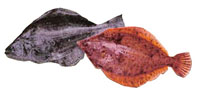 |
| Flounder and sole. Photo courtesy of PacSeafood.com. |
All flatfish start out life looking like normal fish, but after a few weeks, one eye migrates to the other side of their head, their bodies flatten into an oval shape, one side turns dark and one side white, and they settle to the bottom of the sea floor. The meat from a flatfish typically varies in color: fillets from the bottom (white) side of the fish will be thinner and whiter, while fillets from the top (dark) side will be thicker and more gray. Even though many of them are called soles, all the flatfish fished commercially in the U.S. are really flounders. To show the extent of the confusion:
- Pacific Dover Sole, a flounder not the same as true English Dover Sole from the North Atlantic, is the most common flounder sold on the West Coast.
- Yellowfin sole is a small flounder.
- Arrowtooth flounder, which is found from California to Alaska, has a soft flesh and is often marketed as “turbot,” although it is not European turbot, the most expensive flatfish in the world.
- Greenland turbot, which is caught in both the North Atlantic and North Pacific oceans, is not really a turbot either, but instead is a member of the halibut family. Outside of North America, it is called Greenland halibut or black halibut. To avoid marketing confusion with Pacific halibut, the halibut industry successfully lobbied to have the name of this flatfish changed to turbot.
- California halibut is actually a left-eyed flounder.
- Fluke is a common name for summer flounder, a popular East Coast flatfish that occurs from the southern Gulf of Maine to South Carolina. Because it is a closely related species, California halibut may also be called fluke on occasion. It’s enough to make someone flounder, or at least try one’s sole.
FLOUNDER
|
Any one of several species of large flatfish. In America, flounder is often sold as filet of sole, though the only true “filet of sole” is the imported Dover Sole (Solea solea), fished in the North Atlantic off Europe. All the flatfish fished commercially in the U.S. are really flounders. Alaska has the largest flounder resource in the world, capable of producing sustained landings of almost a million tons a year.
|
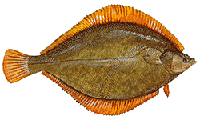
Photo courtesy of TridentSeafoods.com. |
There are two flounder families: the right-eyed Pleuronectidae family and the left-eyed Bothidae family. The flounder is very low in fat, and has a very fine texture and delicate flavor. Flounder is available whole, but more usually as fillets. It can be prepared in any way that respects its fine texture: sautéed, baked, broiled, poached or steamed.
FLYING FISH or FLYINGFISH
|
A common tropical fish found in most tropical waters but especially in the Caribbean. The name comes from its ability to soar through the air for great distances, sometimes up to a quarter of a mile. It has large pectoral fins to help ride the air after bursting from the water to evade predators. A small fish, it makes excellent food with a firm texture and mild flavor. Trivia: Flying fish figure prominently in Santiago’s survival in Hemingway’s “The Old Man and The Sea,” among other works of literature.
|
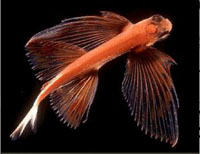
Photo courtesy Thinkquest.org. |
FROG’S LEGS
|
The delicate meat of the hind legs, the only edible part of a frog, is tender and lightly sweet. And, yes, as the old joke goes, they do taste like chicken—more specifically, they can be compared with the white meat of a very young chicken. Fresh frog’s legs can be found from spring through summer. Typically, they can be found in connected pairs, weighing from 2 to 8 ounces. Frozen frog’s legs can usually be purchased year-round in specialty markets.
|
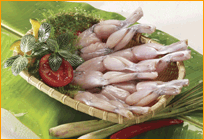
Photo courtesy Vietnam-USTrade.org. |
FUGU
|
Pronounced FOO-goo, this is the Japanese name for a pufferfish that contains a poison sac so toxic, a single fish contains enough to kill 30 adults. Approximately 100 people die every year of fugu poisoning. Yet, it’s still a delicacy in both Japan and the Philippines. In Japan, it is used in both sashimi and nabemono preparations, and only qualified chefs trained in removing the sac may prepare it. In Japan, it is eaten almost in a ritual, first with the fins being fried and served with sake (fugu hire-zake); then the skin is de-spiked and served on a salad (yubiki) with a ponzu dressing; and finally the flesh is sliced and served. Trivia: It is the only food not permitted to be served to the Emperor of Japan.
|
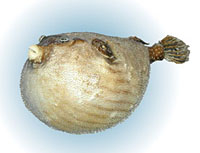
Photo courtesy nersc.gov. |
Continue To Page 6: Seafood Terms Beginning With G & H
Go To The Alphabet Index Above
Lifestyle Direct, Inc. All rights reserved. Images are the copyright of their respective owners.
|
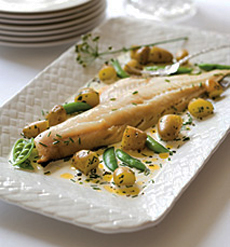 Finnan Haddie available at MackenzieLtd.com. You can also get cold-smoked wild haddock from


