Photo glossaries of more than 100 foods and beverages let you explore your favorites. Take a look!
Get all new posts by email:
Stevia is the latest sugar substitute to hit the market. It’s made from the leaves of a Latin American plant, and used extensively by the Guaraní people for more than 1,500 years. Photo by Ethel Aardvark | Wikimedia.
Sweeteners That Must Be Called Dietary Supplements
Two excellent sweeteners are little known because they are currently labeled dietary supplements, not food additives, by the FDA. The dietary supplement category is not subject to FDA food additive regulations. This means that these products cannot state or even suggest, on package labels or in advertising materials, that they can be used as sweetening agents (i.e., food additives); and manufacturers will not incorporate them into products.
Consumers, however, can buy them at most health food and natural products stores, and use them to sweeten their own foods and beverages. Both also are very stable under high temperatures and thus are excellent for cooking and baking. And both have been used to sweeten foods in other countries for many centuries.
Stevia
Pronounced STEH-vee-yuh (but distorted into STEE-vee-yuh by Americans), this natural sweetener is derived from a South American plant (Stevia rebaudiana) related to the chrysanthemum. One reason given for its lack of approval of a food additive is heavy lobbying by the makers of Nutrasweet, which would stand to lose market share. Quality stevia is a nice, light, calorie-free sweetener. Lesser quality stevia has a slight anise (licorice) flavor which some people might enjoy; it blends well into soft drinks and iced tea. Although it won’t be appearing on food and beverage labels in the U.S. for the time being, stevia comprises forty percent of the sweetener market in Japan. It can be purchased in crushed leaf form (which is about 30 times as sweet as table sugar, measure for measure), as a greenish-black concentrated liquid (about 70 times as sweet), and in powder form (about 300 times as sweet).
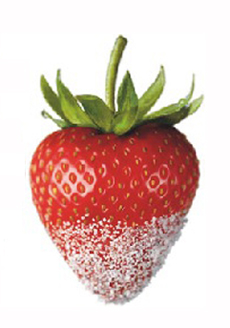
A strawberry dipped in stevia. Photo courtesy Cargill.
Lo Han Kuo
First discovered in 1932 by a Western botanist in China, and relatively new on the horizon as a sugar substitute in the U.S., lo han kuo (also spelled lo han guo and kuo han kuo) is 200 to 250 times as sweet as table sugar. A natural sweetener made from the extract of a fruit by the same name, it has been used in China and neighboring countries for generations. Though almost non-caloric (2 calories per 2 grams, a normal serving portion), it has a pleasant, natural sweetness and a low glycemic index, making it appropriate for diabetics. It can be found mixed with xylitol, a sugar alcohol, to achieve the most natural taste in foods.
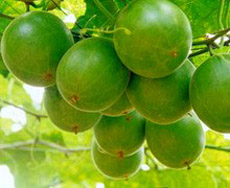
Lo han kuo fruit. Photo courtesy Z Natural Foods.
Both stevia and lo han kuo are sold in liquid and powder forms.



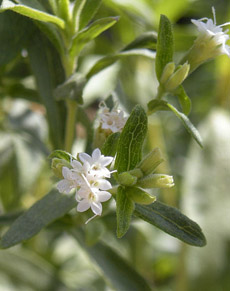 Stevia is the latest sugar substitute to hit the market. It’s made from the leaves of a Latin American plant, and used extensively by the Guaraní people for more than 1,500 years. Photo by Ethel Aardvark | Wikimedia.