|



TIRAMISUWhile there are many variations of this Italian recipe, it is typically composed of layers of sponge or ladyfingers, soaked in espresso liqueur or a similarly flavored syrup, and layered with a mascarpone cheese and custard mixture; then dusted with cocoa or shaved chocolate. The name means “pick me up,” from the espresso flavoring. Here’s the history of tiramisu.
It is sometimes called an Italian trifle, although it is much lighter than a traditional trifle. |
Tiramisu. Photo by Kelly Cline | IST. |

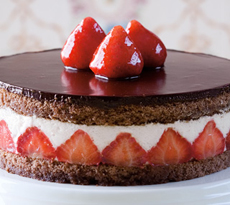
TORTETorte is the Austrian, German, and Hungarian word for cake. Tortes are always round and generally shorter and wider than cakes, as well as denser and less delicate. This denseness and shortness are often due to the use of ground nuts in place of a portion (or all) of the normal amount of flour.
Tortes are made without chemical leaveners, using egg foams for lightness. In addition to the fillings traditionally used by American, British, and French cakes, tortes also use marzipan (ground almond paste) as a filling. |
|
|
What’s the difference between a cake and a torte? It depends on whom you ask.
But essentially, torte is the German word for cake. As opposed to a pound cake or a more casual cake, a torte denotes a rich, dense cake made with many eggs and little or no flour, using ground nuts (and sometimes breadcrumbs) for texture.
Tortes are also shorter and wider—often no more than 2-1/2 inches high, and 10 to 12 inches in diameter—the original style.
Today, many bakers and recipe writers call their cakes “tortes,” possibly in order to make them sound different and more exciting. More accurately, in the U.S., the term should be used to describe a shorter, wider cake.
|
|
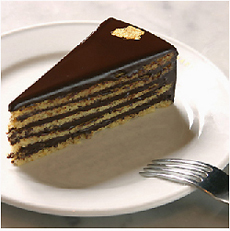
A tart is not a torte! A is not a cake. It is a filled pastry shell. The word is misused by people who don’t know better. Just because you see it in print online doesn’t make it correct!
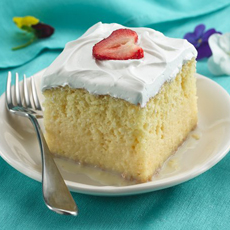
Also see Hot Milk Cake.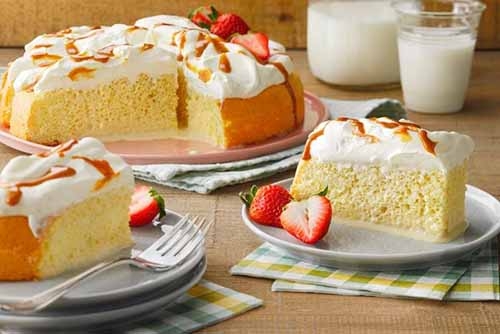 |
Here’s the recipe for this Tres Leches Cake (photo © Taste Of Home).
TRAYBAKE
Traybake, a U.K. term for sheet cake, is a broad category for anything baked in a rectangular or square tray and sliced. The difference between a traybake and a sheet cake is primarily regional terminology and scale. A sheet cake is a larger format designed to feed a crowd; a traybake is a smaller, family-size cake. A sheet cake is almost always topped with a thick layer of buttercream or whipped frosting, often with piped borders and decorations. A traybake can have frosting, or it can be a simple glaze, a crumble topping, a meringue layer, or even just a dusting of powdered sugar. A sheet cake is typically quite thin (about 1 to 2 inches deep), while a traybake can be much deeper and chunky, if it has multiple layers like fruit, jam, or nuts. Finally, while a sheet cake is sliced into uniform, square, or rectangular pieces to be served on a plate with a fork, a traybake is often denser and can be handheld.
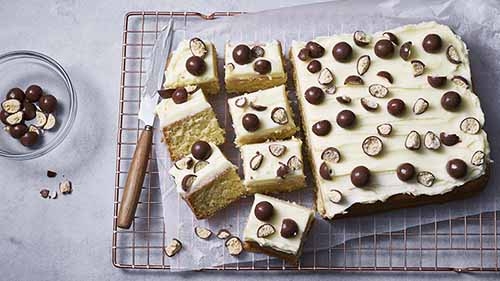
A sheetcake or traybake topped with malted milk balls. Here’s the recipe (photo © BBC Food).
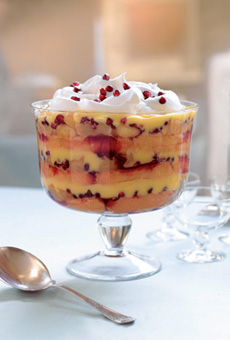
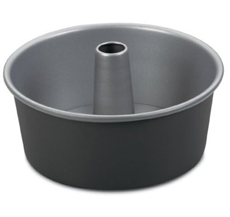
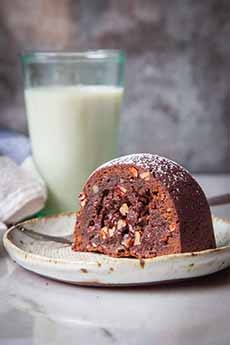
TUNNEL OF FUDGE CAKEThe Tunnel of Fudge Bundt cake placed second in the 1966 Pillsbury Bake-Off. The cake was created by Ella Rita Helfrich of Houston. Adding a circle of Pillsbury Double Dutch Frosting Mix on top of the batter, halfway through, created a moist circle of “fudge” in the center of the cake. Bundt pan sales jumped exponentially, and like other recipes, Tunnel Of Fudge became all the rage.
The frosting mix was discontinued, and subsequent recipes were re-worked with cocoa powder and later, chocolate pudding mix. The first prize winner? Golden Gate Snack Bread, a yeast bread made with instant flour, processed cheese spread, dry onion soup mix, and butter. |
Tunnel Of Fudge Cake. Here’s the recipe (photo © Eat The Love). |
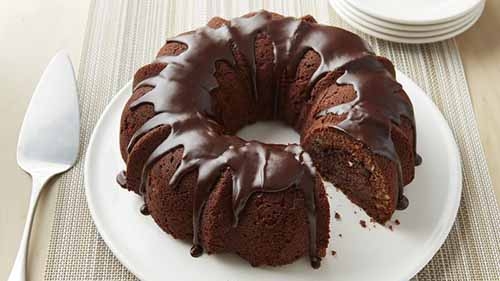
Tunnel of Fudge Cake. Here’s the recipe (photo © Pillsbury),
VACHERINA vacherin is constructed from separately baked meringue rings or discs that are stacked and traditionally filled with whipped cream, ice cream, or both, and often fresh fruit. The ice cream version is called vacherin glacé.
|
 A two-layer strawberry-chocolate vacherin, called a “meringue torte” by some American bakers. Here’s the recipe (this photo and the next © Taste of Home).  A three-layer vacherin. Here’s the recipe.  A three-layer vacherin |

Vacherin glacé, like an ice cream cake, but with meringue layers instead of cake. Here’s the recipe (photo © Lilie Bakery).

Here’s a Pavlov, looking much like a single-layer vacherin (Gemini photo).
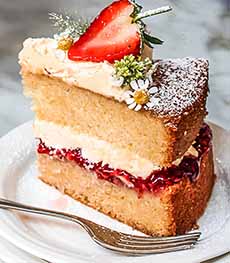
VICTORIA SANDWICH CAKE or VICTORIA SPONGEThis tea cake was particularly enjoyed by Queen Victoria (1891-1901). It was a sandwich of two sponge cakes, filled with layers of jam and whipped cream. After her husband, Prince Albert, died in 1861, the Queen spent time in retreat at the Queen’s Residence (Osborn House), her summer home on the Isle of Wight. According to historians, it was here that the cakes were named after her.
However, credit for creating the tradition of tea is owed to Anna, Duchess of Bedford (1788-1861), one of the Queen’s ladies-in-waiting. There was a big stretch between lunch at noon and dinner at eight, and the duchess became famished at about four in the afternoon. |
This version adds a non-traditional spoonful of malted milk powder, created by a manufacturer of malt. Here’s the recipe (photo © Horlicks). |
Beginning around 1840, at first, she had a pot of tea and a few breadstuffs brought to her dressing room. But later, she invited friends to join her for a late afternoon meal of small cakes (which became known as tea cakes), bread and butter sandwiches, assorted sweets, and a formal tea service. The practice of inviting friends to come for afternoon tea was quickly picked up by other social hostesses, including Queen Victoria.
What became known as the Victoria Sponge cake was made by the Duchess’s cook. In the 1840s, Alfred Bird invented baking powder, which allowed for the creation of much lighter, fluffier sponge cakes—perfect for the afternoon tea. A century or so later, Queen Victoria’s kitchens baked it for her, and it became a favorite of hers with her afternoon tea. The cake became iconic fare for British teatime. It was named in her honor after Prince Albert’s death in 1861. (Coincidentally, the Duchess of Bedford died the same year.)
Before then, the sponge cake was primarily known as a sandwich cake (later, Victoria sandwich), as two layers of sponge were “sandwiched” together with a filling. That year, the Victoria Sponge recipe was popularized in Mrs. Beeton’s Book of Household Management.
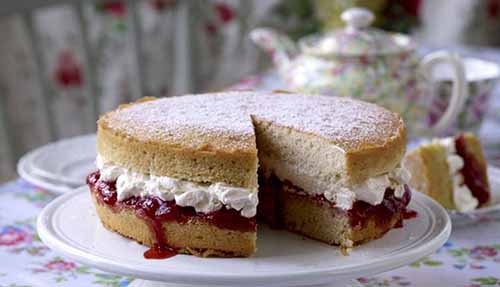
Victoria Sponge, named for Queen Victoria, was a favorite of hers at tea time. Here’s the recipe (photo © Prima).
VIENNESE SPONGEA Viennese sponge (Wiener Masse) differs from the French sponge (genoise) in several ways. (1) It uses the separated egg method, where egg whites are whipped separately to stiff peaks and then folded into the batter. Genoise uses the whole egg method, where whole eggs and sugar are warmed and whipped together until thick and pale (the “ribbon stage”). (2) Viennese sponge often includes a small amount of butter or oil for richness, whereas genoise contains no fat. The result is that the Viennese sponge has a lighter, more airy texture; the separated egg whites create more lift and a softer crumb. Genoise has a denser, more compact texture. It’s still light and has a finer crumb. (3) Viennese sponge sometimes includes a touch of vanilla or lemon zest. Which should one use? |
Viennese sponge. Here’s a recipe (photo © Combine Good Flavors). |

- Viennese sponge is generally easier to make (since you don’t need to warm the eggs and is more tender and cake-like.
- Genoise is more flexible and thus better for rolling (e.g., roulades).
VIENNOISERIEViennoiserie is not cake but laminated pastry dough, an expensive (because of the amount of butter needed) and time-consuming process (because the butter is folded in between layers of dough). This technique is used to make the flaky “breakfast pastries,” croissants, Danish, and brioche. It is a marriage between traditional bread baking and sweet pastry baking. You can see the striations, or layers, of pastry when you look at the top of the Viennoiserie or when you cut into it, and you can pull apart the layers of the baked dough.
According to legend (subsequently disproved), the croissant was created to commemorate the defeat of the Turks in Vienna; hence, the group of specialty breads became known as Viennoiserie. See croissant in our Bread Glossary for the accurate history.
|
You can see the layers of laminated dough. Photo courtesy Sprinkled With Jules. Here’s the recipe. |

WACKY CAKE, CRAZY CAKE, DEPRESSION CAKE, or WAR CAKEWacky cake was a Depression-era recipe made with inexpensive ingredients: no eggs, butter, milk, or cream. It was also made during World War II when these ingredients were rationed, too costly, or simply unavailable. Typical ingredients were flour, sugar, baking soda, salt, water, oil, and vinegar. If you had cocoa powder, you could make chocolate cake. |
Here’s a recipe for chocolate wacky cake (both photos © Taste Of Home). |


WAFFELTORTEA Viennese specialty made from several layers of crunchy waffles and nougat. You can order them online from Demel in Vienna (and their Sachertorte as well). |
Waffeltorte (photo © Demel | Vienna). |

WEDDING CAKEIn America today, a wedding cake is typically a large, multi-tiered cake with white icing, although the cake and filling inside can be whatever the bride desires (First Daughter Jenna Bush chose a tres leches cake). Some brides choose a very plain cake decorated simply with fresh flowers, while others like elaborate decor with spun sugar flowers, birds, and iconic columns holding up the layers.
As can be seen on the Food Network, those who can afford designer cakes can have majestic works of art that don’t look like wedding cakes, but are cake sculptures that represent anything from where the bride and groom met (an art exhibit at a museum) to their hobby (flying planes or scuba diving) to a fantasy of a princess being rescued from the tower by a prince on horseback.
|
|


__________________
*In 1859, Louis Pasteur identified that yeast was a living organism and the agent responsible for alcoholic fermentation and dough leavening. He discovered that yeast feeds on the starches in flour, producing carbon dioxide. The carbon dioxide expands the gluten proteins in the flour, and the gluten proteins cause the dough to expand and rise. Nine years later, Fleischmann’s Yeast was founded, and the modern baking era, with commercially available yeast, was born.
YULE LOGSee bûche de noël. ______________ |
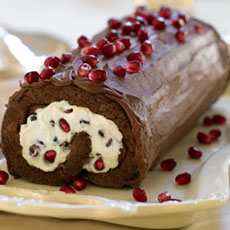
A yule log, or bûche de Noël. Here’s the recipe (photo © Pom Wonderful). |
Lifestyle Direct, Inc. All rights reserved. Images are the copyright of their individual owners.
Follow Us On:


© Copyright 2005-2026 Lifestyle Direct, Inc. All rights reserved. All images are copyrighted to their respective owners.