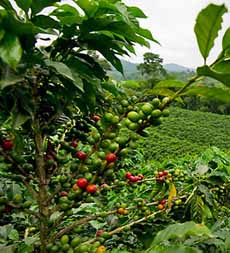
Coffee growing in the hills of Africa. Arabica prefers an altitude of 4,000 to 5,000 feet. Photo by Ana Labate.
October 2005
|
 |
The History of Coffee
Born in Africa, Grown The World Over
Coffee comes from the seeds of the fruit of trees of the genus Coffea of the family Rubiaceae. Arabian coffee is classified as Coffea Arabica, Robusta coffee as Coffea Canephora, and Liberian coffee as Coffea Liberica. Two-thirds of the world’s production is Arabica, Liberica makes up a tiny portion, and Robusta is the difference. Almost all of the coffee we drink is Arabica, but within that species, there are hundreds of different subspecies and blends.
From the Central Plateaus of Ethiopia To Yemen
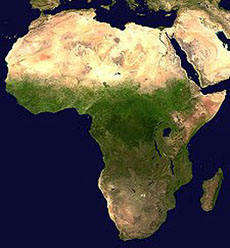
The story of how coffee growing and drinking spread around the world is starts in the Horn of Africa, on the plateaus of central Ethiopia, several thousand feet above sea level, where the coffee tree probably originated in the province of Kaffa. There are various fanciful but unlikely stories surrounding the discovery of the properties of coffee. One story has it that an Ethiopian goatherd named Kaldi was amazed at the lively behavior of his goats after chewing red coffee berries. Kaldi or not, people who ate the seeds of the berries recognized that they gave energy and alertness.
MAP: The “horn” of Africa, shown at the right center of the map, consists of Somalia along the cost, and Ethiopia inland. It juts out into the Gluf of Aden (north side) and the Indian Ocean (south side). The long body of water north of the horn, the Red Sea, separates Africa from the Arabian Peninsula.
Excavations in the Ethiopian highlands where coffee grows wild indicates that humans have been eating the sweet coffee berries for thousands of years. Man has been observed chewing the coffee berries for centuries in Ethiopia and Yemen. Ugandans were noticed chewing dried coffee berries by the first European explorers searching for the source of the Nile. Green coffee beans were ground up and mixed with fat, then made into small balls, good for long journeys.
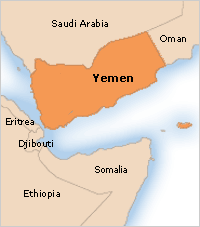
Exactly where and when coffee was first cultivated is not known. Ethiopia invaded Southern Arabia in 525 A.D. Many speculate that coffee could have been introduced to Arabia at this time. Other authorities say that around the year 575, Arab traders took it to the southern tip of the Arabian peninsula, now known as Yemen, where the cultivation of coffee began. Some authorities believe that it was grown initially in Arabia near the Red Sea around the year 675.
MAP: It’s easy to see how coffee would have been traded betwen Ethiopia and Yemen, at the south of the Arabian peninsula.
What we know with more certainty is that the succulent outer berry flesh was eaten by slaves taken from present-day Sudan into Yemen and Arabia, through the great port of its day, Moka—which gave its name to the coffee later exported from there. Coffee was certainly being cultivated in Yemen by the 15th century, though probably much earlier than that.
Initially, coffee was brewed from green, unroasted beans to yield a tea-like beverage. |
 |
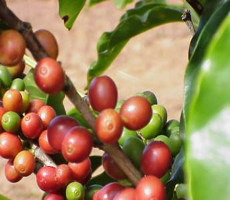
Coffee berries or “cherries,” as the ripe
berries are called,
growing on the bush. The seeds inside, when roasted, become coffee beans.
Photo by Ana Labate. |
Throughout the Arabian Peninsula
Coffee cultivation was rare until the 15th and 16th centuries, when extensive planting of the trees occurred in the Yemen region of Arabia. From Yemen the use and trading of coffee beans spread throughout the Arabian peninsula (what is now called the Middle East) and later via the Ottoman Empire to Turkey, which lay immediately north of it, across the border of modern-day Syria and Iraq. At that time, coffee was used for its medicinal properties and as a ritual drink. However, the drink was not as we know it today: the green (unroasted) coffee beans were boiled. The world’s first coffee shop, Kiva Han, opened in Constantinople in 1475.
 |
 |
| At left, the Arabian Peninsula. Yemen, at the southern tip, was the “birthplace” of the coffee beverage, but the Yemenites boiled the green coffee beans. When coffee migated north, the Turks roasted the beans. |
The modern coffee drink was invented at the end of 15th century, when roasting and crushing the coffee beans over open fires before extracting them with hot water became the accepted methodology. The Turks claimed coffee to be an aphrodisiac and husbands kept their wives well supplied. If the husband did not supply coffee, it was a legitimate cause for a wife to divorce. Coffeehouses became the social centers, competing with mosques for attendance. As gathering places for political activity and sedition, they banned several times over the next few decades, but they kept reappearing. Eventually a solution was found when coffeehouses and coffee were taxed.
By the 16th century, coffee had spread to Persia, Egypt, Syria and Turkey. As the Koran forbade Muslims to drink alcohol, coffee’s energizing properties would have been an appealing option. Coffee was drunk at home and at luxurious public coffeehouses, which featured music, singing, dancing, chess, and socializing. Nothing quite like the coffeehouse had existed before: a place where society and business could be conducted in comfortable surroundings and where anyone could go, for the price of coffee.
At one point in the mid-16th century, Sultan Murat IV closed them all; they were to remain dark until the last part of the century. But as soon as the Sultan’s edict went into effect, the coffeehouse owners packed up and re-opened their businesses elsewhere, including Venice, Greece and the European continent. Ever notice how Greek coffee is exactly the same as Turkish coffee? The Viennese, not enjoying the grounds in their coffee, invented filtration.
As thousands of pilgrims from all over the world made visits each year to the holy city of Mecca, the coffee buzz began to spread beyond Arabia. Moka was also the main port for the one sea route to Mecca, and was the busiest place in the world at the time. Nevertheless, the Arabians closely guarded their coffee production in order to maintain their complete monopoly. Government policy forbade export of any fertile beans, so that coffee could not be cultivated anywhere else. (The coffee bean is the seed of the coffee tree, but when stripped of its outer layers it becomes infertile.) The Dutch eventually acquired some live shrubs or beans in 1616 and brought them back to Holland where they were grown in greenhouses. Another story tells of a Moslem pilgrim from India named Baba Budan, who secreted seeds out of Arabia in 1650 and planted them in the hills in Mysore, India where they flourished.
Introduced to Asia
The Dutch were also growing coffee at Malabar in India, and in 1699 took some to Batavia in Java, in what is now Indonesia. Within a few years the Dutch colonies had become the main suppliers of coffee to Europe. Today Indonesia is the fourth largest exporter of coffee in the world.
A European Debut
Venetian traders first brought coffee to Europe in 1615, around the same time hot chocolate arrived in France and Italy. Imagine what life was like then: cacao, in the form of a cold spiced beverage, was brought back to Spain from Mexico by Cortès in 1527 and only around 1615 had arrived in France and Italy in the form of hot chocolate. Tea, which was brought back from China by Portuguese missionaries and traders, was first sold on the Continent in 1610. And, for more than two centuries after that, these beverages were available only to the wealthy!
The Arabs were known to drink so much coffee that the Christian church denounced it as “the hellish black brew.” But Pope Clement VIII found it so delicious that he baptized it and made it a Christian beverage, saying “coffee is so delicious, it would be a pity to let the infidels have exclusive use of it.”
At first coffee was mainly sold by lemonade vendors and was believed to have medicinal qualities. Coffeehouses appeared as meeting places for men. The first opened in Oxford in 1650, in London in 1652, in Paris in 1672, in Vienna in 1675. The first coffeehouse opened in Venice in 1683. The most famous, Caffe Florian in the Piazza San Marco, opened in 1720 and is still thriving today. The first coffeehouse didn’t open in Berlin until 1721. But then, coffee houses spread quickly across Europe, becoming centers for intellectual exchange. Many great minds of Europe met in the forum, over the beverage.
The largest insurance company in the world, Lloyd’s of London, began as a coffeehouse. It was started in 1688 by Edward Lloyd, who prepared lists of the ships that his customers had insured.
|
 |
| Lloyd’s of London |
Coffee Comes to America
In 1607, Captain John Smith founded the Virginia Colony at Jamestown. It is believed that he introduced coffee to North America: it was grown as a crop alongside tobacco. In the 1660’s, coffee houses were established in New York, Philadelphia, Boston and other towns. The Boston Tea Party Of 1773 was planned in a coffee house, the Green Dragon. Both the New York Stock Exchange and the Bank of New York started in coffeehouses, in what is today the financial district known as Wall Street. Coffee was declared the national drink of the then colonies by the Continental Congress, in protest of the excessive tax on tea levied by the British crown.
Coffee Spreads Throughout the World
Coffee spread through the world when, along with the increase in popularity of coffee in Europe, the Dutch began to cultivate it in their colonies during the 17th century.
In 1715, the Jesuits started coffee cultivation in Haiti. In 1723, a French naval officer, Gabriel Mathieu do Clieu, transplanted a coffee tree to Martinique, and within 50 years an official survey recorded 19 million coffee trees on the island. Coffee was taken to Hawaii in 1825, to Indochina in 1887, to Australia in 1986, to New Guinea in the 1950’s. The espresso maker was invented in France in 1822; the Italians perfected the machine and made the beverage part of their culture.
Coffee Today
North Americans are the world’s largest consumers of coffee. Seattle gave birth to the new coffee movement in the 1970s, introducing the “latte” culture which has swept the country and dramatically improved the general quality of the coffee we drink.
This new “coffee culture” has begun to spread to the rest of the world—somewhat abetted by the expansion of Starbucks overseas, even to countries in Europe with a heritage of fine coffee. Coffee is one of the most valuable primary products in world trade, and in many years is second in value only to oil as a source of foreign exchange to developing countries. It is crucial to the economies and politics of many developing countries. Coffee is a traded commodity on major futures and commodity exchanges, especially the major exchanges in London and New York.
There are now organic coffees, fair trade-certified coffees, coffees with health benefits...a coffee for every psychographic and every demographic. Today, coffee ranks second only to petroleum in terms of dollars traded worldwide; as a global industry, it employs more than 20 million people. Coffee is the world’s most popular beverage, with more than 400 billion cups consumed every year. Kaldi, the Ethiopian goatherd, would be amazed.
Beyond The Basics
 |
 |
 |
| Uncommon Grounds: The history of coffee and how it transformed our world. $12.92. Click here for more information. |
Coffee—A Dark History: Cover the ups and downs of coffees past 500 years. $17.13. Click here for more information. |
Coffee—A Guide to Brewing and Enjoying: You know you like it, discover how much. $10.85. Click here for more information. |
Serve It In Style
 |
 |
 |
| Krups Il Caffee Bistro Coffee/Espresso Maker: By combining a coffee and espresso machine, this unit can satisfy every coffee craving. $169.99. Click here for more information. |
Konitz Espresso Cups and Saucers: Unique drinking vessels made of durable fine white porcelain. $19.95. Click here for more information. |
Konitz Coffee Mugs: The traditional mug shape makes these mugs perfect for serving coffee. $11.95. Click here for more information. |

|
 |
|
|