|

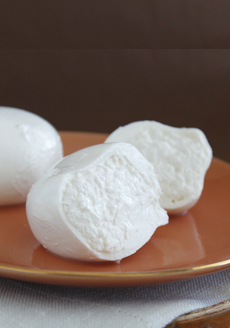
Cut into the ball of mozzarella, and creamy panna filled with mozzarella bits flows out. Photo by Elvira Kalviste | THE NIBBLE.
|
KAREN HOCHMAN is Editorial Director of THE NIBBLE.
|
|
October 2007
Last Updated October 2012
|
|
Burrata Cheese
A Ball Of Mozzarella Filled With Cream
CAPSULE REPORT: Burrata is a fresh Italian cheese, subtly creamy and luscious. It’s actually a ball of mozzarella filled with cream and pieces of mozzarella—when you cut into it, the cream oozes out. Made in the Apulia region of Italy and flown to the U.S., it is hard to find, and has a short shelf life. If you do find one, grab it, find some crusty bread and tomatoes, and head back for lunch, dinner or a snack.
Overview
Burrata is a specialty of the Apulia region of Italy (Apulia is the Latin name, Puglia is dialect) region, (the southeast coast of Italy), the “heel of the boot.” The area has long been known for agriculture and livestock; in the Murgia area where burrata originated, the economy has long been based on sheep farming and agriculture, including olives, fruits and vegetables.
Burrata, which means “buttery” in Italian, is a hollow ball of mozzarella di bufala (buffalo mozzarella) filled with panna, cream that contains scraps of mozzarella left over from mozzarella-making.* Cut into the ball and the cream oozes out. The cheese bits make the panna both buttery and creamy, although not overly rich, since this is still a fresh cheese.
What strikes one when purchasing a burrata is that it’s wrapped in a green leaf, the fronds of an Italian plant called asphodel, from the same plant order (but not the same family) as the leek.
These days, because it travels, the cheese also wrapped in a clear plastic bag to catch the natural liquid that drains from the cheese. The leaves are an indicator of freshness: As long as the leaves are still fresh and green, the cheese within is still fresh. Dried-out leaves mean a cheese is past its prime.
|
|
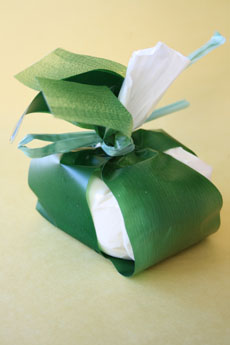
The leaves show the freshness of the cheese. Photo by Hannah Kaminsky | THE NIBBLE. |
*Small pieces of mozzarella curd are soaked in a bath of hot water and sea salt. The cheese is then cooked and stretched with a wooden spoon until the curds stretch to create a pouch. The pouch is filled with a combination of mascarpone cheese, ricotta cheese and heavy cream (some cheese makers use different recipes, but the result is always rich, oozing cream. Then the pouch is closed and ready to enjoy.
The History Of Burrata
We have no idea of the exact origin of most of our foods, from yogurt to bread. Historians deduce how they began, but there is no historic record. Even the origins of such American inventions as fudge and the brownie, which debuted as recently as the 1880s, are lost to history. But we do know who created burrata and when—about 40 years later.
While many cheeses date back hundreds and even thousands of years (Pecorino Romano was made by the Romans 2,000 years ago, Asiago by Cistercian monks in 1000 C.E.), burrata was first made around 1920 in the Murgian town of Andria, about two-thirds of the way up from the heel to the spur of Apulia. The Bianchini family made it on their farm. It was a local product, and remained the delight of the townspeople only, for thirty years.
In the 1950s, burrata became more widely available after a few of the local cheese factories began to produce it. It is believed that their interest rose because burrata represented a way to utilize the scraps of mozzarella (ritagli, or rags) that were being discarded. Burrata maintained its artisan status as a premium-product, even after it began to be made in a number of factories throughout Apuglia.
|
|
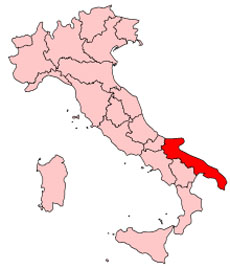
The Puglia region, highlighted on the map of Italy. Image courtesy Wikimedia. |
It is only in recent years that the cheese, still a rare delicacy outside of Apuglia, has been exported, thanks to more economical overnighting of refrigerated products.
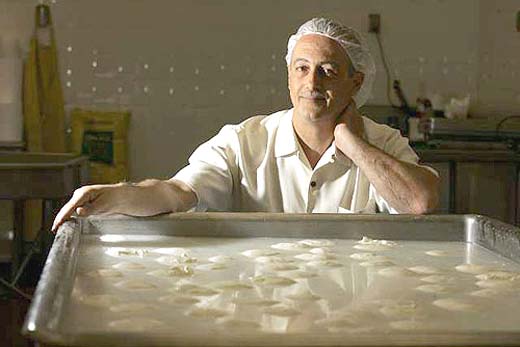 |
| Making burrata: The mozzarella will be shaped into pouches instead of traditional solid balls. Photo courtesy Wikimedia. |
Finding Burrata
Many people lament about the difficulty of finding a burrata. It is a challenge—true. This past summer, a burrata appeared on the cover of a major food magazine located in New York City.
- In New York, a turophile in-the-know can figure out where to hunt down a burrata or two, and a prominent food magazine editor should have no problem in having them sent over as soon as the plane lands.
- Check your local Trader Joe’s: A number of the stores carry a delectable burrata made in California.
For other cheese lovers, it can be more of a chore. There’s not much burrata made in the U.S.; what we get is flown in from Italy. It is then quickly sold, and what is bought must be eaten right away (ideally within 48 hours of manufacture). Given the logistics of flying it in, the demand and the very short shelf life, that’s why it’s so hard to find. Ask the best cheese stores in your town if they carry it. If not, you’ll probably have to order it online. See the shopping information below. You may want to go in with some friends and order more than one. Think of a small ball of mozzarella: One cheese lover with a good appetite could polish it off for lunch; two could split it.
Once you’ve found it, serve it at room temperature!
Serving Suggestions
Enjoy your prized burrata with someone special: It is a treasure to be shared. When you cut into it, the creamy center oozes onto the plate and begs to be spread on fresh, crusty bread or crostini only, or:
- With heirloom tomatoes, fine olive oil and fresh basil, as you would with regular mozzarella
- With a salad
- With prosciutto crudo (slices of prosciutto) and crusty bread
- On bruschetta or garlic toasts
- Atop pasta—penne, spaghetti, linguine or similar cuts
|
|
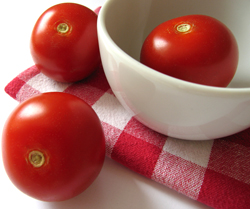
Delicious with burrata! Out of season, use sundried tomatoes in olive oil. Photo by Roswitha Schacht | MorgueFile. |
Buy Burrata Locally Or Online
If you can’t find burrata locally (we get ours at Trader Joe’s), here’s an easy solution: have it delivered from one of America’s leading online cheese stores.
|
|
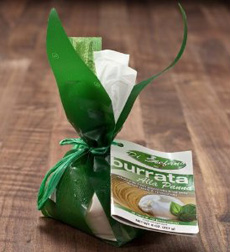
Burrata with its traditiona leaf wrapper. Photo courtesy DeStefanoCheese.com. |
Lifestyle Direct, Inc. All rights reserved. Images are the copyright of their respective owners.
|