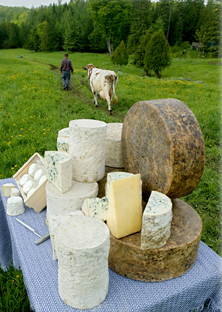
Wonderful wheels! Photo courtesy Jasper Hill Farm in Greensboro, Vermont.
May 2005
Last Updated January 2026
|
|
Cheese Glossary
Types Of Cheese, Terms & Definitions Every Cheese Lover Should Know
Page 1: Overview & Terms Beginning With A
Types Of Cheese Overview
Demystify the terms tossed out by cheesemongers and master the language and types of cheese. A read through our cheese terms and definitions, below, will give you new confidence the next time you approach a cheese counter. And you’ll discover new types of cheeses! If you’d like to suggest additional cheese definitions, click on the link. When you’re finished with cheese, you can look at our other food glossaries.
This is Page 1 of a 12-page glossary. You can go immediately to the glossary. But before you start, we’d like to point out why some cheeses are spelled with a capital letter, and others aren’t. It can appear to be capricious (or an error), but it isn’t.
-
When a cheese is named after a geographical place that is capitalized, e.g., the valley of Aosta and the towns of Cabrales and Roquefort, we capitalize the cheese.
-
Parmigiano means “of or from Parma,” and Reggiano means “of or from Reggio,” two cities in north central Italy; Parmigiano-Reggiano, a DOP-protected cheese that can only be made in these cities, is capitalized. We also capitalize Parmesan, an Americanization of the word Parmigiano (although “Parmesan” cheese does not indicate a D.O.C.-protected Parmigiano-Reggiano, and can be made anywhere in the world).
-
If the cheese name comprises nouns or adjectives that are normally not capitalized, e.g., fromage blanc (white cheese), formaggio al tartufo (truffle cheese), chèvre (goat), ricotta (“recooked”), or cream cheese, we don’t capitalize it.
-
We try to observe the accent marks appropriate to the language, but even here, there are challenges. For example, most American chevre producers don’t observe the accent mark on the French word, chèvre. When we are writing about chèvre in general, we will observe the accent; when we are writing about Cypress Grove Chevre, we will spell the word as they spell it, without the accent. And of course, proprietary-name cheeses like Cypress Grove’s Humboldt Fog are capitalized.
The history of cheese.
The year’s 30 cheese holidays.
Click on a letter to go to the appropriate glossary section:
a b c d e f g h i j k l m n o p q r s t u v w x y z
This glossary is protected by copyright and cannot be reproduced in whole or in part.
You are welcome to link to it.
ACID or ACIDIC
A term used to describe a cheese with a lightly sourish flavor.
AFFINAGE and AFFINEUR
|
The aging of cheese to its optimum maturity. Affinage is an expertise separate from cheesemaking. It is an analogous division of labor to the agriculturalist who grows the grapes and the winemaker who creates the wine. The affineur manages the cave* in which the cheeses are aged. Fine restaurants noted for their cheeses and which offer many different cheeses, like Picholine and Artisanal in New York City, have a full-time affineur to ensure the cheeses offered to diners are at peak development (“a point”) for their enjoyment.
|
|
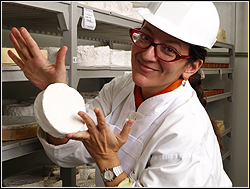
The late Daphne Zepos, one of the pioneers in American affinage. Photo courtesy Artisanal Cheese. |
___________
*In the industry, the French pronunciation, cahve, is used, not cayve. While some farmstead cheeses in Europe are aged in the same rock caves used 1,000 years ago to acquire the bacteria and other environmental elements that provide their distinctive qualities, today’s aging caves are state-of-the-art units that allow for different temperature zones and other settings that accommodate the needs of different types of cheese.
|
AGED CHEESE
Except for the fresh cheese group, all cheeses are aged, or ripened. The longer they are aged, the harder the paste becomes (that’s the main edible portion under the rind) and the more pronounced (sharp) the flavor. Some cheeses are made to age for two years or longer—Asiago, Cheddar, Gouda and Parmigiano-Reggiano, for example. Others age for just a few weeks to several months before they are ready to enjoy. See maturation.
ALPAGE
Refers to cheeses made from Alpine meadow milk.
|
|
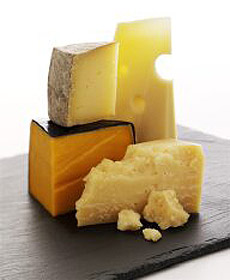
Aged cheeses: Gruyère, Emmenthaler, Grana Padano and Cheddar. Photo courtesy Wisconsin Milk Marketing Board. |
ALPINE CHEESE
Alpine cheese, also called mountain cheese, refers to a range of cheeses produced in the Swiss and French Alps. These cheeses are only produced in the summer months, using milk from cows that spend the summer on mountain pasture, enjoying the grass plus herbs that are unique to each region. The milk creates strong, aromatic cheeses, often made in large wheels. Cheeses include Appenzeller, Gruyère, Raclette, and Vacherin Mont-d’Or, among others. See also mountain cheese and Swiss cheese.
|
|
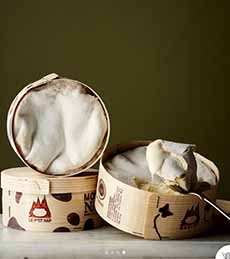
Most mountain cheeses are hard, hearty cheeses made in big wheels. Vacherin Mont d’Or is a more delicate treat (photo © Fine Cheese Co.). |
AMMONIATED
Certain cheeses past their prime and overripe, particularly soft cheeses such as Brie and Camembert, can smell and often taste of ammonia. They are still safe to eat.
ANNATTO or ACHIOTE
|
A natural food coloring derived from the ground seed pods of the achiote tree (Bixa orellana, also known as the Lipstick Tree), native to Central and South America. The seeds are lightly peppery with a hint of nutmeg. Cheese is naturally the color of the milk from which it is made. Some traditional cheeses once had a natural orange hue caused by the vitamin D that cows ingested from grazing on green plants. But commercial cheeses are made from milk from cows that aren’t permitted to graze. Even with fine cheese, winter milk comes from cows that are fed silage (forage plants that are stored in a silo); the cheeses that result from this milk are white. This variation persuaded some cheesemakers to color their cheeses so they would look uniformly nutritious.
|
|
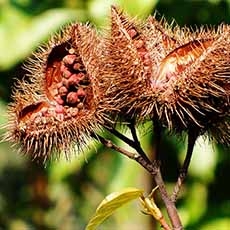
Annatto seeds, also called achiote, named for the achiote tree on which they grow (photo courtesy Wikipedia).
|
The earliest cheese colorings were carrot juice and marigold petals. For the last century at least, cheesemakers who wish to use color have used annatto instead. It is used in cheeses such as Brie and Cheddar, in butter and margarine, and in custard powder (and has numerous non-dairy applications, such as smoked fish). While annatto adds a slightly sweet and peppery flavor to recipes, it does not impact the flavor of the cheese.
AOC (APPELLATION d’ORIGINE CONTRÔLÉE)
|
Controlled designation of origin, the AOC mark guarantees, among other things, that the cheese originates from a specific region of France and has been produced in a traditional way. There are 35 types of cheese carrying the AOC mark, which guarantees that: (1) The cheese was produced within a specific geographical area, from milk from specific herds of animals in the same area, and partly matured there. (2) The cheese was made using strictly defined methods that have been handed down over several centuries. (3) The characteristics of the cheese that have been precisely defined—its size, type of rind, texture, and minimum fat content—are adhered to strictly. (4) The producers submit themselves to review by a public control commission, which guarantees the authenticity and quality of the products. See also D.O. and D.O.P.
|
|
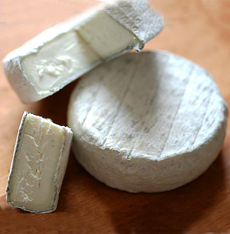
Selles-sur-Cher was the first chèvre to be designated AOC in 1975. It is made of raw goat’s milk. Photo courtesy ArtisanalCheese.com. |
À POINT
Pronounced ah-PWAN in French, à point refers to a cheese that is at the peak (the “point”) of its development, at the perfect stage to be consumed. The cheese is generally aged by an affineur to bring out the finest characteristics in color and texture, as well as the all-important taste. In English, say “at peak” instead of “at point.”
AROMA
This term refers to a cheese’s scent, which can vary from faint and milky (fresh cheeses), to lightly aromatic to pungent and overpowering. While most strong-smelling cheeses will also be strong-tasting, this is not a hard and fast rule: Limburger, Brick, and Liederkranz have distinctive aromas, but are not overly strong-tasting cheeses unless well-aged.
AROMATIC
Another word for a washed rind cheese, such as Epoisses, Livarot, and Munster. See washed rind cheese.
|
|
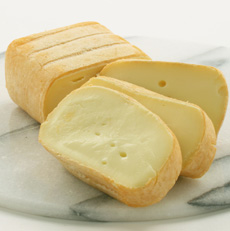
Limberger may be the most famous “stinky” cheese because of the old TV series, Spanky And Our Gang, where the kids hated the aroma. This washed rind cheese, or aromatic, was originally created by Belgian Trappist monks. It originated in the historical Duchy of Limburg, which is now divided between modern-day Belgium, Germany, and the Netherlands. In the 1880s, New Yorker Emil Frey copied the recipe for Limburger and created Liederkranz. This pasteurized cow’s milk cheese has a tangy, creamy, Brie-like flavor with an incredibly pungent aroma. Photo courtesy iGourmet.com. |
ARTISAN CHEESE
Artisan cheese refers to cheese that is produced in small batches, with particular attention paid to the traditional cheesemaker’s art. As little mechanization as possible is used in the production of the cheese. Artisan cheeses may be made from any type of milk; flavorings and inclusions (nuts, fruits, herbs, flowers, etc.) may be added. See also farmstead cheese for the difference between artisan cheese and farmstead cheese.
ASH COVERED
After they are molded into shape, some goat cheeses are dusted with a fine powder of charcoal ash, traditionally from oak but today often vegetable ash. These are known as ash-covered goat cheeses (or chèvres). Originally, the ash was used to protect the delicate cheeses during transport. While some people think it is now decorative in these days of modern transportation and refrigeration, the ash actually makes the cheese ripen more quickly. With the Valençay goat cheese at the right, the ash-covered variety is a bit creamier than the plain cheese of the exact same age; in general, the cheese gets creamier with age.
|
|
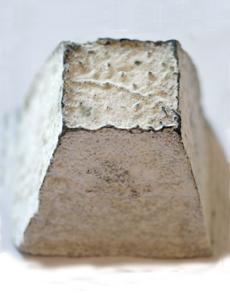
Valençay, named after a town in France’s Loire Valley where it is made, is shaped like a pyramid with the top cut off (in fact, it is sometimes called Pyramide). This classic French chèvre is available plain or coated with wood ash (photo © Artisanal Cheese). |
ASIAGO
|
One of the most common Italian cheeses, Asiago, is a grana-type cheese made from cow’s milk. It is a sweet curd, semi-cooked cheese in the grana group, a group that also includes Grana Padano and Parmigiano Romano. (Grana is the Italian word for grain; it refers to a coarse-grained cheese.) Typically pale yellow in color, Asiago has a mild, cheddary, nutty flavor; it gets more flavorful and more crumbly as it ages. See a comparison of Asiago, Grana Padano, and Parmigiano-Reggiano.
|
|
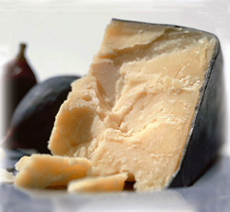
Asiago cheese with figs. Photo courtesy Wisconsin Milk Marketing Board. |
Continue To Page 2: Cheese Terms Beginning With B
Go To The Article Index Above
Thanks to Artisanal Cheese, iGourmet, Murray’s Cheese Shop, Wisconsin Milk Marketing Board, and other experts who contributed their expertise to this glossary.
Lifestyle Direct, Inc. All rights reserved. Some material copyright Murray’s Cheese. Images are the copyright of their respective owners.
|