May 2005
Last Updated October 2025
|
|
Cheese Glossary
Types Of Cheese, Terms & Definitions Every Cheese Lover Should Know
Page 6: Cheese Terms Beginning With H To L
This is Page 6 of a 12-page glossary. Click on the letters below to find terms of interest. When you’re finished with cheese, visit our 60+ other food glossaries.
Click on a letter to go to the appropriate glossary page.
a b c d e f g h i j k l m n o p q r s t u v w x y z
This glossary is protected by copyright and cannot be reproduced in whole or in part.
HALLOUMI
Halloumi, from Cyprus, is mostly a pasteurized sheep’s milk with up to 20% goat’s milk added. It has been called “the grilling cheese” for its ability to resist melting at high temperatures. Instead, it browns beautifully and resembles grilled chicken or tofu. It is also served in salads and sandwiches. Halloumi’s springy, meaty texture (like mozzarella) is achieved by two rounds of cooking the curd. Try it pan-seared with eggs and toast for a Cyprian breakfast, or jazz up kabob night by cubing and skewering.
Here’s the history of halloumi cheese, plus recipes and 11 more types of cheese that don’t melt.
|
|
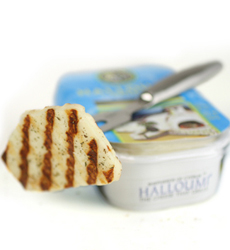
Halloumi, “the grilling cheese,” is available at iGourmet.com. |
HÂLOIR
The cheese drying room, where cheeses are laid out during their maturation period. Some cheeses age for just a few weeks, others age for 24 months or longer.
|
|
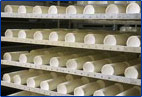
A cheese drying room, or hâloir. Photo courtesy of FromagesdeChevre.com. |
HARD CHEESE or HARD PASTE CHEESE
|
Also known as firm cheese. These have a dry, granular paste and are the hardest of all cheeses, solid and heavy. Hard cheeses are typically aged for more than two years, during which the water and moisture evaporate to make the paste hard (to be classified as a hard cheese, the water content must be less than 40%). Hard-paste cheeses vary tremendously: They can be pungent, sharp, aromatic, or piquant; cooked, semi-cooked, or uncooked; and range in color from stark white to deep yellow, orange, or brown.
|
|
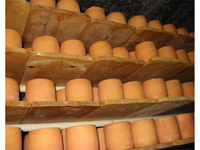
Tête de Moine cheeses aging. |
The cheeses are covered with a very hard rind, which solidifies as they age. Examples include Asiago, Manchego, Mimolette, Parmesan (Parmigiano-Reggiano), pecorino, Romano, and tête de moine (shown at right).
HAVARTI or CREAM HAVARTI
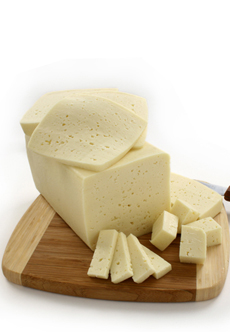
A Danish cow’s milk cheese, Havarti is a semisoft, washed curd cheese, interior-ripened and rindless, with small eyes (see photo at top of page). It is popular as a table cheese, a melting cheese, and a sandwich cheese. Havarti was created by Hanne Nielsen, who operated an experimental farm called Havarthigaard in the mid-19th century. The cheese has a buttery aroma and flavor; as the cheese ages, it becomes saltier and nuttier. Havarti can be found in a variety of flavors (caraway, cranberry, dill, garlic, and more). It pairs well with Chardonnay, Sauvignon Blanc, and light-bodied Pinot Noir. See also Tilsit.
|
|
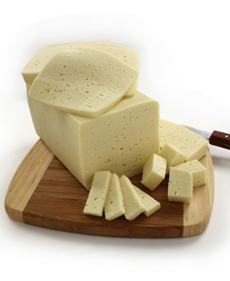
Havarti is a great melter and a wonderful sandwich cheese. You can buy it at iGourmet.com. |
HOLES or EYES
The openings in the body of Swiss-type cheeses, such as Emmentaler and Gruyère. The holes are spherical, equally spaced, and about the size of cherry pits. They are caused by bacterial activity, which generates propionic acid, causing gas to expand within the curd and create pockets or holes. See Swiss cheese.
HOMOGENIZATION
Milk that comes straight from the cow will separate into a cream layer at the top. In the old days, cooks would get cream for recipes or tea by skimming it off the top of the milk. The development of homogenization enabled milk and cream to be sold separately and also gave a longer shelf life to the product. The process is simply the emulsifying of the fat globules in milk into a suspended form by spraying the milk at very high pressure against a flat surface. Homogenized milk denatures many of the necessary proteins, making for inconsistent curd development.
JACK CHEESE
See Monterey Jack.
|
|
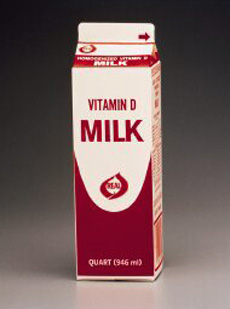
Homogenization keeps the milk supply safe, although it removes tasty bacteria and enzymes along with any harmful bacteria. Photo courtesy WisDairy.com. |
KASSERI CHEESE
In Greece, simple unpasteurized sheep’s milk cheeses (sometimes with a small amount of goat’s milk mixed in) are called kasseri. They are made in large wheels; the fairly firm cheese is pale yellow. The word comes from the Turkish kasar. Because of its ability to hold its shape when heated, Kasseri is often prepared grilled or fried. See also halloumi.
|
|
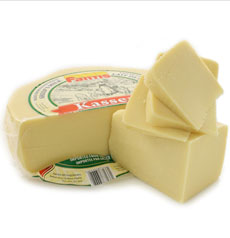
Kasseri holds its shape when grilled or fried. You can buy it at iGourmet.com. |
LABNEH or LABNÉ or YOGURT CHEESE
Labneh (pronounced LOB-nay or LOB-neh) is the Lebanese version of cream cheese: yogurt cream cheese. It isn’t made with vegetable gum and is shaped into a brick-like American cream cheese. Rather, it’s thicker than yogurt and comes in a container the size of a large yogurt. Labné is packed with live cultures (beneficial bacteria), calcium, and protein. The flavor is refreshing and slightly tart. The cheese is popular throughout the Eastern Mediterranean and the Middle East. In Lebanon, labneh is most commonly served as a staple of the breakfast table. In the U.S., it is more often used as a dip for veggies, pita, or crusty bread. Here are more ways to use labneh.
|
|
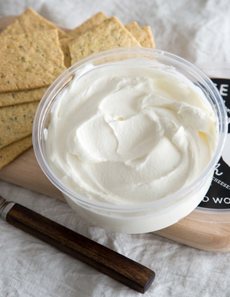
Labneh is actually a cheese that can be spread or used like yogurt. Photo courtesy Good Eggs. |
LACTIC
Referring to the milk aroma and sometimes the flavor of some cheeses.
LACTIC CHEESE
A lactic cheese is a type of cheese where the curds are formed primarily through the process of lactic acid fermentation. The bacteria in the milk convert the lactose (milk sugar) into lactic acid, causing the milk proteins to clump together and form a curd. Minimal to no rennet is added. The result is a soft, often fresh cheese with a mild, slightly sour flavor.
LACTIC FERMENTING AGENT
Bacteria that encourage the coagulation of milk by fermenting the lactose in the milk into lactic acid. See starter culture.
LACTOSE INTOLERANCE
An inability to easily digest lactose, or milk sugar, in cow’s milk. Many cheeses, particularly aged cheeses such as Cheddar and Swiss, contain little or no lactose, as well as sheep, goat, and buffalo milk cheeses. Cheese lovers who have difficulty digesting lactose should try these alternatives.
LIGHTLY PRESSED CHEESE
These cheeses are pressed and uncooked, as opposed to the pressed cheese group, in which the curd is cooked and then pressed. One of the largest groups of cheeses, the paste of a lightly pressed cheese is usually semi-firm to firm. While the number of different cheeses in this category is large, the most common form of lightly pressed cheese is the ever-popular and versatile Cheddar. The next time you have an opportunity, compare Cheddar to Emmenthaler or Gruyère, two popular cheeses whose curds have been cooked. While they will seem related, look for the cooked milk aroma in the latter two. Examples include Cantal, Cheddar, and Salers. See the descriptive terms for lightly pressed cheeses. See also pressed cheese.
|
|
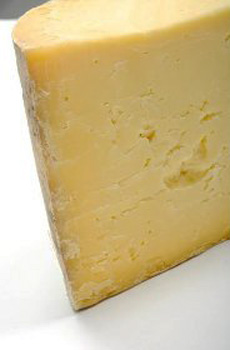
Cantal. Photo courtesy of ForTheGourmet.com. |
LIMBURGER CHEESE
Limburger is a cow’s milk cheese that originated in Belgium in the 19th century, created by Trappist Monks from the province of Luttick, in the historical region of Limburg. It was brought to Germany, where it became extremely popular and began to be produced there (today the Belgians regard it as a German cheese). While the cheese is soft and creamy, it has an incredibly strong, pungent aroma that makes it one of the world’s most odoriferous cheeses (the smell is frequently compared to sweaty feet or gym socks). Yet, the flavor is somewhat mild, tangy, and slightly salty with a rich, buttery texture.
The cheese is aged for 2-3 months, during which bacteria on the surface (Brevibacterium linens) create both the distinctive smell and the soft, spreadable texture. The odor is all in the rind, which is inedible.
|
|

Limburger (photo © New England Cheesemaking Supply Co.) |
B. linens is essential for developing the cheese’s full flavor profile and creamy texture, as well as its characteristic appearance and aroma. Without it, the cheese would be a completely different, much blander product.
Limburger was once the working man’s lunch in the U.S., served on dark bread with sliced onion, mustard, and a beer—the American version of the British ploughman’s lunch.
Limburger came to the U.S. with German immigrants in the 19th century. Wisconsin became a major producer of Limburger cheese in America, though production has declined significantly over the decades, and dropped two-thirds between 1950 and 1960. By the early 1980s, there was only one producer left, The Chalet Cheese Cooperative in Monroe, Wisconsin (still there!).
Here’s more about Limburger.
Continue To Page 7: Terms Beginning With M & N
Go To The Article Index Above
Lifestyle Direct, Inc. All rights reserved. Some material copyright Murray’s Cheese. Images are the copyright of their respective owners.
|