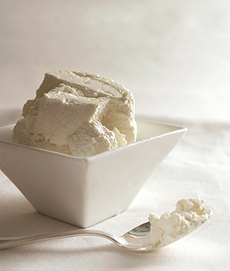
Ricotta is a fresh cheese; it is meant to be consumed within a week of production. Photo courtesy of CaviarRusse.com.
May 2005
Last Updated January 2016
|
|
|
Cheese Glossary
Types Of Cheese, Terms & Definitions Every Cheese Lover Should Know
Page 9: Cheese Terms Beginning With Q & R
This is Page 9 of a 12-page glossary, including such famous cheeses as ricotta and Roquefort. Click on the letters below to find terms of interest. When you’re finished with cheese, visit our many other food glossaries.
Click on a letter to go to the appropriate glossary page.
a b c d e f g h i j k l m n o p q r s t u v w x y z
This glossary is protected by copyright and cannot be reproduced in whole or part.
You are welcome to link to it.
|
|
QUARK
Quark is a soft, unripened (fresh) cow’s milk cheese with a consistency and flavor similar to triple-strained Greek yogurt. It has approximately the same amount of calories, but a richer flavor, than lowfat sour cream. Quark is the German word for curds; curds are coagulated milk. Some definitions translate it as “cottage cheese”; however, American and German quark do not resemble what Americans known as cottage cheese, which has recognizable curds. As the curd for each type of cheese is a different shape, size and texture (the curd for Gouda is much different than the curd Cheddar or that for cottage cheese, for example), with quark, the curd consistency is smooth, like curdled milk. Quark, which is produced all over Central Europe, is whipped before packaging. In the U.S. it is made by a handful of artisan dairies and can be found in whole milk, 2% and fat-free versions.
|
|
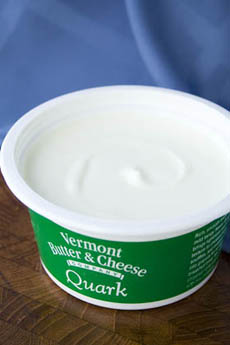
Quark from Vermont Creamery. Read our full review. |
Quark can be eaten like yogurt, plain or blended with fruit or jam; in Germany it is mixed with chives as a bread spread. It is also a common ingredient in filled pastries, savory and sweet sauces, spreads, soufflés, cheesecakes and mousses. Quark is so popular in Germany that it accounts for almost half of that country’s total cheese production—the average German eats about 10 pounds of quark a year. If you’re confused because quark seems similar to fromage blanc, the two are virtually identical. In different parts of Europe, quark is also known as koarg, kwark, qwark, quarg, twarog, saurmilchquark, speisequark and fromage frais.
RAREBIT or RABBIT
Welsh rabbit (“rarebit” is a misspelling) is a very old cheese sauce recipe, served atop toast. The story of how Welsh rabbit got its name is lost to history, but the most logical explanation is that sharp cheese melted into ale or beer, served over crisp toast, was a substitute for meat when the men had an unsuccessful day of hunting. It was left to the women to fix a meal, so perhaps a clever woman came up with the name.
RAW MILK CHEESES
“Raw milk” refers to cheeses made from unpasteurized milk, meaning that the milk has not been heated more than 100°F (40°C). Below this heat threshold, hundreds of varieties of beneficial bacteria remain alive, interacting with the milk to provide more complexity and depth of flavor to the cheese. Due to rare but potential illness from unpasteurized milk, the FDA restricts the distribution of raw (unpasteurized) milk cheeses aged less than 60 days. Recently, North American producers have seized the opportunity to create vibrant, nuanced and remarkable Raw Milk Cheeses.
|
Pasteurization kills many of the natural enzymes and good bacteria in the milk which create flavor complexity, which is why many connoisseurs prefer raw milk (unpasteurized) cheeses. However, despite modern sanitation, raw milk may still harbor a host of disease-causing organisms (pathogens), including listeria and salmonella. A small number Americans become ill each year from raw milk-related causes (and in the past, there have been periodic related fatalities in Europe). Thus, the sale of raw milk cheeses is not allowed in the U.S., except those which have been aged 60 days or longer.
|
|
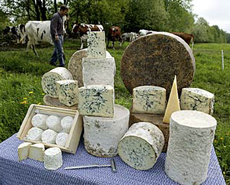
Jasper Hill Farm’s raw milk cheeses are aged 60 days or more, enabling them to be sold in the U.S. |
Many small farmers feel that fresh milk from healthy animals, handled in a responsible manner and used immediately, does not require pasteurization. They drink their own milk raw, because it is far more flavorful, as do their customers, who purchase it at the farm (while it is not legal to distribute raw milk in the U.S., it is possible to purchase raw milk if you bring your own container to the dairy). The decision to drink raw milk or eat raw milk cheese is a personal one, analogous to eating any potentially microbe-carrying raw food, like sushi or steak tartare.
RENNET
|
Rennet is a coagulating enzyme that is added to milk as the first step in making cheese. Used to curdle milk, it causes clumps (curds) to form and separate from the liquid (whey). Rennet is added after the cultures and is also integral to the final flavor of the cheese, including the release of peptides, which play an important role in cheese maturation. The traditional source of rennet is the abomasum (fourth stomach or rennet stomach) of slaughtered, milk-fed new-born calves or other young ruminants. It is also possible to produce rennet from fungi (known as microbial rennet).
|
|
The traditional source of rennet, calf stomachs, has been largely replaced by rennet made from modified yeast or bacteria. |
|
Today, most commercial rennet is made from genetically modified yeast or bacteria, allowing the production of cheese that is considered vegetarian. This rennet is both less expensive and thought to yield greater consistency in cheese quality than traditional animal rennet.
|
rBST or rBGH
Recombinant bovine somatotropin (rBST), also called rBGH (recombinant bovine growth hormone), is a growth hormone used to increase milk production in cows. It has been sold in the United States since 1994 and is controversial because it can cause health problems in cows. According to a 2002 survey by the Department of Agriculture, rBST is used in 22% of the nation’s dairy cows. Many health-conscious consumers prefer not to consume dairy products from rBST-treated cows. Currently there is no test that can distinguish between milk from rBST-treated and untreated cows. Controlling the source of the milk is the key to guaranteeing that dairy products are rBST-free. Farmers who do not treat their herds generally label their products ”rBST-free.”
|
RICOTTA
Actually not a cheese but a by-product of cheese-making. With many cheeses, an enzyme, rennet, is used to coagulate the milk, but the whey proteins (albuminous proteins) don’t coagulate. This milky-colored whey is drained and then heated a second time and curdled with vinegar; ricotta is produced from the curds that precipitate from those proteins. Ricotta means “re-cooked,” referring to the second boiling of the milk. Read more about ricotta.
|
|
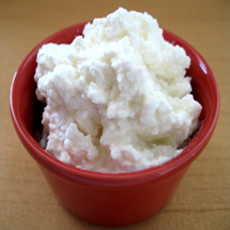
Ricotta from Mozzarella Fresca, a NIBBLE Top Pick Of The Week. Photo by Claire Freierman | THE NIBBLE. |
|
RICOTTA SALATA
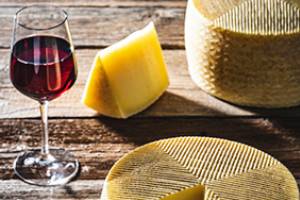
Unlike fresh ricotta, which is made from whey, ricotta salata is firm, rindless cheese made from lightly salted sheep's milk curd that is pressed and dried, then aged for a minimum of three months. Salata means salted in Italian. The cheese is neither salty nor “sheepy,” but has a nutty, sweet milky flavor. Ricotta salata is used as a table cheese, added to salads (try it instead of goat cheese with beet salad or arugula salad) and cooked in, or grated onto, pasta dishes. Ricotta salata originated in Sicily. It can be found in wheels, as shown at right, or in individual flat-top cones.
|
|
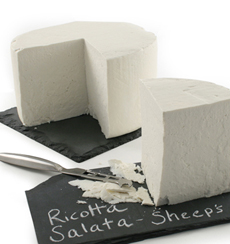
Ricotta salata. Photo courtesy iGourmet. |
RIND
The protective external surface of a cheese. Rinds can be natural or artificially created, thick or thin, hard or soft, washed, oiled, brushed or paraffinned. Its prime role is to protect the cheese’s interior and allow it to ripen and develop harmoniously. Its presence affects the final flavor of the interior of the cheese.
RIPENING
|
Except for fresh cheeses, the majority of cheeses are ripened in a ripening cellar or special storage room. Cheesemakers often put their cheeses in a drying room to speed up the maturation. The ripening cellar may be humid and warm or relatively cool: temperature, humidity, and the natural movement of air are all critical to the ripening process. While temperatures can range from 32°F to 77°F, most cheeses are ripened between 46°F and 60°F with very high humidity—often close to 100%. During maturation, the cheese dispels liquids; and flavor components develop more complexity. Some cheeses get washed every two to three days to inspire surface bacteria; some grow molds on the outside; others, like cloth-bound cheeses, simply get turned and wiped down every few days.
|
|
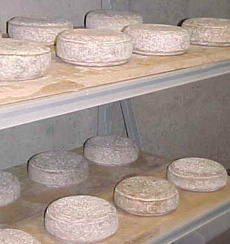
Cheeses ripening at Farmersville Cheeses in New Jersey. |
ROMANO
|
Pecorino Romano is a hard, salty, full-flavored Italian cheese made from sheep’s milk (pecora is the Italian word for sheep). An ancient cheese, Pecorino Romano was a dietary staple for the Roman legionaries. Today’s Pecorino Romano is made from the same recipe, albeit with pasteurized milk. “Romano,” on the other hand, is a mild, domestic cow’s milk cheese made in the U.S. Don’t substitute it for Pecorino Romano or your recipe will be more bland and under-salted.
|
|
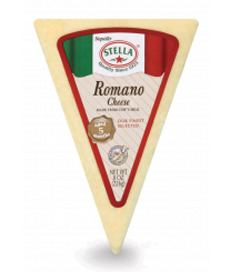
Romano is not the same as the stronger, saltier Pecorino Romano. Photo courtesy Stella. |
ROQUEFORT
|
Roquefort is perhaps the world’s most famous blue cheese. It is made from Lacaune-breed sheep’s milk and is France’s second most popular cheese after Comté (out of 500 different cheeses made in France). It does not have a rind. The mold Penicillium roqueforti, grown on rye bread, is injected into the cheese to create the blue veins. In 1925 Roquefort was the first cheese to become A.O.C.-protected: Only those cheeses aged in the natural Cambalou caves of Roquefort-sur-Soulzon in the department of Aveyron may be called Roquefort. A cheese like Roquefort is mentioned by Pliny the Elder in 79 C.E. In 1782, the French philosopher Diderot called it the “King of Cheeses,” declaring that “Roquefort cheese is without doubt the finest cheese in Europe.”
|
|
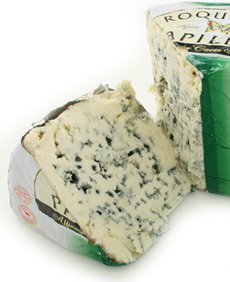
Roquefort is made from sheep’s milk in the caves of Combalou in southern France. It is one of the oldest-known cheeses. Photo courtesy iGourmet. |
The legend of Roquefort is that a cheesemaker inadvertently left a piece of rye bread in the cave. When he returned, the mold that had grown on the bread had attached itself to the nearby cheese. Serve Roquefort with nut or raisin bread, figs, walnuts and apples. The perfect accompaniment is a sweet white wine. It is delicious in recipes, tossed with pasta and salad and made into sauces.
Continue To Page 10: Terms Beginning With S
Go To The Article Index Above
Lifestyle Direct, Inc. All rights reserved. Some material copyright Murray’s Cheese. Images are the copyright of their respective owners.
|