May 2005
Last Updated October 2025
|
|
Types Of Cheese
Cheese Glossary Page 10: Cheese Terms Beginning With S
This is Page 10 of a 12-page glossary of the types of cheese. Click on the letters below to find terms of interest. When you’re finished with cheese, visit our other food glossaries.
Click on a letter to get to the appropriate glossary page.
a b c d e f g h i j k l m n o p q r s t u v w x y z
This glossary is protected by copyright and cannot be reproduced in whole or in part.
You are welcome to link to it.
|
SEMI-HARD CHEESE
Semi-hard is a classification of cheese based on the paste (body) of the cheese. The descriptions semi-hard and hard refer mainly to moisture content, not to texture. The cheeses in this category actually include a broad range of textures, from semi-firm to very firm and from cheeses that are only weeks old to those aged up to several months or more. Because these cheeses contain less moisture than the soft and soft-ripened types, they hold their shape much better.
Examples include young Asiago, Cheddar, Colby, Edam, Emmentaler, Fontina, Fontinella, aged Gouda, Gruyère, Havarti, Manchego, provolone, Taleggio, and queso blanco. The difference between semi-hard and semi-soft cheese is one of moisture: Semi-soft cheese contains more than 45% water, while semi-hard cheeses contain 30% to 45%. A cheese can start as semi-soft, then move to semi-hard via aging, which evaporates the moisture.
Hard cheeses, in comparison, typically contain less than 40% moisture (or conversely, more than 60% solids). The hardest cheeses, sometimes called extra-hard or grating cheeses, can have as little as 25-35% moisture. Examples include the Italian grating cheeses (aged Asiago, Grana Padano, Parmigiano-Reggiano, and Pecorino Romano), aged Manchego (Spain), aged Gruyère (France and Switzerland), and certain Swiss mountain cheeses (Emmentaler, Gruyère/Greyerzer, Sapsago, and Vacherin Fribourgeois, with Sbrinz an extra-hard cheese).
|
|
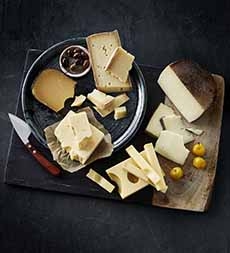
Semi-hard cheeses (photo © Castello Cheese).
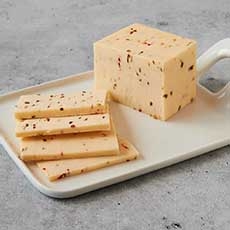
Monterey Jack (in photo, pepperjack) is a classic American semi-hard cheese (photo © Dairy Farmers of Wisconsin). |
|
SEMI-SOFT CHEESE
Semi-soft cheeses include Asadero, brick, Butter Käse, some crottins, Edam, some Fontina, Gorgonzola, young Gouda, Havarti, Limburger, some Monterey Jack, Muenster, young Provolone, Teleme, some Tilsit, and Roquefort. Both semi-hard and semi-soft cheeses can also belong to other categories; for example, Bloomy Rind cheese or Surface Ripened cheese.
SHARP
Sharp is a descriptive flavor term, referring to the fully developed flavor of aged cheeses, such as traditional Cheddar and Parmigiano-Reggiano. The flavor is actually sharp and biting, but not excessively so. The more the cheese is aged, the sharper the flavor becomes.
|
|
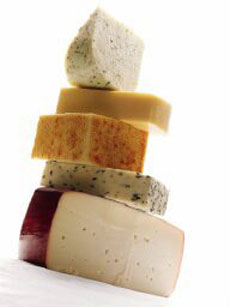
Semi-soft cheeses (photo © Wisconsin Dairy Farmers). |
|
SHEEP’S MILK CHEESE
Sheep produce less milk by volume than cows or goats, accounting for the higher price of sheep cheese. Many sheep’s milk cheeses are formed into mid-size (five-pound) wheels. Examples include Pecorino Toscano from Tuscany, Agour Ossau-Iraty from the French Pyrenees, and Manchego from Spain. Milked twice a day, sheep produce one quart of milk, goats produce 3-5 quarts of milk, and cows produce 8-20 quarts per day. Also, see cow’s milk, goat’s milk, and water buffalo’s milk.
|
|
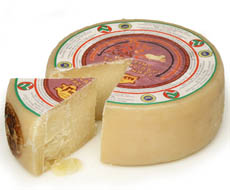
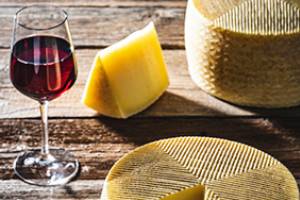
Pecorino Toscano, a sheep’s milk cheese from Tuscany (photo © iGourmet). |
Sheep produce less milk by volume than goats or cows. Many sheep’s milk cheeses are formed into wheels in the middle of the size spectrum, such as Abbay du Belloc, Pecorino Ginepro, and Vermont Shepherd. In general, sheep’s milk is sweet and nutty and has a distinct flavor often described as woolly. Sheep’s milk has a higher fat content than either cow’s or goat’s milk. More about sheep cheeses.
SILAGE
Silage is grass or other green fodder that is compacted and stored airtight in a silo, without first being dried (like hay). It is used as animal feed in the winter for animals that typically graze on grass in the warmer months.
SILKY or SATINY
These texture descriptors refer to the mouthfeel of soft cheeses. They can be spreadable or sliced cheeses, like a ripe Brie or Camembert.
SKIMMING
The removal of fat content from the milk. When part or all of the cream has been removed from the milk, the milk is referred to as skimmed (although the more popular consumer term is now fat-free). Cheeses made from skimmed milk generally have less fat; some (but not all) remain quite flavorful. Skimmed milk cheeses have less than 20% fat, semi-fat cheeses have 20% to 41% fat, and whole milk fat cheeses have 42% or more fat content.
SOFT-FRESH CHEESE
Also called fresh cheese, this category of cheeses has high moisture content and is typically direct-set with the addition of lactic acid cultures. Cheeses in this category include cottage cheese, cream cheese, feta, mascarpone, Neufchâtel, ricotta, and queso blanco. These cheeses must be consumed quickly; they are not made to age. Note that neufchâtel, with a lowercase “n,” refers to the American cheese by that name. The French version is capitalized because it is a proper name, the Neufchâtel-en-Bray region of Normandy, where the cheese is made.
| SOFT-RIPENED CHEESE or SEMI-SOFT CHEESE
Also known as bloomy rind cheeses, these cheeses become softer and creamier as they age. The rind is edible and is produced by spraying the surface of the cheese with Penicillium candidum. Other soft cheeses may have a reddish washed rind or no rind. All cheeses in this category have a high moisture content. Mild when young, they usually develop a fuller, more mature flavor as they age.
|
|
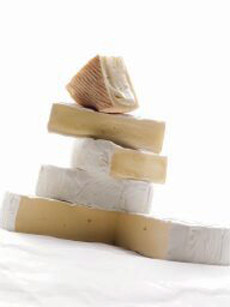
Soft-ripened cheeses (photo © Wisconsin Dairy Farmers). |
|
SMOKED CHEESE
Cheeses can be placed in a smoker to add a layer of smoked flavor. Examples include Gouda, Idiazabal, a handmade, unpasteurized sheep's milk cheese from the Spanish Pyrenees, and Rauchkäse, a smoked cheese from Bavaria. Any cheese can be smoked—from fresh cheese like mozzarella to Cheddar or blue cheese. One of our favorite smoked cheeses is Rogue Creamery’s Smokey Blue, a smoked version of its Oregon Blue (photo below).
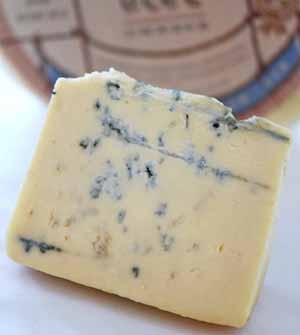
Yes, it’s smoked and it’s fantastic (photo © Rogue Creamery).
|
|
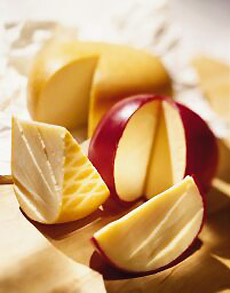
Regular Gouda (red wax)and smoked Gouda (photo © Wisconsin Dairy Farmers).
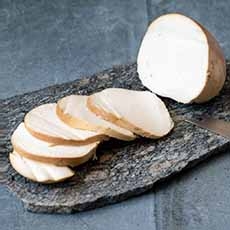
One of our favorites, smoked mozzarella (photo © Murrays Cheese).
|
STARTER CULTURE
Also called a “friendly” culture, starter cultures are added to milk at the start of the cheesemaking process. The cultures change the lactose or milk sugar, the carbohydrate in milk, into lactic acid. This equalizes the pH so the milk protein will form curds when the rennet is added. The cultures used by the cheesemaker are a closely guarded secret as they contribute to the distinct qualities of each cheese.
STRACCHINO or CRESCENZA
| Stracchino (strah-KEE-no), also called crescenza (creh-SEN-za), is a type of Italian milk cheese, about 50% milkfat, found in the Italian region of Lombardy. In general, crescenza is made from whole cow’s milk or semi-skimmed milk and is aged for 1 week, while Stracchino is made only from whole milk and is aged for 20 days. Eaten very young (i.e., minimally aged), it has a soft, creamy texture and a mild and delicate flavor—not unlike American cream cheese, but slightly more acidic. It is sold in a square or rectangular form. Stracchino can be used on pizza, in risotto, on focaccia, baked, or drizzled with honey for dessert. The name derives from the Italian word stracca, which means “tired.” The belief is that the milk from tired cows is richer in fats and more acidic; according to legend, these qualities were discovered in the milk of “tired” cows that were moved up and down the Alps to different pastures. |
> |
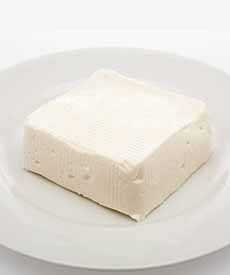 Stracchino cheese (photo © Sensibus). Stracchino cheese (photo © Sensibus).
|
|
STRING CHEESE
String cheese is a snack cheese, typically made from low-moisture mozzarella and formed into cylindrical sticks. The sticks are packaged individually for lunchboxes and grab-and-go snacks. Each cylinder can be peeled into thin, stringy strips. The stringiness comes from the mozzarella-making process. The cheese curds are heated and stretched (the pasta filata technique that aligns the protein strands in parallel. When the cheese is pulled apart lengthwise, it separates along these protein fibers, creating the strings.
While based on the Italian mozzarella technique, string cheese was invented around 1976 by Frank Baker of Baker Cheese, a Wisconsin cheese maker. The concept of low-moisture mozzarella had already been developed in the U.S. for better shelf life and pizza-making.
Baker’s additional innovation was to make individual sticks, specifically designed to be peeled into strings for fun. This became a snack food phenomenon, especially for kids' lunchboxes.
It’s also an easy way to make fried mozzarella sticks.
September 20th is National String Cheese Day.
|
|
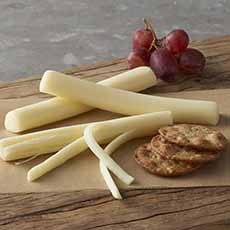
Semi-hard cheeses (photo ©Castello Cheese).
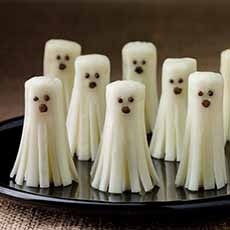
String cheese was made for fun (photo © Burnett Dairy | Facebook). |
STRONG
A cheese with a penetrating aroma and flavor.
|
SUPPLE
A descriptive term describing a cheese’s texture, e.g., firm but not hard; pliable and resilient. Fontina is an example.
SURFACE RIPENED
A cheese that ripens from the exterior when a special bacteria, mold, or yeast is applied to the surface. Bloomy-rind cheeses, like Brie and Camembert, and washed-rind cheeses, such as Pont L’Eveque and Taleggio, are surface-ripened.
|
|
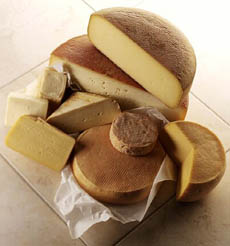
Surface-ripened cheeses (photo © Wisconsin Dairy Farmers). |
SWISS
|
Swiss cheese is the generic name used in the United States for several related varieties of cheese originally made in Switzerland. Emmentaler is the cheese Americans think of as the generic Swiss cheese. While Americans believe that Swiss cheese has holes, properly known as eyes, not all kinds of Swiss cheese do.* There are 450 known Swiss cheeses, classified into five categories: extra-hard, hard, semi-hard, semi-soft, and soft. Cow’s milk is used in 99% of the cheeses produced. The categories of Swiss cheese include:
|
|
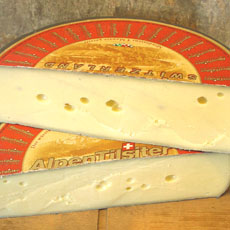
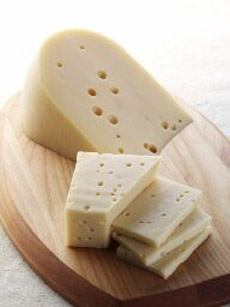
Tilsiter is a semi-hard Swiss cheese (photo © iGourmet). |
- Extra-Hard: Sbrinz
- Hard: Emmentaler (or Emmenthaler or Emmental), Gruyère/Greyerzer, Sapsago, Vacherin Fribourgeois
- Semi-Hard: Appenzeller, Bündner Bergkäse, Mutschli, Raclette cheese, Tête de Moine, Tilsiter
- Semi-Soft: Vacherin Mont d’Or
- Soft: Gala
The difference between authentic Swiss cheese and American “Swiss” cheese.
______________
*Three types of bacteria are used in the production of Emmentaler cheese: Streptococcus thermophilis, Lactobacillus, and Propionibacter shermani. In a late stage of cheese production, P. shermani consumes the lactic acid excreted by the other bacteria and releases carbon dioxide gas. This forms the bubbles that appear to be “holes” when the cheese is sliced. The cheese industry calls these holes or tunnels “eyes.” Swiss cheese without eyes is known as “blind.”
Continue To Page 11: Terms Beginning With T
Return To The Index Above
Lifestyle Direct, Inc. All rights reserved. Some material copyright Murray’s Cheese. Images are the copyright of their respective owners.
|