Advertisement
THE NIBBLE (TM) - Great Finds for Foodies (tm)
  Sign Up | Contact Us | Email To A Friend | Blog  
Twitter RSS feed [?]


Gouda
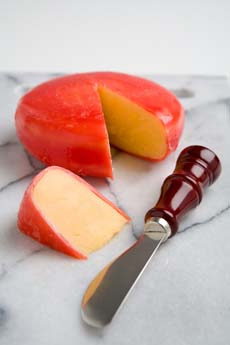
Originating in The Netherlands, Gouda was named after its birthplace, the town of Gouda in the country’s South Holland region. More than 50% of the total cheese production in The Netherlands is Gouda. Photo by Karcich | Dreamstime.
MENU


Cheese

Category Main Page
Articles & Reviews


Cheese-Butter-Yogurt

Category Main Page
Articles & Reviews


Main Nibbles

Main Page
Articles & Reviews Of Foods From A To Z


Product Reviews

Main Page
Food, Beverages, Books,
News & More


ABOUT THE AUTHOR


STEPHANIE ZONIS, Contributing Editor, focuses on good foods and the people who produce them.


February 2008

Product Reviews / Main Nibbles / Cheese-Butter-Yogurt

The Case for Gouda

Gouda, Holland’s Most Famous Cheese, Deserves A Second Look

  • Click here to read other months’ Whey To Go columns


Welcome to Whey to Go! for February, 2008. Every month, we’ll delve into a new cheese-related subject.

PART 1: UNDERSTANDING GOUDA

PART 2: TASTING GOUDA


As with neckties, politics, and diets, various cheeses go in and out of fashion. The best-known cheese from The Netherlands (Holland*), Gouda’s reputation is in decline, and has been for some time now. Disdainful connoisseurs sniff that it’s absurdly bland, with a texture only babies can appreciate, and has no character. But hang on for a minute. It’s true, most Goudas are milder cheeses (we’ll talk about aged Goudas later), smooth-textured and even buttery. Mass-produced Goudas, which are the only kind most Americans have experienced, can indeed be lackluster and dull. But there’s a whole little world of small creameries out there, producing Goudas in more varieties than you knew existed. I don’t mean just raw milk versus pasteurized milk, although that’s one choice you’ll have to make.

*The Netherlands are also popularly known as Holland, after a region of the country.

  • Gouda may be made from cow’s milk, sheep’s milk, or goat’s milk.
  • If the cheese is made from cow’s milk, you can find Gouda from the milk of cows that have been entirely grass-fed.
  • The cheese may be smoked or unsmoked.
  • Its relatively mild taste means that it takes to other flavorings well, too, including chipotles, herbs (fines herbes, garlic), mustard, nuts and spices (black pepper, cumin).

But I’m getting ahead of myself here; we ought to start with background information.

First, let’s talk about pronunciation. The name of this cheese is pronounced variously as “GAOW-duh” or “HOW-duh” (with the Dutch guttural“ch” sound), although most Americans pronounce it “GOO-duh.” Gouda, a traditional, semisoft cheese, originated in The Netherlands, although just how long ago is anyone’s guess. I’ve seen a reference that dated the first recorded mention of the cheese back to 1697, although it may have been around longer than that (food historians note that it can be from 50 to 100 years before a new food appears in the written record). The cheese is named after the town of Gouda, in the South Holland region of The Netherlands, as farmers from the surrounding area would bring their cheeses for sale to the town on market days. Over time, the type of cheese made most often in the vicinity acquired the name of the place where so much of it was sold.

While Gouda continues to account for 50% to 60% of all the cheese made in The Netherlands today, very little Gouda is still made in the town itself. The town remains important to Dutch tourism, and is famous for “De Waag” or the Waaggebouw (weigh house—photo at right). Built in 1667, the building was used for weighing goods to assess taxes. Located across from the Old City Hall, it is now is a national monument.

During the spring and summer, Goudas are still sold in the marketplace and weighed here with great ceremony. “Gouda” is not a protected name,† so Gouda cheese can be made in any location, anywhere in the world, and fine ones are made in the U.S.

†One type of Gouda, Noord-Hollandse Gouda, is name-protected.

Gouda Weigh House
The Waaggebouw, or weigh house, in the town of Gouda is a tourist attraction. The frieze above
the door depicts the scales of the period. Photo by Ellywa Gebruiker, courtesy of Wikipedia.

Gouda is referred to locally as Goudse kaas, or Gouda cheese. Boeren kaas (or boerenkaas), farmer’s cheese, refers to a Gouda that is handmade on the farmstead—an artisanal product rather than a mass-produced cheese. But the two names are often used interchangeably.
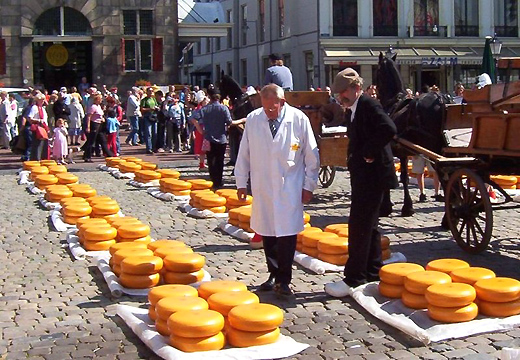
Gouda Cheese Market
The Kaasmarkt, or cheese market, in the town of Gouda. Most of the cheese is no longer made in the town, but has relocated to more affordable real estate. The cheese market has been held since 1194 C.E.

How Gouda Is Made

Gouda, a washed-curd cheese, is always made from whole milk (while close relative Edam is made from partly-skimmed milk). With a minimum butterfat content of 48%, we’re not talking a caloric lightweight here.‡ It is semi-hard, with a creamy yellow paste that may or may not contain tiny holes (air bubbles created during the production process).

‡Volendam, is a young (aged 60 days), creamy Gouda named for a scenic Dutch fishing village, has a butterfat content of 55%.

During the manufacturing process, when the curd has been cut and is separated from the whey, a portion of the whey is drained off. Hot water is added to encourage the release of more whey from the curds. This is considered a “washing” of the curds. Washing the curd removes some of the lactic acid, which creates a sweeter cheese.

  • When the curds have been sufficiently drained of whey, they are scooped into drainable molds, pressed to expel more whey, and eventually, released from the molds. Upon this release, the rounds of Gouda are placed into a tank of brine to promote rind formation and provide flavor to the cheese.
Gouda Manufacture
Curds and whey at Holland’s Family Farm, prior
to draining and pressing into molds.
  • After some hours there (Holland’s Family Farm tells me that their big wheels spend 60 hours in the brine bath), they’re removed, dried off, and covered with a protective coating that inhibits mold growth. The cheese wheels are then placed on shelves (some creameries still use wooden shelves, but most use more modern materials) and turned periodically until the protective coating is dry.
  • What happens next depends upon what fate the manufacturer intends for its Gouda. If the cheese is to be consumed young, it’s often dipped in red or yellow wax at this point, and left in cold storage for two or three months. This is a trickier business than it would seem, as the exterior of the cheese cannot be too wet or too dry when the cheeses are waxed.

An aged Gouda is a different matter altogether, as we’ll see in the next section.

Aged Gouda: Complex & Caramel

Some purists who turn up their noses at young Goudas have far greater respect for Gouda Wheelsthe more mature relatives of the clan. As is typical with more aged cheeses, aged Gouda tends to be harder in texture than a young Gouda; in fact, it has a texture more similar to Parmigiano-Reggiano. The interior, or paste, is more deeply colored than that of a young Gouda; in a Gouda aged for roughly two years or longer, the paste becomes more of an amber, or yellowish-brown. The flavor is complex: intense, butterscotch-caramel, salty yet on the sweet side (it is often described as caramelized or toffee-like).
Gouda wheels aging on traditional wood shelves at Holland’s Family Farm.

Mature Goudas may be difficult to slice evenly with a knife—they frequently come apart in chunks, also similar to a Parmigiano-Reggiano. But they’re wonderful grating cheeses, and add flavor to soups, stews, cooked vegetables, rice, mashed potatoes, eggs—try it on anything you’d like to flavor with cheese. A more mature Gouda is often dipped in wax after it has finished maturing; the wax used sometimes is black, not the red or yellow used for a young Gouda (which is how you can spot them when you’re shopping).

Crystals

Aged Gouda will often contain small, crunchy white crystals (you can see them in the photo below). They are a crystallization of the amino acid, tyrosine, a result of casein (the main protein in milk). They’re perfectly fine to consume—in fact, some people purchase tyrosine supplements, which are believed to reduce stress and help with sleeping. Certain aged cheeses, like Aged Gouda, Aged Gruyère, Parmigiano-Reggiano and Piave Vecchio, will have a preponderance of them. Most cheese lovers consider the crunchy texture one of the delights of the cheese.   

Aging

Exactly how long a Gouda should be aged for great flavor and texture is a matter of serious debate among lovers of this cheese. I’ve seen arguments for Goudas with as little as six months of aging, but there are those who insist that a Gouda isn’t truly mature unless it’s aged for at least two years. There are those who only love their Gouda aged three years and five-years, though those can be harder to find. See the two examples at the right: the five-year-old on top and the three-year-old underneath, both from cheese specialist iGourmet.com.

Remember, too, that the longer a Gouda has matured, the more you should expect to pay for it, although Gouda is less costly in general than many other cheeses. For instance:

  • A younger cow’s milk Gouda, made in The Netherlands and aged for six to nine months, runs about $8.00 per pound.

Aged Gouda - 5 Years
Look at the beautiful, butterscotch color of this
5-year-old Gouda (“triple aged”). You can see
the tyrosine crystals dotting the paste. You can also see how the cheese flakes, rather than slices. Compare the color to the 3-year-old Beemster X.O. Gouda below (“double aged”). Both are available at iGourmet.

Beemster X.O. Gouda

  • A Gouda aged for two years is likely to run in the $12.00 to $15.00 per pound range.
  • Goudas aged for a longer time, those made from sheep’s or goat’s milk, or those manufactured by small, artisan producers can increase the price.
  • The most expensive Gouda I’ve found to date, at Ideal Cheese, is a raw milk, farm-made in the Netherlands, truffled Gouda, aged for fifteen to eighteen months. It retails for $28.00 a pound (shown in the photo at right). 

Truffled Gouda Cheese
Perhaps the most elegant-looking wheel of
Gouda you’ll ever see, and with good cause: black
truffles are added.

Now that you understand Gouda, join us in Part 2 to pair and taste the Goudas.

CONTINUE TO PART 2:
Food & Beverage Pairings
Thirteen Goudas Tasted
Have A Gouda Tasting Party


© Copyright 2005- 2009 Lifestyle Direct, Inc. All rights reserved. Images are the copyright of their respective owners.


Spread The Word: Each icon below links to a site where you can bookmark, share and comment on this article:
Dine52    del.icio.us    ma.gnolia    Newsvine    Yahoo Myweb    BlinkList    simpy    reddit


.