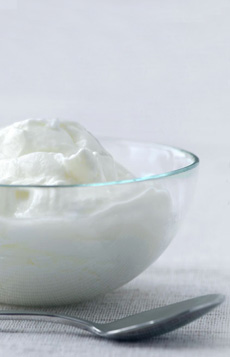
 Greek yogurt is triple-strained. Photo courtesy Oikos. Greek yogurt is triple-strained. Photo courtesy Oikos.
February 2005
Last Updated October 2023
|
|
Yogurt Types
Page 2: Glossary Terms G To N
This is Page 2 of a three-page glossary of yogurt facts and terms. Let us know if you’d like to suggest additional yogurt terms or definitions. Also see our Probiotics Glossary and Glossary Of Organic Terms, plus more than 80 delicious food glossaries.
Click on a letter of the alphabet to get to the appropriate glossary section:
a b c d e f g h i j k l m n o p q r s t u v w x y z
This material is copyrighted and cannot be reproduced in whole or in part.
You are welcome to link to it
GREEK YOGURT or GREEK-STYLE YOGURT
Greek yogurt is triple-strained to remove the moisture, resulting in a thick, creamy product with the consistency of sour cream (see photos at right and top of page). Greek yogurts can also be sweeter, less tangier than European- and American-style yogurts. Yogurt cultures such as L. bulgaricus and S. thermophilus naturally decrease the lactose content during fermentation, so lactose-intolerant individuals can potentially enjoy them without feelings of discomfort. On top of that, in triple-strained Greek-style yogurt, most of the whey and its lactose are removed through straining. Also see strained yogurt. Trivia: The liquid and whey strained from the yogurt is used to make ricotta cheese!
|
|
Greek yogurt is triple-strained to the consistency of thick sour cream. Photo by Saidi Granados | THE NIBBLE. |
HOMOGENIZED
Milk is homogenized to distribute the cream evenly throughout the vat, ensuring that each container of yogurt (or milk) has the same amount of cream. The fat in milk normally separates from the water and rises to the top. Homogenization breaks the fat into smaller pieces by forcing the milk at high pressure through small holes; the fat no longer separates. Prior to homogenization, the cream rose to the surface. You can still find unhomogenized milk produced by artisan dairies; it is called “cream top” milk.
KEFIR
Kefir is a beverage similar to thin yogurt. Its origins date back some 2,000 years to the Caucasus Mountains. Kefir is made from cow’s or goat’s milk with a combination of bacteria and yeasts; Lactobacillus acidophilus and Saccharomyces kefir are widely used, though the exact combination of bacteria and yeasts varies from nation to nation.
What makes kefir unique among drinkable yogurts is its starter grains, that are blended into the milk to develop the beverage (see photo). The grains are not actual grain, but are granules of live probiotics that are soft and jelly-like . They are grown in milk, thus giving it their name.
In authentic kefir, the lactose is fermented, resulting a sour, carbonated, slightly alcoholic drink. The taste is slightly tart and you’ll notice an almost bubbly quality to it.
Most commercially-available American kefir is neither carbonated nor alcoholic, but essentially liquid yogurt—and is often fruit-flavored. In addition to serving as a beverage, in the U.S. kefir can also be used in place of milk with cereal.
Read our review of Green Valley kefir.
The word kefir is believed to derive from the Turkisk “keif,” meaning a good feeling. Depending on how it is made (i.e., local preferences), kefir may differ from other drinkable yogurts due to a longer fermentation process.
Kefir is also known as búlgaros, kephir, kewra, milkkefir, mudu kekiya, talai and waterkefir.
|
|
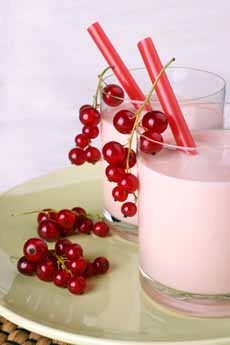
As with yogurt, kefir is available plain and flavored (photo © S. Mohr | Fotolia).
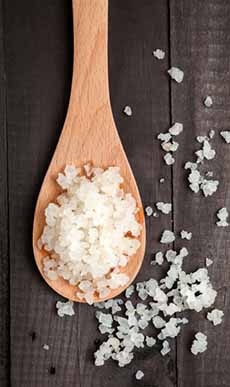
Kefir grains (photo © Cultures For Health). |
KUMIS, KUMISS, KUMYS or KOUMISS
Kumis is a fermented dairy drink traditionally made from mare’s milk, long enjoyed by people of the Central Asian steppes. Since mare’s milk is a very limited commodity these days, industrial-scale production uses cow’s milk.* The drink is similar to kefir, but is produced from a liquid starter culture, in contrast to the solid kefir “grains.” Because mare’s milk contains more sugars than cow’s milk, the fermented kumis has a higher, though still mild, alcohol content. Kumis is an ancient beverage; the first description is by Herodotus the 5th century B.C.E. In the 19th century, it was used as a medical cure-all at “kumis cure” resorts in south-eastern Russia.
|
|
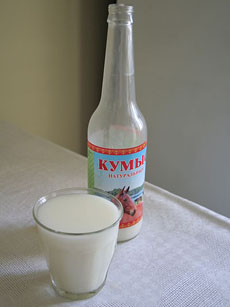
Kumis: like kefir but made from mare’s milk and a liquid starter culture. Photo by A. Savin | Wikimedia. |
___________
*The recipe is adjusted to accommodate the differences between mare’s and cow’s milks. Mare’s milk has more sugar, for example; cow’s milk has less lactose and more fat and protein.
L. ACIDOPHILUS
Lactobacillus acidophilus is a strain of live bacteria added to some yogurts for certain health purposes, including better digestion. They have no impact on the flavor of the product, and can be consumed by any adult whether or not prescribed by a healthcare provider.
LABNEH or LABNÉ or YOGURT CHEESE
Labneh (pronounced LOB-nay or LOB-neh) is the Lebanese version of cream cheese: yogurt cream cheese. It isn’t made with vegetable gum and shaped into a brick like American cream cheese. Rather, it’s thicker than yogurt and comes in a container the size of a large yogurt. Labné is packed with live cultures (beneficial bacteria), calcium and protein. The flavor is refreshing and slightly tart. The cheese is popular throughout the Eastern Mediterranean and Middle East. In Lebanon, labneh is most commonly served as a staple of the breakfast table. In the U.S. it is more often used as a dip for veggies, pita or crusty bread. Here are more ways to use labneh. Check out the history of labneh and an easy recipe for homemade labneh.
|
|
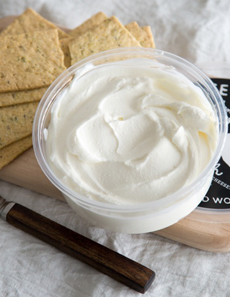
Labneh is actually a cheese that can be spread or used like yogurt (photo © Good Eggs). |
LACTOBACILLUS BULGARICUS
One of the two special strains of bacteria, along with Streptococcus thermophilus, used to make yogurt. These are the “yogurt cultures” added to milk to curdle it.
LACTOSE-FREE YOGURT
While all yogurt is low in lactose, people with extra sensitivities can find lactose-free yogurt that has been treated with a special enzyme, lactase, breaks down the lactose found in milk to avoid the discomfort of lactose intolerance. It tastes just like traditional yogurt.
LASSI
Another variety of drinkable yogurt, the word “lassi” means “yogurt drink” in Hindi. Essentially the world’s first smoothie, this fruit-flavored yogurt drink originated in India around 1000 B.C.E. A light, cool and creamy drink, it’s a blend of Indian-style yogurt flavored with the fruits and spices. The probiotic drink is believed to have healing Ayurvedic properties. As with kefir, another yogurt-based beverage, it can be enjoyed by lactose-intolerant* people. Lassi is a simpler recipe than kefir, which is made by adding a colony of bacteria and yeast to milk. Read our review of Dahlicious Lassi, a NIBBLE Top Pick Of The Week.
LIQUID YOGURT or YOGURT SMOOTHIE
Yogurt that has been thinned to make it drinkable and blended with fruit, fruit juice, or other flavorings. See also smoothie. Find delicious smoothie recipes.
|
|
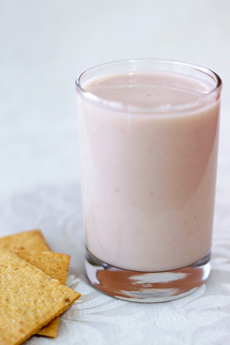
A glass of strawberry lassi. Photo by Elvira Kalviste | THE NIBBLE.
|
LIVE AND ACTIVE CULTURES
“Live and active cultures” refers to the living bacteria Lactobacillus bulgaricus and Streptococcus thermophilus, which convert milk to yogurt. The FDA requires all yogurts to be made with these two cultures. In addition, some yogurts contain Lactobacillus acidophilus, Bifidus and other cultures. In heat-treated yogurt, these cultures are killed during post-fermentation heating. While research is ongoing, live and active cultures are believed to help prevent gastrointestinal infections, boost the body’s immune system, fight certain types of cancer and prevent osteoporosis. They also break down lactose in milk, such that lactose-intolerant individuals can eat yogurt without discomfort.
|
|
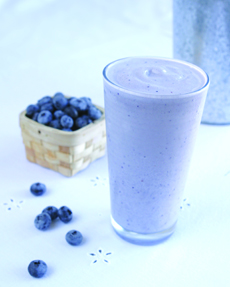
A refreshing yogurt smoothie (photo © RevivalSoy).
|
LIVE AND ACTIVE CULTURES SEAL
Although all yogurts initially contain live and active cultures, some are heated after they are made for the purpose of prolonging shelf life and/or decreasing the yogurt’s natural tartness. The heat destroys the live cultures. (For the same reason, yogurt-covered pretzels and candy, yogurt-based salad dressings and other shelf-stable foods made with yogurt no longer contain active cultures.) Also, some yogurts are initially formulated with a low level of cultures. The National Yogurt Association, an independent trade association of yogurt manufacturers, has established its own criteria for live and active culture yogurts that enables manufactures to use its Live & Active Culture seal on yogurt containers.
|
|
A refreshing yogurt smoothie. Image courtesy National Yogurt Association.
|
This program is not sanctioned by the U.S. Food And Drug Administration. In order for manufacturers to carry the NYA’s seal, refrigerated yogurt products must contain at least 100 million cultures per gram at the time of manufacture; frozen yogurt products must contain 10 million cultures per gram at the time of manufacture. Note that not every manufacturer that provides this level of live and active cultures elects to use the seal on the container, so read the label. Here’s more on live and active cultures.
LOWFAT YOGURT
Low-fat or lowfat yogurt is made from 1% or 2% reduced fat milk. See also Nonfat Yogurt. Plain low-fat yogurt can contain from .5% to 2% milk fat. A typical brand can contain 2-5 grams of fat and about 155 calories per 8-ounce serving.
NATURAL FLAVORS AND COLORS
Companies add “natural flavors” (as well as artificial ones) to intensify the flavors of the fresh or frozen fruits in flavored yogurts. Natural and artificial colorings are added to make the color more pleasing than pallid, and to imply that there is a greater concentration of strawberry, peach or mango than there actually is. The difference between a naturally-flavored and artificially-flavored yogurt is quite noticeable.
|
|
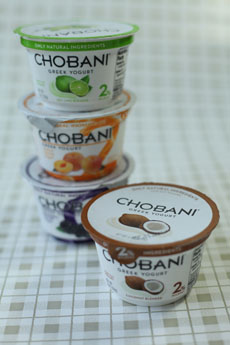
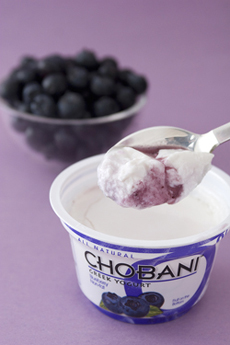
Chobani lowfat and nonfat yogurts (photo by Elvira Kalviste | © THE NIBBLE).
|
NONFAT YOGURT
As its name implies, nonfat yogurt has no fat. It is made from fat-free (skimmed) milk. A typical brand has approximately 100 calories per 8-ounce serving.
|