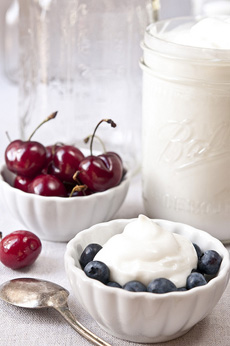
Plain Greek yogurt and fresh fruit. Photo by Saidi Granados | THE NIBBLE.
February 2005
Last Updated October 2023
|
|
Yogurt Information
Page 3: Terms O To Z
This is Page 3 of a three-page glossary. Master these yogurt terms and definitions and you’ll be part of the language of fine “culture.” Let us know if you’d like to suggest additional yogurt terms or definitions. Also see our Probiotics Glossary and Glossary Of Organic Terms. See our many other food glossaries.
Click on a letter to go to the appropriate glossary page:
a b c d e f g h i j k l m n o p q r s t u v w x y z
This material is copyrighted and cannot be reproduced in whole or in part.
You are welcome to link to it.
ORGANIC
Certified USDA organic. This means that the product adheres to the standards of the U.S. Department of Agriculture’s National Organics Program, which includes no antibiotics or hormones used on the cows and no pesticides or chemical fertilizers on the land or feed. See our Organic Glossary for a full explanation of the different types of organic certification.
|
|
|
PASTEURIZED
Milk (or other liquid) that is heated to kill harmful bacteria. In the process, the beneficial bacteria are killed as well, which is why some cheesemakers prefer to make their cheese from raw (unpasteurized) milk. Since the U.S. Department of Agriculture prohibits the sale of raw milk products that are aged less than 60 days. raw milk, yogurt and fresh cheese cannot be sold at retail.
PECTIN
A fruit derivative that is used to jell, thicken, stabilize, and/or increase the shelf life of various foods including commercially-distributed yogurts. It is produced commercially as a white to light brown powder. Other additives used to thicken yogurt include gelatin, gums, and starches.
PLAIN or UNFLAVORED YOGURT
The original yogurt “flavor,” it can be made from cow, sheep, or goat milk. The calories per serving will vary depending on the animal milk source; and whether the yogurt is made from whole milk, low fat milk (2%), or fat-free milk (0%). Production techniques, e.g. straining, which remove moisture and creates a denser product, can also slightly impact calories for equivalent serving sizes.
PREBIOTIC or PREBIOTICS
Prebiotics are a food source for probiotic bacteria, to make them more effective. Some prebiotics have been shown to enhance the absorption of important minerals like calcium. They can take the form of items commonly added to foods, such as dietary fiber. More about prebiotics.
|
|
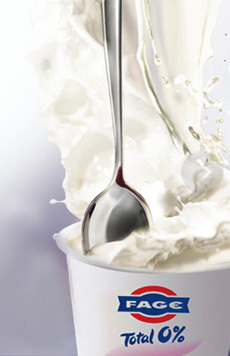
Plain Greek yogurt. Photo courtesy FAGE Total, one of our favorite brands.
|
PROBIOTIC
Having probiotic (friendly) bacteria like Bifidobacterium bifidus, L. acidophilus, L. bulgaricus, L. casei and S. thermophilus. All about probiotics.
PROBIOTICS
Probiotics are the healthy bacteria found among the intestinal microbiota, the living microorganisms in the intestinal tract that are necessary for proper digestive health. They are responsible for protective effects, including healthy turnover of cells in the intestinal tract, production of essential nutrients such as short-chain fatty acids and amino acids, stimulation of intestinal immunity and prevention of overgrowth of harmful organisms. Probiotics can also be found in fermented food products such as yogurt and in supplements. Research has only begun to scratch the surface about the health benefits of probiotics, but suggests that consumption of probiotics may positively enhance the immune response and allow for improved resistance to infectious diseases.
|
|
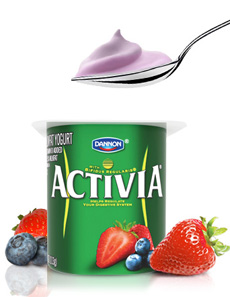
Activia, perhaps the best known brand of probiotic yogurt. Photo courtesy Dannon. |
There may be a strong indication for the use of probiotics in the treatment of numerous gastrointestinal diseases, including irritable bowel syndrome. Read our detailed article on probiotic foods and the sequel probiotics article, plus our Probiotics Glossary.
PRESERVATIVES
The best yogurt brands have no preservatives, and are fresher. Preservatives are added to extend the shelf life of a yogurt.
SKYR or ICELANDIC SKYR
Originally from Norway, this recipe arrived in Iceland in the Middle Ages, and became the preferred form of yogurt. In the days before the invention of pasteurization, it was made from raw milk.
Skyr is mildly tangy and thicker than Greek yogurt: It is strained four times as opposed to three with Greek yogurt, and is the thickest style of yogurt available except for labneh. One cup of Siggi’s Skyr, the leading skyr brand in the U.S., requires four times more milk than a typical American yogurt brand.
Skyr is sometimes referred to as a cheese. That’s because some brands in Iceland are made with a coagulant that creates curds, which is the definition of a cheese (even though skyr curds are too tiny to see). The difference between a cultured dairy product, like sour cream or yogurt, and a cheese that looks just like it, such as fromage blanc or quark, is the addition of the coagulant. You can’t tell the difference by looking at it or tasting it.
Even if made with a coagulant, skyr is not the same as yogurt cheese, which looks like the soft cheese it is.
|
|
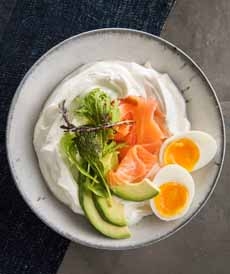
Skyr for lunch, with smoked salmon, avocado, and hard-boiled eggs (photo © Icelandic Provisions).
You can see the thickness in this bowl of skyr (photo © Icelandic Provisions). |
SMOOTHIE
A beverage of fruit and yogurt with the consistency of a milkshake, but much healthier: the concentration of calcium and beneficial bacteria in the yogurt blends with fiber and vitamins in the fruit. Blend 1/2 cup of diced fruit with 3/4 cup of yogurt and 1 cup of milk. Wheat germ, grains and other nutrients can be added. See also liquid yogurt.
STREPTOCOCCUS THERMOPHILUS or S. THERMOPHILUS
One of the two special strains of bacteria, along with Lactobacillus bulgaricus, used to make yogurt. These are the “yogurt cultures” added to milk to curdle it.
|
|
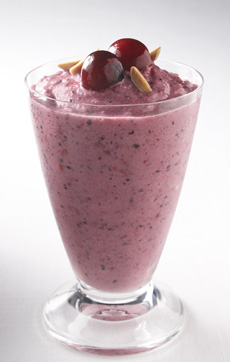
A tempting cherry smoothie. Photo courtesy ChooseCherries.com. |
STRAINED YOGURT or GREEK-STYLE YOGURT
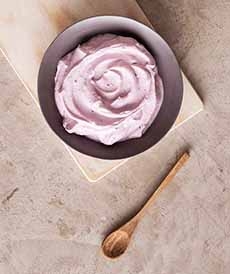
Yogurt that has been strained to remove excess moisture, resulting in a product that is very thick and creamy. It may be made from cow’s, sheep’s or goat’s milk. It can have up to 8% butterfat, compared to 5% for other whole milk yogurts. In addition, cream may be added for extra richness. Because yogurt made in Greece is strained, other strained yogurts are often referred to as “Greek-style.” See photo at top of page.
SUNDAE-STYLE YOGURT
Fruit-flavored yogurt in which the fruit is at the bottom of the container and must be stirred into the plain yogurt on top of it. See also Swiss-style yogurt.
SWISS-, FRENCH-, or CUSTARD-STYLE YOGURT
Fruit-flavored yogurt with a custard-like consistency in which the fruit is already mixed in and distributed evenly throughout. Swiss-style yogurt is very creamy and not as thick as other styles. It often has pectin or gelatin added for extra body. In contrast, see sundae-style yogurt.
WHOLE-MILK YOGURT
Plain whole-milk yogurt has at least 3.5% milk fat; especially rich yogurts can contain 5%, and Greek or Mediterranean styles up to 8%. A typical brand can contain six to eight grams of fat and 225 to 250 calories per eight-ounce serving. Some brands of whole milk yogurt, called farm-style, have a layer of rich yogurt cream on top. Here’s a recipe to make beet yogurt similar to the one in the photo.
|
|
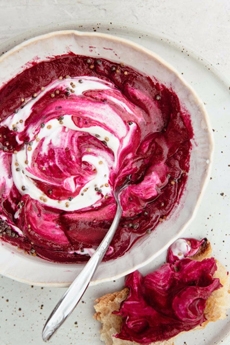
Savory yogurt: plain yogurt mixed with beet purée (photo © Good Eggs). |
YOGURT or YOGHURT
A fermented milk food that is made by adding two specific bacterial cultures to warm milk. Yogurt available in the U.S. is made from the milk of cows, sheep, goats, and water buffalo; but can be made from the milk of any mammal. In other parts of the world, e.g., it is made from camel or yak milk. Dairy-free yogurt is made from soy milk. The Standard of Identity established by the U.S. Food and Drug Administration requires that a refrigerated product called “yogurt” must be produced by culturing permitted dairy ingredients with a bacterial culture that contains Lactobacillus bulgaricus and Streptococcus thermophilus.
These cultures are killed during the heat treatment of the yogurt. Other live and active cultures may be added after the heat process; these yogurts are identified by the words “live and active cultures” on the container.
|
|
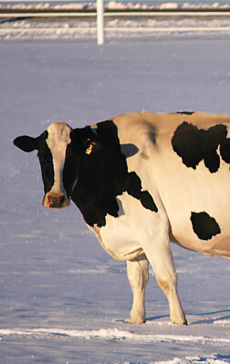
A Holstein getting her exercise in the winter. Photo courtesy Wisconsin Milk Marketing Board.
|
|