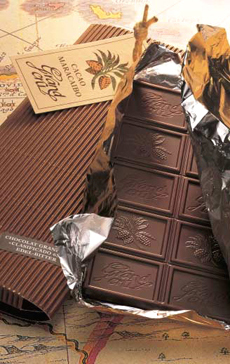
![]() Felchlin’s Maracaibo Clasificado 65% couverture was named the best couverture by the Italian Pastry Academy. A pure Grand Cru Chocolate made of Criollo beans from Sur del Lago, Maracaibo, Venezuela, it has aromas of coffee and plum and notes of orange blossom, cinnamon and raisin. Visit Felchlin.com for more information.
|
Product Reviews / Main Nibbles / ChocolateUnderstanding Couverture ChocolateGreat Couverture Equals Great Chocolate
OverviewCouverture (French for coating or covering) chocolate is the basis of all chocolate, as grapes are the basis of wine. It is professional-quality chocolate that is used for tempering and making bonbons, truffles and chocolate bars, or enrobing other confections (chocolate-covered pretzels and marshmallows, e.g.). If you are a serious student of chocolate and want to understand why you prefer one brand over another, you need to learn your couvertures—and the companies that make them. Couverture chocolate is made with better beans. It is ground to a finer particle size and has a higher cocoa butter content than most chocolate bars for eating†. These two latter qualities enable it to be used for delicate work—for example, to be molded into delicate designs. Otherwise, it contains the same ingredients as eating chocolate:
†Fine chocolatiers, of course, make their chocolate bars from the same quality couverture. Couverture won’t be confused for a candy bar: it is made in kilo (2.2 pound) to 10 pound bars or blocks. Some companies make smaller bars and “wafers,” discs smaller than a quarter, for the home baker and chocolatier. Where It Comes FromWhile there are many thousands of chocolatiers in the world—from large companies like Godiva to the local artisan who makes chocolates in your town, couverture is made by perhaps less than 50 companies in Europe and the U.S. That’s because it requires a complex network of agents to scout and buy beans, and factories to roast and process them into the blocks of couverture. As a result, most chocolatiers—companies that make chocolate products for consumers—and pastry chefs buy their couverture from one of the couverture manufacturers. They can buy from the regular line, or request custom blends.
There are numerous others that do not currently sell their products in the U.S., e.g. Bernachon, Chocolaterie de L’Opera and Corné de la Toison d’Or (France), Haigh’s Chocolates (Australia) and Ludwig Weinrich (Germany). Most of the couverture manufacturers sell to chocolatiers that do not make their own couverture (like Godiva) and to smaller chocolatiers and pastry chefs. However, they also make their own chocolate products for consumers.
How Couverture Is Different From Eating ChocolateCouverture is tempered so that it will form a thin, smooth, shiny coating on hand-dipped candies. The extra cocoa butter, generally 36% to 39%, makes it easier to work with, allows for a thinner shell coating and gives it a different texture and consistency than non-couverture chocolate, i.e. chocolate bars. (Bars for eating can be 25% to 33% cocoa butter, depending on the quality of the bar.) Can you eat couverture? Of course! Some people might even prefer it because of the extra cocoa butter, which creates a creamer mouthfeel. One of the highlights of trade shows for us is digging into the huge block of white Chocovic—one of the best white chocolates we have ever tasted, and not available for purchase as a consumer product. Choosing Couvertures
For example, at these different descriptions of Felchlin couvertures will have you matching them to different kinds of chocolates and truffles:
Most fine couverture producers offer a variety of origin chocolate, as well as house blends in different percentages of cacao from milk to semisweet to bittersweet.
How To Determine Your “Flavor Profile”To understand your flavor preferences, ask chocolatiers which couverture they use: it gives the chocolates their defining taste, regardless of fillings. By understanding, e.g., that you like Couverture A but don’t like Couverture B as much, you will understand your preferred flavor profile. (It’s like knowing that you like the fruitier style of many California Pinot Noirs better than the more balanced style of many Oregon Pinot Noirs.) Most chocolatiers don’t make a secret of the brand of couverture they use—they’re proud of their choice(s) and want you to be an educated consumer. And, knowing your preferences lets you make more informed choices the next time you purchase chocolate. If you know you enjoy chocolate made with Guittard couverture, e.g., the next time you see a Guittard chocolate bar, you might stop to buy it. Or, the next time you encounter a new chocolatier and find that he or she uses Guittard couverture, you know you have a good chance of really enjoying those chocolates.
NOTE: Even if you don’t like a particular couverture in eating chocolate, it will probably be splendid in baked goods and ice cream, where the flavor is nowhere as intense as biting into a chunk of it. One brand that has flavor notes that we don’t enjoy in eating chocolate is one of our top choices for baking and for making ice cream. For an overview on some of the great chocolate producers in the world, read our article, “House Tour: The World’s Great Chocolate Houses.” © Copyright 2005-2008 Lifestyle Direct, Inc. All rights reserved. Images are the copyright of their respective owners.
|
|
|||||||||||||||||||
|
|