Advertisement
THE NIBBLE (TM) - Great Finds for Foodies (tm)
  Sign Up | Contact Us | Email To A Friend | Blog  
       
Twitter RSS feed [?]


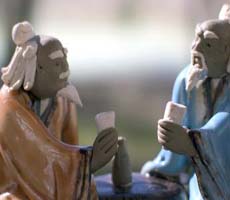
sake figures
To your health!  Photo by Neal Horstmeyer.
MENU


Wine

Category Main Page
Articles & Reviews


Main Nibbles

Main Page
Articles & Reviews Of Foods From A To Z


Product Reviews

Main Page
Food, Beverages, Books,
News & More


October 2005

Product Reviews / Main Nibbles / Wine

Saké Glossary

Terms & Definitions

Saké is categorized by the percentage of the outer husk of the rice that is milled away, or polished, before processing. This enables more complex flavors to develop. While the categorizations do not necessarily reflect the quality of the saké, in general, the more of the grain is eliminated, the more delicate the flavor of the saké tends to be. While it’s made from rice and often referred to as “rice wine,” it’s not technically a wine, which, by definition is fermented from fruit. Like beer, it is fermented from grain, although the the production processes is significantly different.

Since saké originated in China and first became popular in Japan, much of the vocabulary associated with saké is either Chinese or Japanese.


Click on the letter of the alphabet in this bar to get to a term
without having to scroll manually:

a  b  c  d  e  f  g  h  i  j  k  l  m  n  o  p  q  r  s   t  u  v  w  x  y  z

Daiginjo Saké or Daiginjoshu: Ultrapremium saké, the finest quality. Handmade, free run, small batch saké made with purified water, the finest quality rice milled to at least 50%—some are milled to 35%—and the most refined processes to create the most complex character and layers of flavor. Aged in temperature-controlled stainless steel tanks for at least nine months. Can be junmai or honjozo (alcohol added); if no alcohol is added it is labeled junmai. These delicate sakés with more gently flavored foods, such as poached whitefish or raw scallops. FLAVOR PROFILE: Fragrant, full flavors, short finish. See also ginjo and futsu.

Futsu or Futsushu Saké: Ordinary saké or economy saké, made with lesser ingredients, with rice milled down only to 70% of the grain, with less complex processes, and aged 3 months or less. Typically served warm (premium saké is generally best served slightly chilled), the alcohol level can be as low as 4%. Can be junmai or honjozo. About three-quarters of all the saké produced in Japan is futsushu.

See also daiginjo and ginjo.

Genshu Saké: The strongest saké, genshu means “cask strength.” Also referred to as undiluted saké, as little water is added in the brewing. Thus the alcohol percentage is the highest of all sakés—18% to 21%, compared to a typical nigori saké, which has one of the higher levels of alcohol at 15%.

Ginjo Saké or Ginjoshu: Premium saké. Made with better ingredients than economy sake, with rice milled down to 60% of the grain (40% removed), better processes, and aged for at least 6 months in steel tanks, it delicate, light and complex with a fragrant nose. The complexity has to do with the additional milling away as well as special yeast, lower fermentation temperatures and labor-intensive production techniques. It can be junmai ginjo (no alcohol added) or simply ginjo (distilled alcohol added). Ginjos can be paired with bigger flavors, like toro, grilled chicken and tempura. FLAVOR PROFILE: fragrant nose, other elements in more subtle balance. See also daiginjo and futsu.

Honjozo Saké or Honjozoshu: Along with junmai, one of two broad categories of saké generally available in the U.S. At least 30% of the rice polished away. Honjozo differs from junmai in that a small amount of distilled alcohol has been added at the end of fermentation—generally 5% by volume. The alcohol smoothes and lightens the flavor and makes the fragrance more prominent. There are sakés that have a higher percentage of added alcohol than honjozo sakés, but they are almost never imported into the United States. In Japan, about 88% of all sakés are honjozo. For average sakés, the distilled alcohol is usually processed grain alcohol. Finer sakés may use distilled alcohol collected from the esters during fermentation, which enhance the aroma. FLAVOR PROFILE: Fragrant, earthy, long finish. See also junmai.

Infused Saké: Currently a product unique to the United States, where it is used for innovative cocktails, or drunk neat like infused vodka. Flavors such as yuzu, honey, ginger, lemongrass, pomegranate and asian pear, are added to the saké during the blending process. As with vodka, some restaurants and cocktail lounges infuse their own sakés. Commercial infused sakés tend to be lower in alcohol content than classic sakés.

Jiu: Pronounced joe, the Chinese word used to describe the entire category of alcoholic beverages made from rice. Saké is one beverage in this category.

Jizake: A term that usually refers to saké from smaller rural breweries, the antithesis of mass-produced saké.

Junmai Saké or Junmaishu: Junmai is a pure rice distillate, with no added alcohol. Until recently, it was a saké with at least 30% of the grain removed; however, the Sakelaws have changed, and junmai no longer requires a specified milling rate (the amount milled away must, however, be listed on the label). Junmai often has a fuller, richer body and a higher-than-average acidity, but a less prominent nose than other types of saké. Junmais and ginjos can be paired with bigger flavors, like toro, grilled chicken and tempura. Along with honjozo, junmai is one of two broad categories of saké generally available in the U.S. It differs from honjozo in that no distilled alcohol is added (i.e., only rice, water, koji and yeast are used to make the saké). By law, sakés that are made in the U.S. cannot add distilled alcohol; so all domestic-made sakés are junmai style. FLAVOR PROFILE: Subtle nose, assertive, higher-acid, full-flavored, earthy notes, good finish. See also honjozo.
Yuki No Bosha, Cabin In The Snow Daijingo, available at EnglewoodWineMerchants.com.

Kobo: The yeast used to make a seed mash called moto, in a room called the moto-ba. Kobo propagates itself by feeding on the koji rice. The propagation of koji and kobo are the most critical processes in brewing sake. Specialists called koji-ya and moto-ya supervise these processes.

Koji: The unique enzyme required to make saké.  Koji convert starch to glucose and are responsible for saké’s aroma and taste. Koji mold is cultivated on a bed of steamed rice, and the mold eats its way into the rice. The enzymes in the mold break down the rice’s starch molecules into smaller sugar molecules that are food for the moto required to brew the saké.

Kojimuro: The room in which the koji conversation takes place (for up to two weeks). The temperature of the kojimuro is always kept at 86° Fahrenheit (30° Celsius). The moisture of the room is also controlled carefully in order to stimulate the multiplication of the koji. This is one of the most critical processes in sake-making.

Kura: A sakéry, or place where saké is produced. Saké is very sensitive to temperature and can be brewed only during the winter. In order to sell saké throughout the year, brewers store saké in the kura, where the temperature change is relatively constant. In the old days, saké was stored in wooden tanks; but today, it is stored in enameled porcelain or stainless steel tanks.

masuMasu: A wooden box, typically made from aromatic cedar but also made in lacquer, from which saké is drunk. The boxes were traditionally used to measure rice as well.

Milling or Polishing: The process of polishing off the external portion of the grain of rice to get to the starch packet at the heart of the grain, which converts into fermentable sugar and then into alcohol. There are three grades of saké based on the percent of the grain milled away: economy (futsu) saké, 30%; premium (ginjo) saké, 40%; ultrapremium saké (daiginjo), 50% or more.

Moto or Syubo: The seed mash.

Namazake: Unpasteurized saké, which needs to be stored cold. Namazake has a fresh, lively clarity of flavor. All types of saké (junmaishu, honjozo, ginjo-shu and daiginjo-shu) can be made as namazake.

Nigori Saké or Nigorishu: Classic antique-style saké. This cloudy saké is filtered through a rough weave filtration system, which is how saké was made prior to modern technology (nigori means ”roughly filtered” or ”loosely filtered”). With this rough process, tiny rice particles filter through and settle on the bottom of the bottle like white sediment. While many prefer the crystal-clear saké made possible by modern multiple filtering techniques, others prefer the rough filter, which retains more flavor. The contents are shaken before pouring, creating a milky white saké that is naturally sweet and goes well with spicy cuisines, fried foods and desserts. Nigori saké  is available in economy, premium, and ultrapremium varieties. It higher in alcohol than average sakés, typically 15 percent.

Rice Wine: Saké is often referred to as “rice wine,” but this is inaccurate: By definition, wine must be fermented from fruit. Rice is fermented from grain, like beer, although the production process is different, and saké produces no carbonation. From a body and flavor perspective, it is closer to wine than beer, although like beer, it is meant to be drunk fresh, and does not age like wine. Sake is not a distilled beverage, and thus is not in any way related to gin, vodka or other spirits.

signSakabayashi: A sign that lets customers know that the new saké is ready for sale. In some sakéries, the sugidama (see photo at left) is hung outside. Saké can be brewed only during winter as it needs to be fermented for a long time at a low temperature. In the old days, people bought saké directly from breweries—there were few stores that sold it directly. With today’s broad distribution, a sakabayashi has no practical meaning; but brewers hang one when the new saké is ready, in ceremonial celebration.

Sakamai: The strain of rice grown for saké. It has a much higher starch content than normal table rice. A method called San’ou, which means three-yellow, produces the strongest, hardiest rice. The rice is withered and “yellowed” three times: first as seedlings, then in the rice paddy by starving the rice, and finally, when it is reaped, it dries and yellows for the third time.

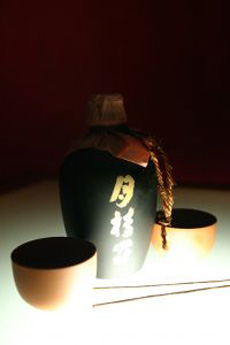
sakeSaké (SAH-keh): A fermented and brewed alcoholic beverage made from rice, ranging from 4% alcohol to 21% alcohol. (Photo of saké bottles at right courtesy of Tenranzan Japanese Saké.)

Sakémaker: A person who makes saké, equivalent to a winemaker. The lead sakémaker is called the chief sakémaker. In Japan, the chief sakémaker is called a tohji. A sakémaker is equivalent to a winemaker.

Sakémaster: A saké educator who can knowledgeably educate people about saké. A sakémaster is equivalent to a wine sommelier.

Sakéry or Sakagura or Kura: The place where saké is produced, analogous to a brewery or a winery. In the U.S. it has been called a brewery, winery and distillery. By Federal law, each saké producer in the United States is required to have a brewery license. Each state government agency that regulates saké treats it like a wine, which requires the producer to have a winery license. Ninety-four percent of all sakés that are made in Japan have distilled alcohol added to them (honjozo), so when they are imported into the United States, they are classified as a spirit. Thus, saké is a beer on the federal level, a wine on the state level and a spirit when imported from Japan with added distilled alcohol.

Sake Meter Value (SMV) or Nihonshu-Do: The measure of specific gravity, or density, of saké. A dry saké has a positive SMV, a sweet saké has a negative SMV.  The larger the number, either positive or negative, the drier or sweeter the saké is.

Seishu: An older Japanese term for refined saké, separating it from the less refined saké that was made in China in earlier times. Japanese sakéries often refer to saké as “nihon-shu” which literally means “Japanese saké.”

Seimai Buai: “Degree of milling,” the percentage of rice milled away, which is part of what determines the category of saké. Sometimes the number appears on the label (e.g. 70 indicates 70%); but in most cases, this is not mandatory.

Shu: The suffix for saké.

Sugidama: A ball of woven green cedar boughs used to measure aging. When the ball turns brown, the saké is ready. The balls are also popularly used as decor in modern Japanese homes.

taruTaru: A traditional celebratory saké cask or barrel. As sake is used in many Shinto ceremonies, people donate large barrels of sake to shrines and temples. (Photo at right.)

Tokubetsu: Saké brewed in a special manner with high quality rice and extra care.

Tohji or Toji: A sakémaker. Equivalent to a winemaker or brewmaster. Saké-making is much more complex than winemaking; saké quality is 80% toji and 20% rice, while wine quality is 80% grapes and 20% winemaker-dependent. Skills and techniques are handed down from generation to generation.

Varietal: A particular strain of saké rice. Analogous to grape varietals. Some fine rice varietals are yamadanishiki, mutsuhomare, gohyaku-mangoku, myamanishiki, and yumeakari. As with wines, saké varietals can be blended. The same varietals used to make saké are not used for eating: they much less protein than eating rice.

sakery
A sakéry. Photo by Sean Okihiro.


© Copyright 2005-2009 Lifestyle Direct, Inc. All rights reserved.  Images are the copyright of their respective owners.


Spread The Word: Each icon below links to a site where you can bookmark, share and comment on this article:
Dine52    del.icio.us    ma.gnolia    Newsvine    Yahoo Myweb    BlinkList    simpy    reddit


.