An asterisk (*) indicates a natural product, i.e., one derived principally from a plant or other natural product.
SACCHARINE (Sweet ‘N Low)
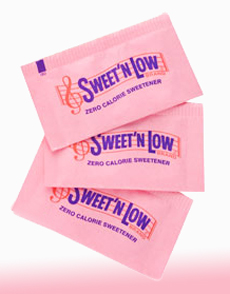
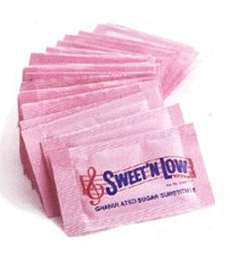
Saccharine was discovered in 1879 by a Johns Hopkins University chemist—he accidentally spilled a substance on his hand and noticed the sweet taste while eating dinner. It has been available worldwide since the end of the 19th century; its popularity grew during the sugar shortages of World War I. Saccharine is 300 times sweeter than sugar and is very stable in foods, but has a bitter aftertaste. The human body is unable to metabolize saccharin, which is why it has virtually no calories. Saccharine can be used in cooking. Sweet ‘N Low, which is powdered, branded saccharine, was launched in 1957, and was immediately preferred for its superior dissolvability to the tiny tablets that preceded it. In the 1970s, lab experiments feeding rats enormous amounts of saccharine produced tumors, and a scare that saccharine was carcinogenic. Today, the National Cancer Institute gives it a clean bill of health for humans, however it is banned in Canada (Canadian Sweet ‘N Low has cyclamate, which is banned in the U.S.). The FDA Acceptable Daily Intake is 5 mg per kg, or 8.5 packets of sweetener.*
SORBITOL*
Also known as glucitol, sorbitol is one of the sugar alcohols. It is a nutritive sweetener that occurs naturally in many stone fruits and some berries. Sorbitol is often used to sweeten mints and gum plus other diet foods and cough syrup.
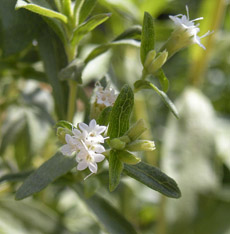
Stevia, which is 150 to 400 times sweeter than sugar, is derived from a South American herb called Stevia rebaudiana. It has been used for centuries in Paraguay and Brazil to sweeten yerba mate and medicinal teas. It is almost calorie-free, does not cause cavities, and does not trigger a rise in blood sugar. Stevia accounts for 40% of the sweetener market in Japan. In the U.S. it is currently classified as a dietary supplement and not as a food additive. It is usually found in a liquid concentrate, but there are also packets and tablets. Lesser-quality stevia can have a subtle anise or licorice flavor, but this does not occur with the better-quality products. Stevia used in Coke
Stevia bush. Photo by Edith Aardvark | Wikimedia.
and Pepsi products has been refined to the point where there is no aftertaste.
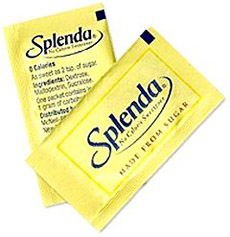
SUCRALOSE (Splenda)
Sucralose, 600 times sweeter than sugar, was approved by the FDA and came onto the market in 1998. It is the only artificial sweetener made from sugar: It begins as sucrose, but is then chemically altered, including the addition of a chlorine atom, so it is a chemical, rather than a natural, product. Sucralose is heat-stable and can be used for cooking and baking; it also has a longer shelf life (aspartame breaks down in a year when used in soft drinks). Sucralose is not utilized for energy in the body because it is not broken down like sucrose. It passes rapidly through the body virtually unchanged. The stability of sucralose allows both food manufacturers and consumers to use it virtually anywhere sugar is used, including cooking and baking.
†FDA-established acceptable daily intake (ADI) limit per kilogram (2.2 pounds) of body weight. Product consumption equivalent for a 150-pound person.
Sucralose does less well in beverages, which is why most good diet soft drinks use a combination of aspartame and acesulfame-K. The FDA Acceptable Daily Intake is 5 mg per kg, or 5 cans of diet soda.†
SUCROMALT
Xtend Sucromalt is a product of Cargill Corporation, derived from sucrose and maltose. It is 60% to 70% as sweet as sugar and behaves like corn syrup, with a slow carbohydrate release.
SUCROSE*
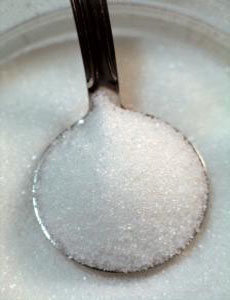
Sucrose—the cane sugar commonly referred to as table sugar—is a disaccharide comprising glucose and fructose. It is derived from sugar cane or sugar beets, and has four calories per gram (about 16 calories per teaspoon). The refining process removes impurities from the sugar plant, producing the white crystals we know as table sugar. Molasses is simply a less refined sucrose.
Sugar alcohols (also known as polyols, polyhydric alcohols, or polyalcohols) are a hydrogenated form of carbohydrate. They are a natural plant-based sweetener. They occur naturally in a wide variety of fruits and vegetables; but can be commercially made from other carbohydrates such as sucrose, glucose and starch. Sugar alcohols include erythritol, isomalt, maltitol, mannitol, sorbitol, and xylitol, among others. There is no alcohol in sugar alcohols; they are so named because their molecules resembles that of alcohol. Because sugar alcohols are absorbed slowly by the body (or not at all), they are useful for diabetics because they don’t cause a spike in blood sugar levels. They’re also great for those watching carbs. Sugar alcohols are also prebiotics. Prebiotics are not well understood but the consensus among scientists is that they can be beneficial in maintaining intestinal health.
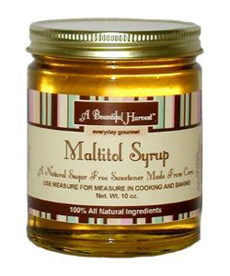
Maltitol syrup, a natural sweetener, is also available in crystal form. You can purchase it online.
Sugar alcohols are commonly used for replacing sucrose in foodstuffs, often in combination with high intensity artificial sweeteners to counter the low sweetness.
SUGAR-FREE
A product that has been sweetened by a non-nutritive sweetener that is not metabolized by the body, and contributes zero (or very low) calories. This is not the same as No Sugar Added.



 dinner. It has been available worldwide since the end of the 19th century; its popularity grew during the sugar shortages of World War I. Saccharine is 300 times sweeter than sugar and is very stable in foods, but has a bitter aftertaste. The human body is unable to metabolize saccharin, which is why it has virtually no calories. Saccharine can be used in cooking. Sweet ‘N Low, which is powdered, branded saccharine, was launched in 1957, and was immediately preferred for its superior dissolvability to the tiny tablets that preceded it. In the 1970s, lab experiments feeding rats enormous amounts of saccharine produced tumors, and a scare that saccharine was carcinogenic. Today, the National Cancer Institute gives it a clean bill of health for humans, however it is banned in Canada (Canadian Sweet ‘N Low has cyclamate, which is banned in the U.S.). The FDA Acceptable Daily Intake is 5 mg per kg, or 8.5 packets of sweetener.*