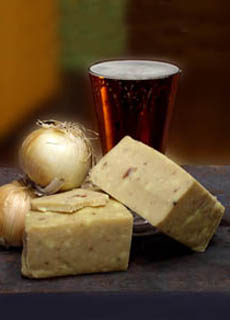
If you don't know a bitter from a hop, use this glossary as a quick study guide. After you pass the test, treat yourself to an ale or a lager. Above, amber ale with caramelized onion Cheddar cheese from iGourmet.
February 2005
Last Updated April 2026
|
|
Beer Glossary
So Many Types Of Beer: These Definitions Let You Know What You’re Drinking
Page 1:
|
A Brief History Of Beer Plus Beer Types Beginning With A
|
This is Page 1 of an eight-page glossary of beer terms. Note that there are many hundreds of official beer styles. To see the full list, visit The Brewers Association.
Click on the links below to visit other pages. Also see our 100+ food glossaries, chock-full of information about your favorite foods.
The year’s 40+ beer holidays.
The year’s 14 American-specific beer holidays.
This glossary is protected by copyright and cannot be reproduced in whole or in part.
Beer History
Beer has been brewed prior to written history. Archaeologists date it to around the 6th millennium B.C.E. The oldest known recipe found to date is one for brewing beer, found on stone tablets in Sumer, in southern Mesopotamia. The “fertile crescent” or “cradle of civilization” between the Tigris and Euphrates Rivers was the original area for much cultivation of hitherto wild foods, and much food innovation. Today, the area includes modern Iraq, northeastern Syria, southeastern Turkey, and southwestern Iran.
Beer is the most frequently consumed beverage in the world, after water and tea! By 4000 B.C.E., the Babylonians were brewing at least sixteen varieties of beer (when you see all of the different styles in this glossary, you won’t be surprised at that number). The Pharaohs of Egypt paid their workers with jugs of beer (later, the Romans would pay their legions in salt, leaving us with the phrase, “worth his salt” rather than “worth his beer”).
For those of you who have never been exactly clear on the difference between all the beer types—ale, pale ale, bock, pilsner, and lager (only that you’re happy to drink them all)—this glossary is a tutorial on the types of beer.
|
ABBEY BEER
A beer not necessarily made in an abbey, or by monks, but imitating the Trappist monk style. These are top-fermenting brews that characteristically add sugar in the kettle and are always bottle-conditioned. Sometimes these beers are licensed by an abbey, but there is no legal regulation of the term. See Trappist.
A.B.V. or ABV
The abbreviation for Alcohol By Volume, the percentage of the beer that is alcohol. It is analogous to % alcohol on a wine label, or the proof of a spirit (the percent of alcohol is half the proof, e.g., 80 proof is 40% alcohol by volume). Some beers, such as Imperial Stout, can approach the levels of low-alcohol wines (10%). However...
|
|
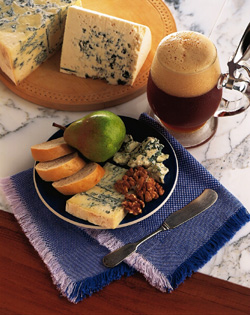
Abbey-style beer with Gorgonzola and blue cheeses, pear, walnuts, and slices of baguette. Photo courtesy Wisconsin Milk Marketing Board. |
|
For marketing and PR reasons, some craft brewers like to test the limits. Snake Venom, a brew from Brewmeister (Scotland), boasts an ABV of 67.5%. It’s a barleywine-style ale, freeze-distilled (meaning, it’s repeatedly frozen and partially thawed). If you buy a bottle, note that it has a higher alcohol content than most spirits: It would be 135 proof! That means sip it very slowly.
Other super-high ABV beers include The Strength of Arm (65%) from BrewDog & Schorschbräu and The End of History (55%) from BrewDog, sold in a bottle inserted into a taxidermy animal—squirrel, stoat, or hare—for $20,000 when released in 2014. Only 12 bottles were made. Here’s more about it.
|
|
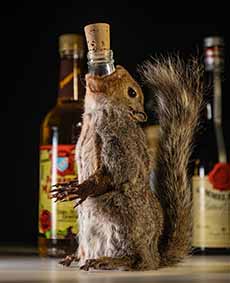
The End Of History is a beer sold in a taxidermied squirrel (photo © Disgusting Foods Museum in Malmö, Sweden). |
A.B.W.
The abbreviation for Alcohol by Weight.
ADJUNCT, MALT ADJUNCT, or CEREAL ADJUNCT
Any substitute, unmalted cereal grain, or fermentable ingredient, added to the mash in order to reduce costs. It is used to produce more, usually cheaper, fermentable sugars, and/or to produce paler, lighter-bodied, and less malty beers. Adjuncts include corn, flaked rice, inverted sugar, glucose, maize, oats, tapioca flour, and wheat. In Belgium, the amount of unmalted cereals added to the grist varies from 10% to 50%, whereas French and U.S. lager beers may contain 30% to 40% adjuncts. In Germany, the use of adjuncts was long prohibited by law; now it is permitted.
AGED BEER
While most commercial beers are meant to be consumed fresh, several types of beer are intentionally aged, either to develop complex flavors or to mellow harsh characteristics. certain styles are well-suited to aging—sometimes for months or even years. They can be barrel-aged, bottle-conditioned, or cellar-aged.
Beers that are commonly aged include Barleywine, Belgian Quadrupel Ale, Brett Beers, Gueze, Flanders Red, Imperial Stout, Lambic, Old Ale, and Saison/Farmhouse Ale.
Beers that are never aged include IPAs and other hoppy beers, light lagers/Pilseners, and wheat beers.
|
ALE
The English language term for a beer made in a cask or bottle with top-fermenting yeast (the same way Champagne is carbonated), which generally gives the beer a fruitiness. Because of the living yeast, real ales are sometimes cloudy and have a slightly yeasty character. Ales are easier and less expensive to brew than lager beers, which require precision in the brewing plus cold storage before they are ready to sell. Ales are produced in a wide variety of colors, palates, and strengths: Bitter, Brown Ale, India Pale Ale, Light Ale, Red Ale, etc. The state liquor authorities of some American states wrongly apply the term to indicate brews of more than 4% alcohol. Interestingly, the term ale, once used to indicate a beer made without hops, now generally indicates a dark amber, strongly hopped malt beverage. Serve ales with mortadella, salami, and lightly smoked sausages.
|
|
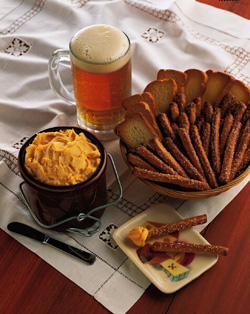
Amber ale served with Cheddar cheese crock, pretzels and toasts. Photo courtesy Wisconsin Milk Marketing Board. |
ALTBIER
A dark amber, hoppy pale ale brewed around Düsseldorf and the Lower Rhine region of Germany. The name literally means “old beer,” and refers to the pre-lager brewing method of using a warm top-fermenting yeast (like British pale ales). The production techniques create a cleaner, crisper ale.
AMBER ALE
Amber ale arose from the American craft movement. It is a pale ale recipe brewed with a proportion of amber malt to produce an amber color, light copper to light brown. An “American red ale” would be an ale with a more robust, ruddy color. The style is different from European (Irish)-style red ale.
|
AMBER LAGER
Amber Lager was created in Vienna, Austria, by Anton Dreher of Vienna in the mid-19th century. The style balances rich, fragrant malt flavors with crisp hops. Pair it with spicy dishes, pork, sausage, and robust pasta dishes.
AMERICAN BEER & ALE
American craft brewers have put their own spin on classic European beer styles. There are some 30 different styles, including Pumpkin Ale.
AMERICAN PALE LAGER
American lager is highly carbonated, very clean, and crisp. It is brewed without cereal adjuncts (e.g., rice or corn), which gives it a depth of malt flavor and a complex bitterness. It has little hop flavor, so it has been called “all-malt.” It’s a fizzy without cereal adjuncts. It is straw to gold in color, very clean and crisp, lager. There is also an American dark lager.
|
|
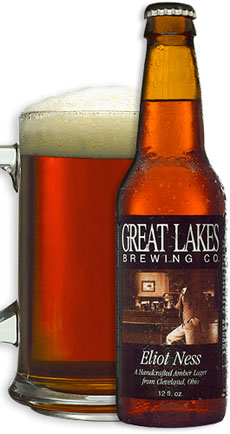
Amber Lager. Photo courtesy Great Lakes Brewing Co. |
AMERICAN PALE ALE
American pale ale is dry and hoppy like the British original, but uses zestier American hops instead of earthier English hops. Some brewers emphasize maltier flavors rather than the conventional hoppier ones. They can also be slightly higher in alcohol.
AUBURN BEER
Another word for an amber-colored beer.
Continue To Page 2: Terms Beginning With B
Go To The Article Index Above
© Lifestyle Direct Inc. All rights reserved. Photos are the copyright of their respective owners.
|
|