March 2005
Last Updated January 2026
|
|
Types Of Tea & Tea Terminology
Tea Glossary Page 4: Terms D & E
This is Page 4 of a 15-page glossary. Click on the links below to visit other pages. This Tea Glossary is one of our many delicious food glossaries.
Click on a letter to go to the appropriate glossary page:
a b c d e f g h i j k l m n o p q r s t u v w x y z
This glossary is protected by copyright and cannot be reproduced in whole or in part.
DA HONG PAO OOLONG
See red robe oolong.
DARJEELING
A tea-growing area in the Darjeeling area of Northern India at the foothills of the Himalayan Mountains, at altitudes up to 7,000 feet above sea level (a “high-grown” tea). The unique soil, microclimate, elevation, and other factors produce a very high-quality black tea coveted by connoisseurs; Darjeeling can be found in green tea as well. Often called “the Champagne of Indian teas,” it is light in color and body with a delicate, muscatel flavor and flowery aroma and a crisp astringency. The first crop harvest of the year, known as the “first flush,” commands the highest price.
|
|

Organic Darjeeling estate tea from MightyLeafTea.com. |
Its light fermentation and greenish leaf deliver a brisk character and complex aroma, reminiscent of semi-fermented oolong tea. Darjeeling was planted with seeds and plants originally imported from China.

A cup of Darjeeling (photo © Artful Tea).
DECAFFEINATED
A tea that has had most of the caffeine removed. It is important to note that a decaffeinated tea is not 100% caffeine-free; the amount of caffeine is reduced to about 3% of its original strength.
DELICATE
Characterized by a fragile, mellow, or subtle flavor.
DESSERT TEA
A dessert tea is a blend to be enjoyed after a meal, providing natural sweetness from the addition of ingredients such as coconut husks, coconut slivers, cinnamon, and other spices such as licorice root and dried fruits. While it is possible to add milk and sugar, the teas have enough flavor to be enjoyed without further embellishment. They have no added sugar and almost no calories.
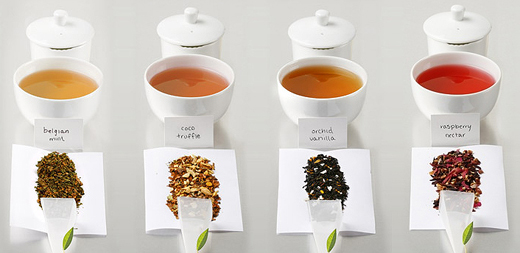
Dessert Teas: Belgian Mint, Coco Truffle, Orchid Vanilla and Raspberry Nectar. Photo courtesy of TeaForte.com.
|
DIET TEA
See wu long slimming tea.
DISPLAY TEA or BLOOMING TEA or PRESENTATION TEA
Chinese artisans hand-tie tea leaves with flowers into tight balls. When the ball is placed into water, it unfurls into a flower-like bloom. This needs to be done in a glass vessel (cup, glass, teapot) in order to see the magic as the ball turns into a flower before your eyes. Put them in water and watch them bloom! While you pay extra for the handcrafting than you would for the same amount of loose tea, these balls of tea make a lovely gift, along with a glass pot or cup.
|
|

A plain ball of green tea leaves blossoms into a visually beautiful cup of tea (photo © In Pursuit Of Tea) |

Blooming tea for two (photo © Sur La Table).
|
DRAGON WELL or DRAGON’S WELL TEA
Dragon Well, or long jing in Chinese, is perhaps the most famous Chinese green tea. It is a pan-fired green tea that is flat-fried by hand in large woks to produce leaves shaped like the blade of a sword. It is named after the Dragon’s Well, a landmark in Hangzhou, where the tea originated. If you’re in the area, you can see the well, which is in a government-protected garden. But you really have to know where you’re going, as the locals point to a fake well five minutes away, to get tourist traffic to Loongjing Village (Dragon’s Well Village).
|
|
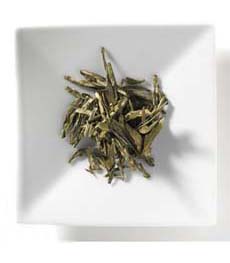
Dragon Well tea from MightyLeafTea.com. |

A cup of Dragon Well tea (photo © Verdant Tea).
DRY
The result of slight over-firing or drying during manufacture.
DULL
Not clear or muddy, lacking any brightness or briskness, flat-tasting. Dullness usually denotes poor-quality tea, which can be due to faulty manufacture and firing or a high moisture content. The opposite of bright.
DUST
The smallest grade of tea, commonly used in teabags and typically associated with lower quality. However, it is appreciated by some for its quick extraction (i.e., it brews much more quickly than whole leaf tea).
|
EARL GREY
An aromatic, light-bodied black China tea treated with the oil of bergamot, a bitter Mediterranean orange, which gives the tea a distinctive citrus-scented aroma and taste. Earl Grey was the first scented tea to be drunk in the Western world: Some claim it’s the most popular black tea in the world. Earl Grey was blended for and named after Charles, the Second Earl Grey (1764-1845), by a Chinese mandarin when Earl Grey was prime minister of Britain during the reign of William IV (1830-1837). He led a successful British diplomatic mission to China. The Earl was an arch-rival of the Duke of Wellington, whom he beat to become Prime Minister in the 1830s. A humanitarian, Earl Grey abolished slavery throughout the British Empire.
|
|

Earl Grey tea from Mighty Leaf Tea. See the brewed Earl Grey tea in the photo below. |

A fragrant cup of Earl Grey Tea (photo © Cup Of Tea).
EARTHY
A taste caused by damp storage of tea, but which can also be characteristic of teas from certain regions.
EMPTY
A liquor lacking fullness and substance.
|
ENGLISH BREAKFAST TEA
A blend of black teas, often including keemun. Actually developed by a Scot, it acquired its full name after becoming very popular with Queen Victoria, and thus all of England, becoming a classic blend. It is a fuller-bodied and deeper in color than the other popular blend, Earl Grey. Irish breakfast tea is stronger than English Breakfast tea.
ESTATE
A tea-growing property or holding that may include more than one garden under the same management or ownership. In the past, tea estates were known as plantations.
|
|
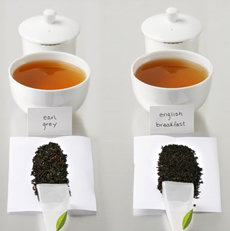
Earl Grey tea, left, and English Breakfast tea, right. Photo courtesy TeaForte.com. |
Continue To Page 5: Tea Terms Beginning With F
Go To The Alphabet Index Above
Lifestyle Direct, Inc. All rights reserved. Images are the copyright of their respective owners.
|