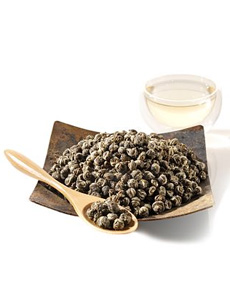
 This green jasmine tea is rolled into pearls. It’s available at Teavana.com. This green jasmine tea is rolled into pearls. It’s available at Teavana.com.
March 2005
Last Updated March 2012
|
|
Types Of Teas & Tea Terminology
Tea Glossary Page 8: Terms I & J
This is Page 8 of a 15-page glossary of teas. Click on the links below to visit other pages. This Tea Glossary is one of our many delicious food glossaries. Learn more about your favorite foods.
Click on a letter to go to the appropriate glossary page:
a b c d e f g h i j k l m n o p q r s t u v w x y z
This glossary is protected by copyright and cannot be reproduced in whole or part.
ICED TEA
Brewed tea chilled with ice. Iced tea originated in 1904 at the World’s Fair in St. Louis. A visiting English tea merchant and plantation owner had intended to provide visitors with free hot tea samples. Due to the unusually hot weather, it was not of interest to most people. To promote sales, he asked a nearby ice cream vendor for some ice to cool off the hot tea, and the American iced tea tradition was born. Today, bottled iced tea sales make up about 80% of the U.S. tea market. Iced tea should be brewed double strength, twice the amount of tea to the same amount of water, brewed for the same amount of time.
INDONESIA
A nation producing teas which are bright and brisk.
|
|

Refreshing iced tea. Photo by Kelly Cline | IST. |
INFUSION
Brewed tea. In some areas, the term refers to herbal teas. See also tisane.
IRISH BREAKFAST TEA
A robust black tea blend from Ireland, generally made with an Assam tea base. Due to the strength of the brew, it is usually drunk in the morning with a considerable amount of milk and sugar. It is stronger than English breakfast tea.
IRON GODDESS OF MERCY TEA
See ti kuan yin.
JAGERTEA
A tea infused with rum.
|
|
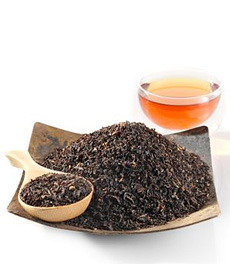
Irish Breakfast Tea from Teavana.com. |
JAPANESE TEA
There are eight basic styles of Japanese tea. Sencha is by far the most popular. See also bancha, genmaicha, guricha, gyokuro, houjicha, kukicha, matcha and mecha. Japanese green tea is steamed versus pan-fired, like Chinese green teas. This prevents oxidation. This step, called the kill-green stage (sassei), is responsible for the grassy, delicate flavor which is distinct to Japanese green teas. Regular sencha is steamed for 30 to 40 seconds, but deep-steamed (fukamushi) sencha can be steamed for up to 120 seconds. The tea is then rolled and finished.
JASMINE TEA
One of the best-known Chinese teas, jasmine can be a black, green, oolong or white tea scented with jasmine flowers. It is typically made with a base of pouchong tea. Jasmine tea is a specialty of Fu Zhou in Fujian Province, where it is scented five times between April and June with fresh jasmine blossoms—a fashion developed during the Ming Dynasty. This method instills the green leaves with attar of jasmine. Jasmine flowers are picked early in the day and mixed in with the tea at night, when they open and release their scent. The scent is infused into the leaves, which are steamed in order to hold scent well. In a top-grade tea, 20 pounds of blossoms are used to scent one pound of tea. Afterwards, the tea is crafted in many different shapes, but the pearl, shown at right, is one of the most popular.
|
|
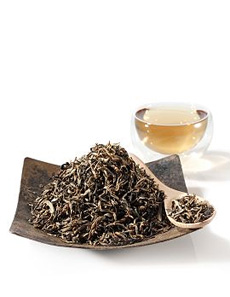
Jasmine tea is made in black, green, oolong and white varieties. Above, black tea jasmine pearls from Teavana.com. See the photo at the top of the page for pearls. |
Some leaves are placed in gauze, gently pressed into the shape of a flower, and then fire-dried to preserve the freshness. Others are hand-rolled into individual “pearls” as in the photo at the top of the page, to lock in the delicate aroma. When brewed, the tea releases the aroma of jasmine flowers. Jasmine should be brewed with water slightly below the temperature of boiling.
JAT
A hybrid form of the tea plant, the origin of the tea bush. For example, if a tea comes from the China or Indian jat, this means that the tea bushes originated either from seeds or cuttings from China tea plants or from the indigenous Indian tea found in Assam. The tea plant can grow to heights of 32 to 50 feet in the wild, but to make it easier to pluck the leaves, the plant is maintained in shrub form at a height of four feet.
JAVA
A tea-producing island of Indonesia.
Continue To Page 9: Tea Terms Beginning With K To M
Go To The Alphabet Index Above
Lifestyle Direct, Inc. All rights reserved. Images are the copyright of their respective owners.
|