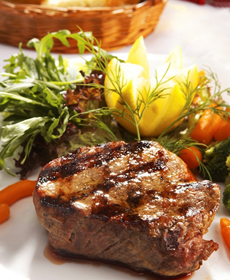
 Know your beef cuts: A breakfast sirloin is a smaller sirloin steak, usually five ounces. Photo courtesy Niman Ranch. Know your beef cuts: A breakfast sirloin is a smaller sirloin steak, usually five ounces. Photo courtesy Niman Ranch.
June 2005
Last Updated July 2026
|
|
Beef Glossary & Beef Cuts Diagram
Where’s The Beef? Find Your Beef Cuts Here!
Page 1: Terms With A & B, Including Black Angus Beef
If you’re looking for the definition of a particular cut of beef, you’ve come to the right place. Here’s the lingo butchers and other industry professionals use as they cut beef. (If you’d like to suggest additional words, click here.) On this page of the glossary, you’ll find terms such as aged beef, beef bacon, beef cheeks, beef jerky, beef stew meat, Black Angus beef and an answer to the question, What is beef? When looking up beef cuts, it’s helpful to refer to the beef cut diagram, courtesy of the National Cattleman’s Beef Association. If you enjoy this Beef Glossary, we have a food glossary for almost every category of food—including a Lamb Glossary and a Pork Glossary.
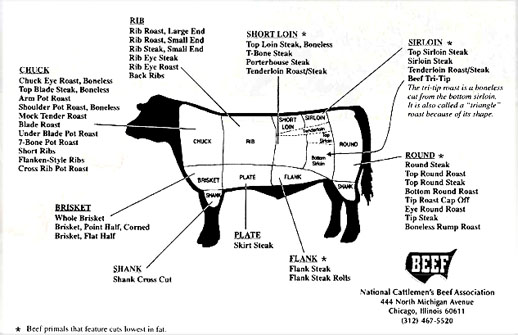
Download your own beef cuts chart (pdf).
Click on a letter of the alphabet to go to the appropriate glossary section:
a b c d e f g h i j k l m n o p q r s t u v w x y z
This glossary is protected by copyright and cannot be reproduced in whole or in part.
You are welcome to link to it.
> The year’s 25+ beef holidays.
AGING or AGED BEEF
Refers to wholesale beef cuts that are held at refrigerated temperatures for a specified period of time in order to optimize the tenderness and flavor of the product. See dry aging and wet aging.
ALL-NATURAL
A misleading term. According to the USDA, “all-natural” or “natural” means that the meat has been “minimally processed with no artificial ingredients.” However, it may still contain antibiotics and growth hormones. To avoid these additives with certainty, choose organic beef.
ANGUS BEEF CATTLE
Angus cattle comprises two breeds of hornless cattle from the original Scottish Aberdeen stock, Black Angus and Red Angus (the original name of the breed was Aberdeen Angus). Black is the predominant color; Black Angus is the most popular breed of beef in the U.S. Four bulls were brought to America in 1873; at the time, Shorthorn and Longhorn cattle were the norms. The crossbred offspring impressed breeders, and purebred herds were imported. The American Aberdeen Angus Association was founded in 1883.
|
|
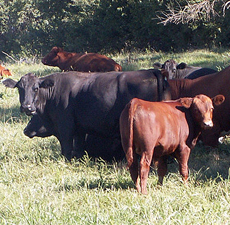
Black and Red Angus cattle. Photo courtesy Wikimedia. |
BABY BACK RIBS or BACK RIBS
While most people think of baby back ribs (or simply, back ribs) as pork, they are also available from a steer. Also called loin ribs, they come from the top back of the rib cage, where the bones are short (“baby”) but meaty. Spare ribs, which come from the front, or belly side, have more fat, but the meat is “spare.”
BASEBALL CUT SIRLOIN
A “new” cut, part of the never-ending search to find something new to sell customers, the baseball cut gets its name from its rounded shape. (We’d actually call it filet-cut sirloin, but “baseball cut” may sound better to some.) This steak is cut from the center of the top sirloin. It’s lean, thick, and flavorful, similar to filet mignon, at a lower price. A baseball-cut steak is not commonly found in a grocer’s meat case, but the cut can be requested from a local butcher.
|
|
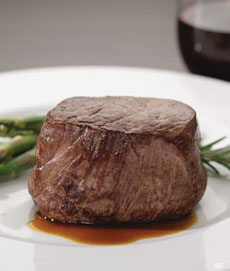
Sirloin cut like a baseball (some might say, like a filet mignon). Photo courtesy Harris Ranch. |
BARBECUE or BARBEQUE or BBQ or BAR-B-QUE
A method of cooking food, often meat, over smoking wood or hot coals. Often, meats are marinated to tenderize tougher cuts, and rubbed with spices and/or basted with sauce. In the U.S., barbecue is a Southern tradition, with each state specializing in different meats, seasonings, and cooking techniques. The term also refers to the food itself and the apparatus used to cook the food. Beef short ribs and brisket are popular for barbecue. Here’s a recipe for beef short ribs.
National Barbecue Day is May 16th.
|
|
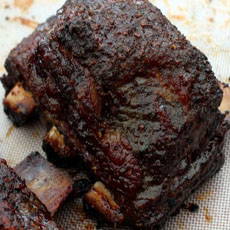
Barbecue beef short ribs. Photo courtesy SlapYoDaddy.com. |
BAVETTE STEAK or FLAP STEAK or FLAP MEAT
Bavette is the French name for the unflatteringly sounding flap meat, the center of the sirloin flap cut. It is short for bavette d'aloyau, “bib of the sirloin.” The term can be confusing: There are several types of bavette steaks in France, including the bavette de flanchet, or flank steak. In France, bavette can be used as a catch-all phrase for any thin steak. In the U.S., it is often called flap steak. Many people think it is the most flavorful cut of steak. As with skirt steak or flank steak, the bavette benefits from marinating and high, dry heat: grilled, broiled, pan-fried, or stir-fried, to no more than medium-rare. The meat should be very thinly sliced across the grain. Here’s a recipe for Asian Flap Steak.
|
|
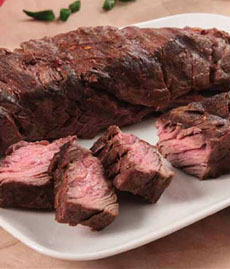
Bavette, or flap steak. Photo courtesy RocheBros.com. |
BEEF: WHAT IS BEEF
Beef is the culinary name for meat from bovines, especially domestic cattle, although beef also refers to the meat from the other bovines: antelope, African buffalo, bison, water buffalo, and yak. The muscle meat is cut into steaks, roasts, or short ribs or processed into corned beef, jerky, and other processed meats. Trimmings are ground (e.g., for hamburger), minced, or used in sausages; organ meat is consumed; blood is used in some varieties of blood sausage. Other parts that are eaten include beef cheeks, bull or bison testicles, heart, kidney, liver, tail (“oxtail”), thymus gland (sweetbread), tongue, tripe; the brains, previously eaten, are no longer because of the danger of Mad Cow Disease (bovine spongiform encephalopathy or BSE). The intestines are used as sausage casings, and the bones are used for making beef stock. The hide is used for leather.
|
|
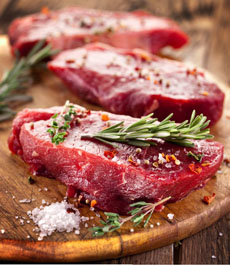
Raw beefsteaks. Photo courtesy Pompeian.com. |
BEEF BACON
Beef bacon is a product made from the steer’s belly meat, close to the flank area. It is smoked and flavored with spices to taste like bacon. It is generally made by producers of healthier, grass-fed beef, who create a “leaner, healthier bacon” (beef bacon is up to 90% leaner than pork bacon). Beef bacon also contains the Omega-3s and CLA of grass-fed beef. It can be found at health food stores, special-ordered from butchers, and ordered online from producers such as GrasslandBeef.com.
National Bacon Day is December 30th.
|
|
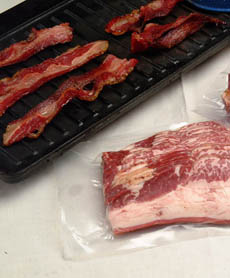
Beef bacon. Photo courtesy GrasslandBeef.com. |
BEEF CHEEKS
The muscles on either side of the cheekbones, braised beef cheeks (and veal cheeks) are popular French bistro fare. They are an inexpensive cut with rich flavor. In Italy, pork cheeks (guancia) are used in dishes and sausage-making.
BEEF JERKY
Jerky is one of the oldest ways of preserving food; the meat was cut into strips, smoked, and dried in the sun. Today, it’s smoked and dried in smokers. Read more about the history of jerky and modern jerky.
June 12th is National Jerky Day.
|
|
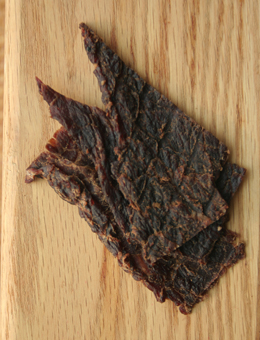
Beef jerky. Photo by Michael Steele | THE NIBBLE. |
BEEF STEW MEAT
See stew meat.
BEEF TALLOW
Beef tallow is a nutrient-dense cooking fat, high in saturated fat and fat-soluble vitamins (A, D, E, K2). While it shares similar uses as butter for cooking and frying, tallow is 100% fat with a higher smoke point (420°F). While beef tallow is sold in jars, you can make your own by rendering fat trimmings from your butcher, or freeze your own trimmings until you have enough. Here’s a recipe (photo © The Seasonal Homestead).

BEEF WELLINGTON
Beef Wellington is a classic luxury dish featuring a beef tenderloin coated in mushroom duxelles, wrapped in prosciutto and puff pastry, then baked until golden. Some recipes include wrapping the contents in prosciutto, or dry-cured ham, which helps retain moisture while preventing the pastry from becoming soggy; coating the beef in mustard; or substituting shortcrust pastry for puff. Although originally made with the entire tenderloin, restaurants have created individual squares. And as with all recipes, the toppings have been varied with everything from creamed spinach to blue cheese. We first learned to make it with pâté in addition to the mushrooms.
 Beef Wellington in a very fancy crust. Here’s the recipe (photo © Snake River Farms).
BISON
Perhaps the most misunderstood beast in the animal kingdom is the bison. Native to North America, its own government calls it a buffalo, having yielded to folk pressure (“Oh give me a home where the buffalo roam...” and misnamed a piece of currency, that, in return, has misinformed an entire populace. From a zoological standpoint, there are no buffalo in the Americas (except for a few imported from Africa and Asia for zoos, and small herds of Asian water buffalo imported to make water buffalo milk cheese and yogurt). Our bison are not related to the African and Asian buffalo, and you can read the facts. Confusion notwithstanding, bison meat is superb: lean and healthy, tender and flavorful. Try it, and you’ll be converted. Just as with beef, however, good bison meat comes from good ranchers. Our favorite is Blackwing Bison.
November 7th is National Bison Day.
|
|
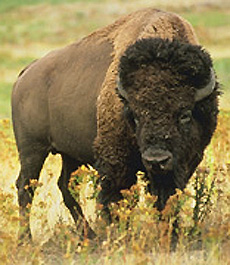
Why does everyone think I’m a buffalo? Because the U.S. Treasury Department erroneously coined the term “buffalo nickel”. I’m a bison. There are no buffalo in America! Read the reality! Photo by Jack Dying, U.S. Agricultural Research Service.
|
BISTRO STEAK
Another term for hanger steak.
BLACK ANGUS BEEF CATTLE
See Angus beef cattle.
BLADE STEAK
The blade steak is cut from the chuck. The cut is not popular because it has a line of tough connective tissue down its center, resulting in a tough steak best suited to braising. However, if the tissue is removed, it produces flatiron steaks, a more tasty, tender, and value-priced cut.
BLOOM
Refers to the process of beef changing from a dark purple (as seen in vacuum-packaged meat) to bright cherry-red color when exposed to oxygen.
|
|
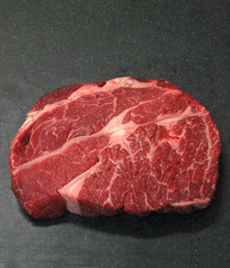
Blade steak. Photo courtesy HealthyButcher.com. |
BONELESS ROAST
A general term covering the eye of round roast, bottom round roast, and cross rib roasts.
BONELESS STRIP STEAK
See New York strip steak.
BOSTON CUT
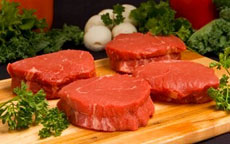
A Boston cut originally referred to a flavorful roast cut from the center of the sirloin. Today, the term is being applied to steaks cut from the center of the sirloin—a very tender cut. Boston cut also refers to the way that the side of beef is cut in New England: When a side of beef is butchered, it is cut across at right angles to the backbone, dividing the side into hindquarters and forequarters.
|
|
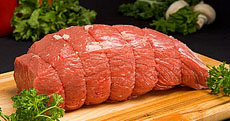
Above, Boston cut roast. Below, Boston cut sirloin steaks. Photos courtesy River Breeze Farm.
|
In the Boston system, three ribs are left on the hindquarter; in the New York or Philadelphia cut, all ribs are left on the forequarter. This means that the first cut of the forequarter in New York (the prime ribs) is the same piece of meat as the first cut on the hindquarter in Boston. The hindquarter cuts also differ. So, asking for a particular cut of meat may bring confusion if you move from or to New England. The U.S. Department of Agriculture refers to cuts by the New York system, as does the rest of the country except parts of New England. See also New York cut.
BOTTOM ROUND ROAST
A large roast, typically ranging in size from 2 to 3 pounds. This cut is ideal for the slow, moist crockpot style of cooking, or wrapped in foil and cooked in the oven at 250°F for four to six hours.
BOVINE SPONGIFORM ENCEPHALOPATHY
See BSE.
BREAKFAST STEAK
A smaller sirloin steak, generally five ounces in weight. See also sirloin steak.
|
|
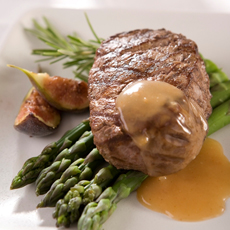
Breakfast steak. Photo courtesy Niman Ranch.com |
BRISKET
Brisket is a flavorful cut of meat from the breast or lower chest, directly behind the foreshank. It is best suited for long-cooking preparations like barbecue, braising, smoking, slow roasting, casseroles, and stews. See also pot roast.
|
|
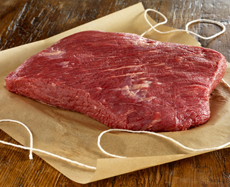
Brisket. Photo courtesy Cyber-cucina.com. |
BSE or MAD COW DISEASE
Bovine spongiform encephalopathy (BSE), or Mad Cow Disease, is a fatal brain disorder that occurs in cattle. The connection between BSE and humans was uncovered in Great Britain in the 1990s when several young people died of a rare brain disorder called Creutzfeldt-Jakob Disease (CJD), which typically strikes elderly people. The British government concluded that BSE was probably the cause of CJD and that the victims contracted the disease probably by eating meat from BSE-infected cows.
BULL TESTICLES
Also known as calf fries, cowboy caviar, prairie oysters, Rocky Mountain oysters, and other terms, this dish originated among cattle ranchers, utilizing the castrated bull testicles. They are floured, deep-fried, and served with a dipping sauce, generally as an appetizer.
BUTCHER’S STEAK
See hanger steak.
BUTT STEAK
See sirloin steak.
|
|
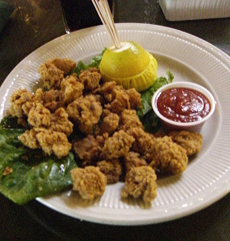
Rocky Mountain Oysters. Photo courtesy Vincent Dismantle | Wikimedia. |
Go To Next Page, Terms C, D & E
Go To Glossary Alphabet Index Above
Lifestyle Direct, Inc. Some definitions were provided by the Cattlemen's Beef Board and are © Copyright 2005 Cattlemen’s Beef Board. All rights reserved. Images are the copyright of their respective owners.
|