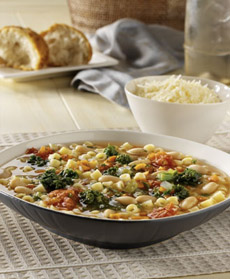
 White bean pasta e fagioli, the classic Italian soup, uses ditalini pasta. Photo courtesy Barilla.us.
Last Updated March 2026
|
|
Pastas: A Glossary
Page 2: Pasta Types With C & D
If you enjoy this Pasta Glossary, we have a food glossary for almost every category of food, including Italian favorites like cheese, espresso, and olive oil. Plus, find reviews of our favorite brands of pasta and sauces, pasta recipes, and informative articles about pasta in our Pasta Section.
| |
Click on a letter to go to the appropriate glossary section.
a b c d e f g h i j k l m n o p q r s t u v w x y z
This glossary is protected by copyright and cannot be reproduced in whole or in part. You are welcome to link to it.
|
|
CALABRIA
A region in southern Italy that occupies the “toe” of the Italian peninsula south of Naples—you can see it in the map below, beneath the highlighted region of Campania. To the northeast is the region of Basilicata; to the west is Sicily. The capital is Catanzaro.
|
CALAMARI orCALAMARATA or
CALAMARETTI
Thick pasta rings are cut to look like sliced calamari (squid). An unusual cut, it is typically made only in the area around Naples, in the region of Campania (see below). And, there’s a version colored black with actual squid ink. The shape is pronounced cah-lah-MAHR-ee, but everyone knows that.
|
|
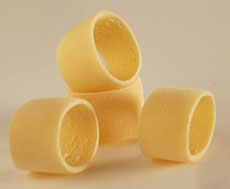
Calamaretti pasta is shaped like rings of squid. Photo courtesy Italen-Pasta.com. |
|
CAMPANELLE
Literally “small bells,” this delicate-looking but sturdy shape has fluted, petal-like edges and a hollow center for capturing sauce. Pronounced cahm-pah-NELL-lay. The cut originated in Puglia.
|
|
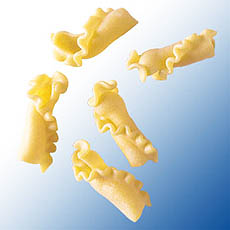
Campanelle pasta. Photo courtesy Italen-Pasta.com. |
|
CAMPANIA
Campania (cahm-PAHN-yah) is a region of southern Italy, whose capital is the famous city of Naples, where pizza is said to have originated. It is surrounded by lesser-known regions: Lazio to the northwest, Molise to the north, Basilicata to the southeast, and the better-known Puglia to the northeast.
CANDELE
Literally, “candles,” candele (con-DAY-lay) are very long, hollow pasta tubes, dramatically, the length of candles.
Candele pasta from PastaGarofolo.it
|
|
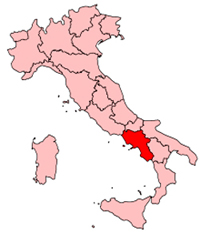
Map of Campania. Image courtesy Wikimedia. |
|
CANNELLONI
Cannelloni (cah-neh-LOE-nee) are often confused with manicotti. Both are stuffed, baked pasta dishes. The difference is that manicotti are stuffed, pre-formed tubes, while cannelloni are rectangular sheets of pasta dough that are filled and rolled into tube shapes. Both are filled with savory stuffing, which can be cheese, spinach, and cheese, or various meats, seafood, or vegetables. The tubes are then covered with a sauce, typically tomato or béchamel, and baked. Cannelloni is Italian for “large reeds.” Some people confuse cannelloni with manicotti. The former is a premade pasta tube, the latter is a filled crêpe.
|
|
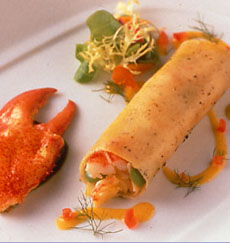
Who needs sauce? The most luxurious cannelloni are these from Tru Restaurant in Chicago. |
CANNEROZZETTI
Ridged, tube-shaped pasta. Pronounced cahn-nay-roe-TSET-tee.
DO YOU KNOW HOW TO PAIR PASTA WITH SAUCE?
YOU CAN’T TOP DELICATE CAPELLI D’ANGELO WITH
A HEAVY MARINARA SAUCE.
HERE’S THE SCOOP!
|
|
CAPELLI D’ANGELO
Literally, “angel’s hair.” The finest strands of pasta. See angel hair pasta. Pronounced cah-PELL-lee DON-jel-loe.
CAPELLINI
Literally, “fine hairs,” capellini (cah-peh-LEE-nee) are long, thin strands of round pasta only slightly thicker than angel hair (capelli d’angelo). Like angel hair, they are used in entrées and side dishes, or broken and cooked in soups. Capellini can take cream sauces, but avoid thick sauces—the strands are too delicate.
|
|
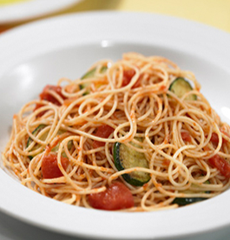
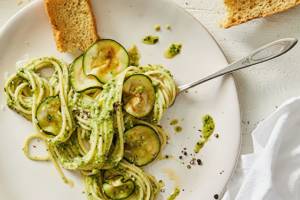
Capelli d’angelo with marinara, zucchini and mint. Photo courtesy Barilla.us. Get the recipe. |
|
CAPUNTI
A charming shape, capunti (cah-POON-tee) is a rolled pasta shaped like open pea pods. Originating in Italy's Puglia region (the heel of the boot, capunti come in a variety of shapes and sizes, and are very similar to cavatelli. The main difference is the divots, which resemble pockets that could hold peas. They make the shape especially good at catching sauce, and it’s what the shape is known for.
|
|
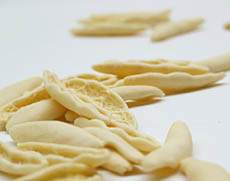
Capunti, pasta shaped like open pea
pods. Photo by Elochan | Wikimedia.
|
CAPPELLACCI
A specialty of the Emilia-Romagna region of Italy, these stuffed pastas are traditionally filled with zucca, which is similar to butternut or acorn squash. The filled pasta dough is folded and twisted like tortellini (but slightly larger).
CAPPELLETTI
The name means “little hat.” This stuffed pasta is a cousin of the better-known tortellini. As you can see in the second photo at right, they are similar in appearance to cappellacci (first photo), but look much more like sailor hats.
Cappelletti, from the Romagna area of Italy (Ravenna, Forlì, Cesena, Rimini), are stuffed with Parmigiano Reggiano or Grana Padano Cheese and Robiola—also local cheeses. Tortellini were originally made with some type of meat. They are from Bologna, also in Emilia-Romagna.
|
|
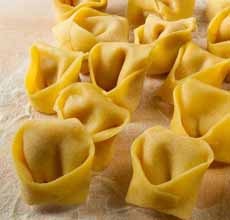
Cappelli are filled pasta pockets, not
unlike the better-known tortellini (photo © CosyCooking.com).
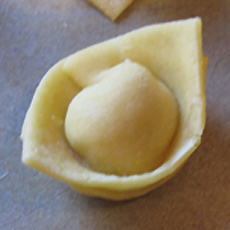 Cappelletti, little hats (photo © Another Jennifer). Cappelletti, little hats (photo © Another Jennifer).
|
|
CARAMELLE
Also known as candy pasta, caramelle is a filled pasta shaped like a wrapped candy with twisted ends. The name means “caramel” in Italian, and those handmade caramels were wrapped in wax paper. The shape is believed to have originated in the Emilia-Romagna region of Italy, where other popular pasta shapes, such as cappelletti, lasagne, tagliatelle, and tortellini, originated.
CASARECCE
A typical pasta of Puglia, the name, meaning “home style,” refers to two-inch-long thin twists. It’s a short pasta shape with curled edges and a groove down the middle, traditionally made by rolling small pieces of dough around a thin wooden pin or metal rod called a ferro. The result looks like a rolled scroll. Pronounced cah-sah-RECH-ee, the shape is called casareccia in some parts of Italy.
|
|
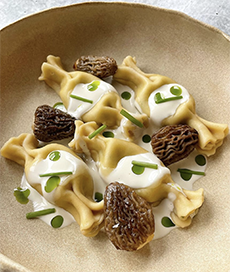
Caramelle with morels and cream sauce (photo © Regalis Foods).
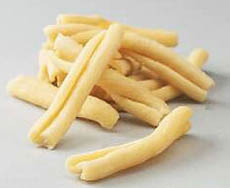
Casarecce (photo © Kenwood Chef Store).
|
|
CASTELLANE
Castellane (cah-steh-LAH-nay), which means “castle dwellers,” is a charming, ridged shell shape, originally called paguri because it resembles the shell of a tiny crab found in the waters along the coast of Italy. They also look like castle towers (keeps).
CASSULI
Curved pasta with horizontal raised ridges. Pronounced cas-SOO-lee.
|
|
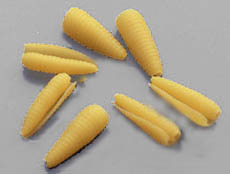
Castellane. Photo courtesy Moldrek.com.
|
|
CAVATAPPI
Short (1-inch) tubular corkscrew or spiral-shaped pasta, native to southern Italy. Cavatappi is used in entrées, side dishes, baked dishes, and pasta salads. They work with just about any type of sauce. in a spiral tube shape. Elsewhere in Italy, they are known as cellentani, spirali, and tortiglione; some English speakers call them double elbows. They usually have rigati (lines or grooves on the outside surface). The shape originated in Southern Italy
|
|
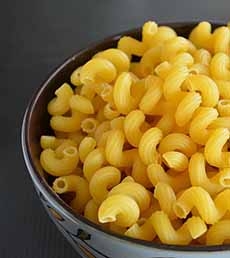
Cavatappi or cellentani. Photo by Heath Caldwell | Wikimedia
|
|
CAVATELLI
Cavatelli (cah-vah-TELL-lee) are small folded pasta shapes that, along with orecchiette and cavaturi (below), small rolled shapes, are the three traditional shapes of the Puglia region of Italy. Some think they resemble tiny hot dog buns. They are ridged, and also called orecchie di prete, priest’s ears, their hollow shape holds thicker sauces. Serve them with seasonal vegetables and ricotta, or sautéed garlic and broccoli.
CAVATURI
These small, rolled pasta pieces (cah-va-TOO-ree) are one of the three traditional pasta cuts from Puglia, along with cavatelli (above) and orecchiette. They pair well with vegetable-based sauces and are good in pasta salads.
|
|
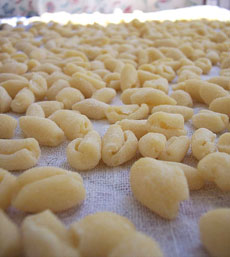
Cavatelli look like miniature hot dog buns. Photo by Luigi Scorcia | Wikimedia.
|
|
CELLENTANI
A small tubular pasta with a ridged surface, cellentani (chay-len-TAH-nee) is sturdy enough to partner with cream sauces and chunky vegetable sauces, as well as tomato sauces. The name means “whirls,” and it is poetically seen as locks of hair. It is very popular in pasta salads.
CELLOPHANE NOODLES or THREADS
These are mung bean threads, translucent, gelatin-like noodles cooked in the same manner as rice noodles. While the Asian word translates as threads, note that the translation of spaghetti is similar: cords or strings. See photos here.
|
|
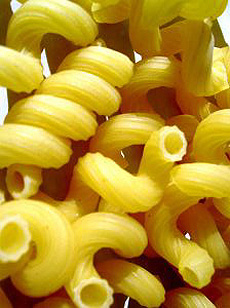
Cellentani pasta. Photo by Linda Pannekoek | SXC. |
|
CHESTNUT PASTA
For fall and winter, northern Italians enjoy pasta made from chestnut flour, an ingredient that is more costly than semolina or other wheat. Use it with duck, game, and in preparations with squash, leeks, portobello, and other mushrooms.
CHITARRA
Literally, “guitar strings,” a rectangular strand of pasta that is thinner than spaghetti (kee-TAR-rah) and flat, like linguine. Different regions of Italy make similar shapes called by different names. Chitarra comes from the Marche region of Italy.
|
|
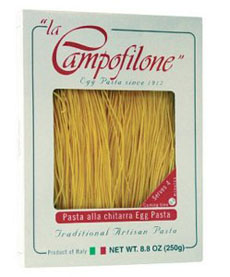
Chitarra pasta. You can find it online. |
|
CHOCOLATE PASTA or COCOA PASTA
Savory chocolate pasta is an old tradition in Tuscany, where it is served with game as well as in a light cream sauce with walnuts. It can also be served as a dessert, topped with whipped cream, ice cream, and dessert sauces. We have served it in a dessert pasta Mont Blanc, with chestnut purée and whipped cream. While the latter is best done with a long cut of pasta swirled into a nest and filled with the chestnut purée, we have not seen chocolate fettuccine in the U.S. in many years. However, the Tuscan pastificio (pasta-maker) Morelli makes a small penne rigate that is 9.25% cocoa powder. It has a deep brown chocolate color and a lightly bitter cocoa flavor. You can find it online.
|
|
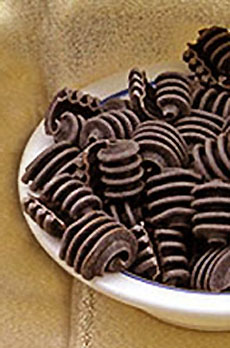 Chocolate pasta. Treat yourself to spirals or . Chocolate pasta. Treat yourself to spirals or . |
|
CONCHIGLIE
Italian for “conch shells,” conchiglie (con-CHEE-lee) are a popular shape of pasta that comes in a regular size that is sauced and a large size that is stuffed (then sauced). Jumbo stuffed shells are traditionally found in the south of Italy, where stuffed pasta dishes are popular. A rich ragù (meat sauce), a cream sauce, or a cheese sauce is perfect with this pasta, as the shell serves as a “scoop” for the sauce. See photo at right.
|
|
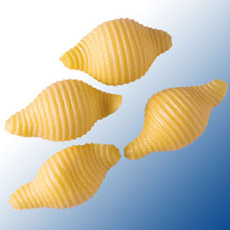 Shell pasta, or conchiglie. Photo courtesy Pastazanini.it Shell pasta, or conchiglie. Photo courtesy Pastazanini.it |
|
CORALLINI
Tiny tube-shaped pasta used in soups and casseroles (coh-rah-LEE-nee).
CORZETTI or CROXETTI or CURZETTI
or CROCHETTI
A specialty of Liguria, these pasta shapes are pressed to look like stamped coins from ancient times. Some have family crests, some have other designs. The shapes are cut out of the rolled-out dough with a round stamp cutter. Pronounced cor-ZEH-tee or other pronunciation, depending on the dialect..
|
|
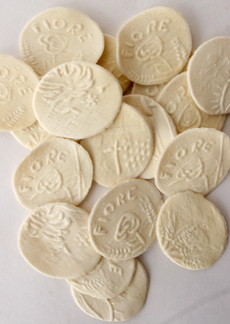
Corzetti. Photo by Brian Van Sise | THE NIBBLE.
|
|
COUSCOUS
Couscous is spherical granules of pasta, made by rolling moistened semolina wheat and then coating the granules with finely ground wheat flour. The finished grains are about 1mm in diameter before cooking. Couscous is usually steamed rather than boiled. It is traditionally served under a meat or vegetable stew, but is also eaten plain, as a side, and flavored as a dessert. Couscous is a staple throughout Northern Africa and parts of the Middle East. Israeli, or pearl, couscous is larger and served in different ways.
|
|
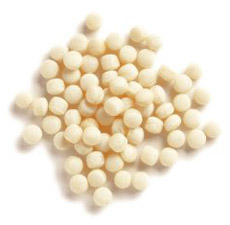
Pearl couscous available on Amazon.com. More about couscous. |
DITALI
Large pasta tubes that are also used for soups (dee-TAH-lee).
|
DITALINI
Ditalini (dee-tah-LEE-nee), or “little thimbles,” are tiny, very short tubes of pasta. From the Campania region of Italy, they are typically used in the classic bean and pasta soup, pasta e fagioli, minestrone, and plain broth.
DUMPLING
Small balls of dough are either boiled in soup or separately steamed and served with soup. The word is a diminutive of the German dump, a badly-shaped piece, and dompelen, to plunge. Savory dumplings exist in Western and Eastern cultures. They are traditional in the southern United States, British cuisine, Central and Eastern Europe (pierogies), Chinese jiaozi, potstickers, and wontons; Japanese gyoza and shumai; and Korean mandu. Adding to the confusion, there is also a dessert pastry dumpling, made by frying a sweet dough ball or baking fruit wrapped in pastry—for example, apple dumplings.
|
|
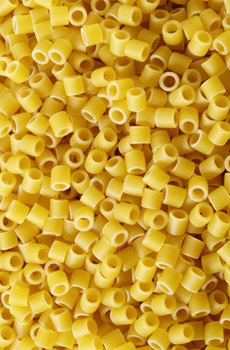
Ditalini pasta. Photo courtesy Pastazanini.it. |
|
DURUM WHEAT
Triticum durum is the hardest wheat grown today and the wheat from which Italian pasta and the majority of American dry pastas are made. Durum is the hardest wheat known to man—the name durum comes from the Latin word for hard. “Durum semolina” will appear on most pasta labels. Some labels also may state “durum flour,” which is a finer granulation produced in the milling process and is primarily used in noodle products. Durum gives pasta its yellow-amber color and nutty flavor. The hardness of the wheat imparts the ability to retain both shape and firmness when cooked. Durum wheat is high in gluten and is used only for pasta, never for baking, cereal, or other purposes. See also semolina.
|
|
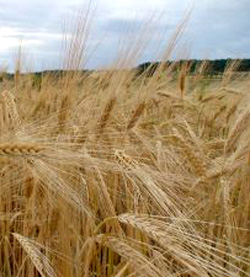
Durum wheat. Photo courtesy of SXC. |
Continue To The Next Page: Pasta Terms With E & F
Go To The Glossary Alphabet Index, Above
© 2005-
|