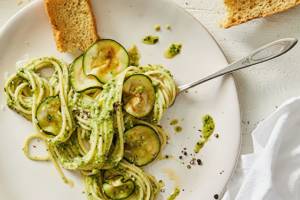
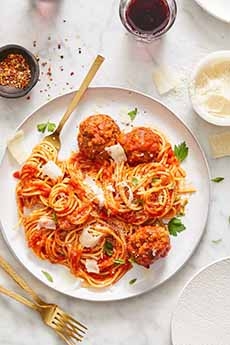
 An Italian-American favorite, spaghetti with meatballs didn’t exist in Italy, where meat was too expensive (photo © DeLallo).
Last Updated March 2026
|
|
Pasta Glossary
Page 8: Pasta Types With S
If you enjoy this Pasta Glossary, we have a food glossary for almost every category of food, including Italian favorites like cheese, espresso, and olive oil. You can also find reviews of our favorite brands of pasta and sauces, pasta recipes, and informative articles about pasta in our Pasta Section.
Click on a letter to go to the appropriate glossary section.
a b c d e f g h i j k l m n o p q r s t u v w x y z
This glossary is protected by copyright and cannot be reproduced in whole or in part.
SACCHETTE
These sacks, or “beggar’s purses,” are made with a variety of fillings, like ravioli. They are most often boiled and served like regular pasta. However, in the photo at the right, they were deep-fried for two minutes in safflower oil and served as an hors d’oeuvre with a dipping sauce. Pronounced sah-KAY-tay.
SAGNE
A specialty of the Puglia region of Italy, these are long cuts of pasta curled like ringlets.
|
|
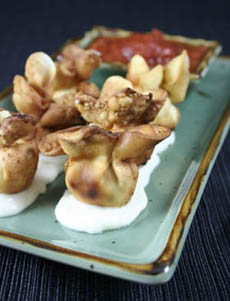
Photo of Nuovo Pasta sacchette by Ryan Clark. Read our full review of Nuovo Pasta. |
|
NIBBLE TIP
Beautiful cuts like the creste de gallo, “crest of the rooster” (cockscombs), are conversation pieces as well as delicious and easy-to-make courses.
They require no special sauce, because the pasta itself is the center of attention.
Italians would use butter or garlic, and olive oil.
Pick one day each month—the first Monday, e.g., as “specialty pasta night” at your house, and try some of these wonderful cuts.
|
|
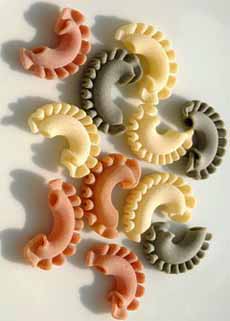
Creste de gallo, cockscombs, are a delightful shape. Photo Fotolia.
|
|
SARDINIA or SARDEGNA
The second largest island in the Mediterranean Sea (Sicily is the largest), Sardinia lies west of Italy and south of Corsica, between Italy, Spain, and Tunisia. It is an Italian region with a special autonomous statute. The capital is Cagliari.
SAFFRON-FLAVORED PASTA
Saffron, the world’s most expensive spice, makes an elegant pasta that pairs wonderfully with shellfish, spicy tomato, or light and creamy sauces. Several artisanal pasta-makers offer saffron long cuts; Rustichella d’Abruzzo makes a lovely Saffron Fettuccine that is available online.
|
|
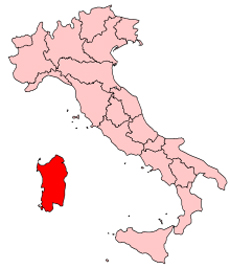
Map of Italy highlighting the island of Sardinia, courtesy Wikimedia.
|
|
SEMOLINA
Semolina is the coarsely ground and granular endosperm of durum wheat. These round golden kernels are the base of most American and all Italian dry pasta. Semolina is granular like sugar, not powdery like most other flours. Homemade fresh pasta is generally not made from semolina, but from general-purpose flour that is lower in gluten. Preparing semolina dough requires industrial mixers or several hours of kneading the granular mass. As a result, homemade pasta cooks much more quickly, often in half the time, and can overcook easily if the pot is not watched. In general, properly-cooked, top-quality commercial artisan pasta is as good or better than what most people can make at home.
|
|
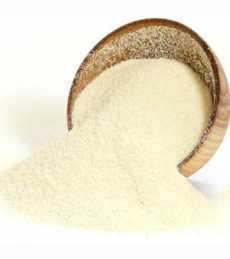
Semolina flour is available online. Photo courtesy Gourmet Imports | Amazon. |
|
SEME DI MELONE
Seme di melone (SEH-may dee meh-LOE-nay) literally, “melon seeds,” is a small pasta used in soups.
SENATORE CAPELLI
A high-protein variety of durum wheat (seh-nah-TOE-ray cah-PEL-lee). The artisanal Italian producer Latini makes spaghetti and pennette out of this flavorful variety of wheat.
SHORT-CUT PASTA, SHORT PASTA CUTS, or SHAPED PASTA
Short-cut pastas are always dried pastas, since it is not feasible for fresh pasta to hold a shape. They are available in many different sizes and specific shapes: bow ties (farfalle), corkscrews (fusilli), elbows, penne, orechiette, rigatoni, rotelle, rotini shells (conchiglie), and wagon wheels (ruote/rotelle) are a few of the more popular ones. They were created to capture hearty ragùs and chunky vegetable sauces in their hollows and ridges, ensuring both pasta and sauce in each bite. The concept of shaped pasta originated with 13th-century German bakers, who made bread dough in symbolic shapes like words, birds, and stars.
|
|
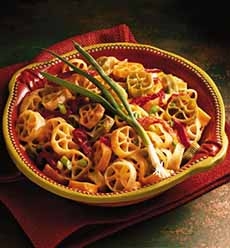 Wagon wheels are a short cut pasta (photo © Wisconsin Dairy). Wagon wheels are a short cut pasta (photo © Wisconsin Dairy).
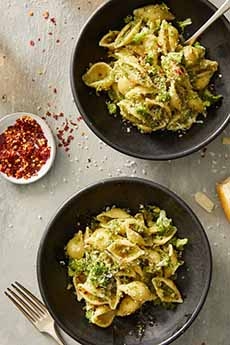 Shells are available in mini (conchigliette, a short cut), medium (conchiglie), and large (conchiglioni). The conchigliette, above, are too small to be stuffed, so they’re topped with sauce and, in the photo, broccoli and anchovies (photo © DeLallo). Shells are available in mini (conchigliette, a short cut), medium (conchiglie), and large (conchiglioni). The conchigliette, above, are too small to be stuffed, so they’re topped with sauce and, in the photo, broccoli and anchovies (photo © DeLallo).
|
| SHELLBOWS
Shellbows are a hybrid pasta shape launched in 2022. A podcaster and an artisan pasta maker, Sfoglini, collaborated to create the “new” shape. You will read elsewhere that the cut is also called lumache, conchiglie, or pipette, but in reality, it is a heavily modified lumache.
They combined lumache’s snail-shell structure with extreme much deeper ridges than a standard piper rigate to increase the surface area for sauce. They added a double offset slit, a specific opening that allows sauce to enter easily but makes it harder for it to fall out. Finally, there are thicker walls to ensure an al dente snap.
|
|
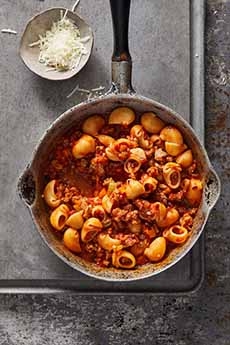
Turkey sausage with shellbows. Here’s the recipe (photo © DeLallo). |
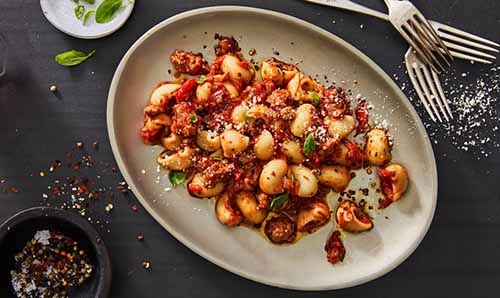
Shellbows with Italian sausage. Here’s the recipe (photo © DeLallo)
SHELLS or CONCHIGLIE
The conch shell is one of the more popular shapes of pasta. Jumbo shells can be stuffed with everything from basic ricotta, luxurious crab, or fusion flavors like taco or Thai fillings. Small shells are a perfect everyday pasta for sauce, soups, salads, or macaroni and cheese (more charming than elbows).
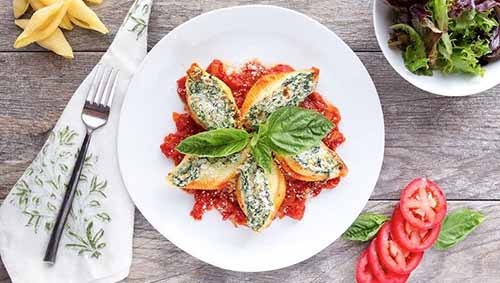
The large shells are for stuffing (photo © Gobble).
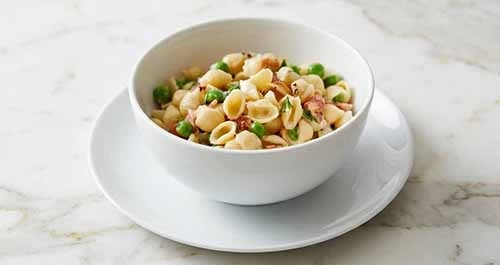
Small shells are for saucing. These have peas and prosciutto tossed with melted butter(Gemini Photo).
|
SOUP PASTA
Various smaller and tiny dried pasta shapes. Some varieties include:
- Alphabets
- Corallini, ditallini, and tubettini, tiny
tube-shaped pasta
- Orzo, a pasta shaped like grains of rice
- Pastina (tiny stars)
- Pearl couscous, small rolled balls of
semolina
|
|
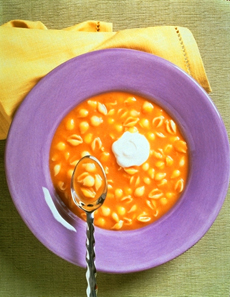
Acorn squash soup with miniature shells. Photo courtesy National Pasta Association. |
|
SPACCATELLI
A specially cut long strand tube pasta (pronounced spah-cah-TELL-lee.). The tube is slit from top to bottom.
|
|
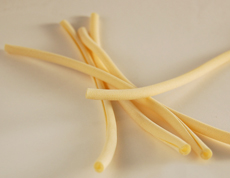
Photo courtesy PastaficioFiorillo.it. |
|
SPAGHETTI
Spaghetti is the most famous cut of pasta. It is said to be the oldest shape known, and despite fashion for more elegant or unusual shapes, it is still the number one pasta shape in America. Long, thin, and round, spaghetti literally means “lengths of cord” (spaghetti is the diminutive of “spago,” meaning cord or string). The thickness of spaghetti varies from region to region (see spaghettini and spaghettoni). A versatile pasta, it can be used in almost any kind of dish and with almost any thickness of sauce. However, it works best with oil- or tomato-based sauces, which are thinner and allow the sauce to cling to the pasta. It is available in plain semolina, colored and flavored with spinach, beets, and bell peppers, and in numerous specialty flavors.
|
|
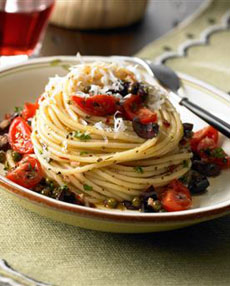
Spicy Spaghetti Provençal. Photo courtesy McCormick. Get the recipe. |
|
SPAGHETTI or LINGUINI A MATASSA
Specialty nested spaghetti. Rather than purchasing straight “sticks” of pasta, it is dried in attractive coils or figure-eights. (Pronounced ah mah-TASS-uh.) A matassa is a skein of wool.
SPAGHETTI TAGLIATI
Spaghetti tagliati (tahl-YAH-tee) is cut into smaller lengths for soups. While you can purchase it (Barilla makes it, called Cut Spaghetti), home cooks simply break up conventional sticks of spaghetti before cooking.
|
|
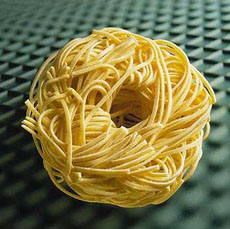
Matassa is a skein of wool. Photo courtesy Moldrek.com. |
|
SPAGHETTI DI NERO DI SEPIA or
SQUID INK PASTA
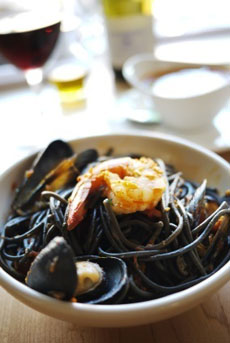
Pronounced dee NAY-roe dee SAY-pee-ya, black spaghetti is a specialty of the island of Sardinia. The pasta is colored black by squid (cuttlefish) ink, which adds to the texture and flavor. Squid ink pasta has a slightly tangy, briny flavor that pairs best with seafood sauces: a frutti di mare recipe (meaning “fruit of the sea,” an assortment of clams, mussels, scallops, and shrimp or simply alle vongole, with fresh clams in a garlic butter sauce. Other pasta shapes are also made with squid ink, but spaghetti is the most frequently found cut. You can buy it online. Some brands don’t use enough squid ink, so even though the pasta is black (some are dark gray), the squid ink flavor doesn’t present itself. If you miss it, keep trying different brands until you find the right one.
|
|
Matassa is a skein of wool. Photo courtesy Moldrek.com. |
SPAGHETTINI
A very thin spaghetti, but thicker than vermicelli. It is popular in Southern Italy, where it is often served with spicy sauces.
SPAGHETTONI
Thick spaghetti with a more substantial mouthfeel, a style preferred in central and southern Italy, where they eat their pasta more al dente (firmly cooked) than in northern Italy. It is made into two-foot-long strands that are usually broken up before cooking. In Puglia, it is typically served with olive oil and fresh garlic.
|
SPÄTZLE or SPAETZLE
Pronounced SPEHTZ-sell, spaetzle is German for “little sparrow.” It is a dish of tiny noodles or dumplings made with flour, eggs, water or milk, salt, and sometimes a dash of nutmeg. The spaetzle dough is either rolled and cut into slivers or forced through a sieve or colander with large holes. The small pieces of dough are usually boiled before being tossed with butter or added to soups or other dishes. In Germany, spaetzle is served as a side dish much like potatoes or rice, and is often accompanied by a sauce or gravy.
|
|
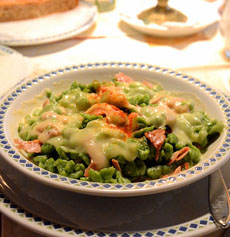
Spinach spaetzle or Spinat Spätzle, a variety of Spätzle made with spinach, is popular in the Southern Tyrol. Photo by Takeaway | Wikimedia. |
SPECIALTY PASTA
Specialty pastas have added ingredients, such as vegetable colors and flavors, herbs, and other seasonings. They can also have specialty shapes. Spinach provides a green color, carrots an orange color, beets or tomatoes a red color, black beans a brownish color, and squid ink a black color. Common herbs and seasonings include basil, black pepper, chile, garlic, lemon peel, and rosemary. Specialty pastas are available in both dry and fresh varieties. Specialty shapes commemorate every holiday and every icon, from cartoon characters and sports equipment to palm trees and dollar signs. (For examples of these, read our review of Pasta Shoppe novelty pastas.)
SQUID INK PASTA
See spaghetti nero, above.
STRAND PASTA or LONG CUTS
This is a category that includes the most famous name in pasta—spaghetti—as well as angel hair, capellini, vermicelli, and other long rods of pasta. The category is also called long cuts. The strands are generally round but can be square or curly, as in the case of long fusilli bucati. The basic difference is the thickness of the strands. Thicker strands work well with heavier sauces, while the thinner strands work better with lighter sauces. (Long flat strands of pasta, like linguini and fettuccini, fall into the category of ribbon pasta.) Oil-based sauces like pesto are ideal for strand pastas: They coat the noodles evenly and keep the strands from clumping together.
STRANGOZZI
Pronounced strahn-GOAT-tsee, a strand egg pasta from the Italian region of Umbria.
|
STROZZAPRETI or STRANGLOLAPRETI
Literally “priest stranglers” or “priest chokers,” this attractive twisted tubular pasta (pronounced STROAH-tsa-PREH-tee) was named centuries ago when it was common practice in Italy to let priests eat for free in restaurants and homes. According to the story, some restaurateurs wished that the “freeloaders” would choke on the pasta course before they could get to the more expensive meat and fish courses. The apocryphal story is that they rolled a shape that might get lodged in the priest’s throat.
|
|
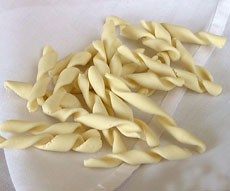
A shape restaurateurs hoped would “strangle the priest.” Photo PacificiaFiorillo.it. |
Hand-rolled squares of pasta are twisted in one quick motion with open palms in opposing directions. It’s the perfect cut to serve your gluttonous relatives! Strozzapreti handmade by Rustichella d’Abruzzo is available at Amazon.com.
STUFFED PASTA
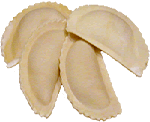
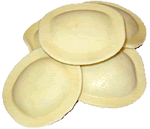
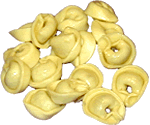
Fresh pasta sheets stuffed with a filling. Filling is placed on a flat sheet of pasta, another sheet is placed on top, and the edges are sealed. Examples include agnolotti, cappelletti, fagottini (purses), mezzelune, pansotti, ravioli, sacchettini, tortellini, tortelloni, and others. Each region created its own versions, with all styles of pasta.
Stuffed pastas are formed in a variety of shapes—squares, circles, half moons, triangles, “hats”—and are stuffed with almost any kind of filling, either single or combinations of different meats, cheeses, vegetables, seafood, and herbs.
Not all stuffed pasta is sealed: Think of shells (conchiglie) and tubes, like cannelloni and manicotti. These can be stuffed with seasoned ricotta cheese, spinach and ricotta, spinach and almonds, mascarpone and walnuts or many other variations. Stuffed pastas are meant to be dressed lightly—with butter or olive oil instead of a constructed sauce—because the filling is the center of attention.
 |
 |
 |
Agnolotti.
|
Ravioli. |
Tortellini.
|
Stuffed pastas from AlfonsoGourmetPasta.com
Continue To The Next Page: Types Of Pasta With T
Go To The Glossary Index, Above
© 2005-
|