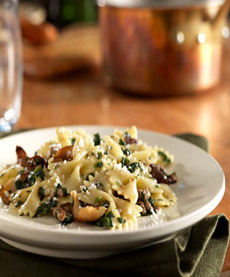
Bow tie pasta with veal sauce. Photo courtesy Barilla.us.
Last Updated March 2012 |
|
Italian Pastas
Page 3: Italian & Other Pasta Types ~ E & F
If you enjoy this Pasta Glossary, we have a food glossary for almost every category of food, including Italian favorites like cheese, espresso and olive oil. Plus, find reviews of our favorite brands of pasta and sauces, pasta recipes and informative articles about pasta in our Pasta Section.
Click on a letter to go to the appropriate glossary section.
a b c d e f g h i j k l m n o p q r s t u v w x y z
This glossary is protected by copyright and cannot be reproduced in whole
or in part. You are welcome to link to it.
EGG PASTA or EGG NOODLES or PASTA ALL’UOVO
Egg noodles originated in the Emilia-Romagna region of north central Italy. This is one of the two basic categories of commercial pasta. In Italian, the category is known as pasta all’uovo. The other category, pasta made without eggs, is called pasta di semola di grano duro. By law, egg noodles must have 5.5% egg solids by weight. The egg provides a richer color and flavor, and a few more calories. Plain pasta has a slightly nutty flavor, reflecting the durum wheat with which it is made.
The classic Italian egg pastas, such as tagliatelle, fettuccine and lasagne, are flat and of varying width. They are also made in non-egg versions. Egg pasta goes well with hearty dishes with meat-based sauces and cream sauces. They can be flavored with spinach (green-colored), tomato (red-colored), or squid ink (black-colored). They are often used in comfort foods, such as casseroles and soups.
ELBOW MACARONI
A short, curved semicircular tube of macaroni, most popular for macaroni and cheese and macaroni salad. With their short cooking time and familiar shape, elbows are a popular cut. They also are used in entrées, salads, soups and baked dishes in addition to macaroni and cheese. See Ronald Reagan’s macaroni and cheese recipe.
ELICHE
“Propellers,” a very twisted shape that has many folds to hold tomato-based and cheese sauces.
|
|
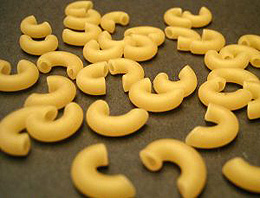
Elbow macaroni. Photo courtesy SXC. |
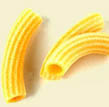 ELICOIDALI ELICOIDALI
A specialty style of grooved rigatoni.
EMILIA-ROMANA
A region of Northern Italy comprising the two historic regions of Emilia and Romagna. It forms a rough triangle, bounded on the East by the Adriatic Sea, on the North by the Po river and on the South by the Appennine range. Bologna is the capital; other provinces include Ferrara, Forli-Cesena, Modena, Parma, Piacenza, Revena, Reggio Emilia and Rimini.
|
|
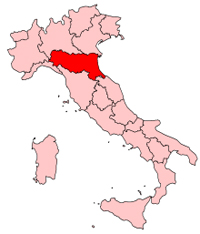
The Emilia-Romagna region of Italy. Map courtesy Wikimedia. |
ENRICHED
The term enriched on a pasta label refers to the addition of nutrients considered essential to a balanced diet, including several vitamins in the B complex, thiamine, riboflavin, niacin and folic acid.
EXTRUSION
A manufacturing process where the material is pushed and/or drawn through a die to create a shape. For artisanal pastas, the die surface is the traditional bronze, which provides a rough surface that has artisan visual appeal and is said to hold sauce better. Commercial production uses Teflon-coated dies, which enable faster processing and provide a smooth surface. In food processing, not only pastas, but breakfast cereals and ready-to-eat snacks are manufactured by extrusion.
FARFALLE or BOW TIE PASTA
Farfalle date back to the 1500s, originating in the Lombardy and Emilia-Romagna areas of northern Italy. The Italian word for butterflies, farfalle (far-FAH-leh) are commonly called bow ties in the U.S.—literally, they look more like bow ties than butterflies, but the bow tie hadn’t been invented in the 1500s. Rectangular pieces of pasta are pinched in the middle to create the shape. They are versatile for most purposes and sauces, but showcase well with lighter and creamy sauces. Miniature farfalle are made for soups.
FARFALLONI
Large bow tie pasta (far-fah-LOE-nee).
|
|
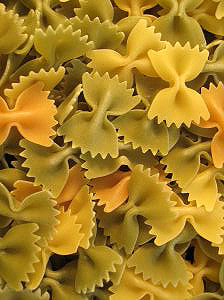
Farfalle or bow tie pasta. Photo courtesy of SXC. |
FARRO
An unhybridized ancestor of modern wheat, farro is one of the first grains “discovered”: It sustained the Roman legions as they conquered Europe. It has a nutty flavor, is high in fiber content and nutrients and can be tolerated by many wheat-sensitive people because its gluten is more easily digested (check with your healthcare provider). Fettuccine from farro flour, made by artisan producer Rustichella d’Abruzzo, is available from SalumeriaItalia.com.
FETTUCCINE or FETTUCCINI
The first pasta shapes were made by hand with simple tools. Fettuccine, (feh-too-CHEE-nay), which some credit with originating in Rome, are made from flat sheets of pasta cut into ribbon-shape strands (fettucce, or “small ribbons”). It is one of the most popular pasta shapes. Wider than the other popular flat shape, linguine, this basic noodle provides a better surface for catching sauce. It pairs best with rich and creamy sauces, including cheese sauces, but olive oil, tomato sauces and butter are commonly served with it. One of the best-known pasta dishes, Fettuccine Alfredo, is made with a rich sauce prepared with butter, cream and Parmigiano-Reggiano cheese. Fettuccine are similar to tagliatelle, the flat pasta from the northern Italian region of Emilia-Romagna, but are narrower. The alternative spelling and pronunciation, fettuccini (feh-too-CHEE-nee), is an Americanization.
|
|
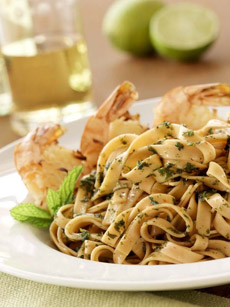
Tomato fettuccine. Photo courtesy MorgueFile. |
FREGULA
Fregula (FRAY-gyoo-luh) is a Sardinian pasta similar to couscous, but with a rougher texture. It is lightly toasted, giving it a nutty flavor. The pasta is formed into small round balls about the size of Israeli couscous, and is used in soups and stews. A traditional Sardinian recipe uses clams and broth—see a recipe for Sardinian Clam Soup With Fregula.
|
|
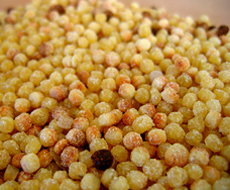
Fregula. Photo by Emily Parkhurst | Wikimedia. |
FRESH PASTA
Limited to long goods such as spaghetti, linguine and fettuccini, or filled pastas such as ravioli and tortellini, fresh pasta can be commercially-made, artisanally-made or homemade. The dough is made from all-purpose wheat flour, whole eggs, salt, and usually, oil for easier handling. The dough is blended, kneaded and rolled out by hand or machine and cut into the desired widths. Fresh pasta is very perishable. It must be wrapped in airtight packaging, refrigerated and used within four or five days. Learn how to cook fresh pasta.
FUSILLI
Fusilli (foo-ZEE-lee) means “little spindles” in Italian—pasta in longer spiral shapes (though they are also sold in shorter spirals). Each region has its own “twist” on what we call corkscrews. Some are very long, some just half an inch, some are tightly wound, some less so. Corkscrew-like twists are an excellent cut for vegetable, cream and cheese sauces. Short-cut fusilli make excellent pasta salads and baked pasta.
|
|
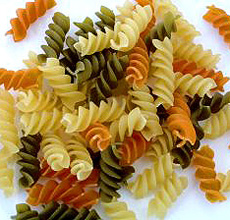
Tricolor fusilli. Photo courtesy SXC. |
FUSILLI BUCATI or FUSILLI COL BUCCO
Hollow fusilli. These beautiful fusilli are long, tightly-spiraled pasta straws with a tiny hole in each strand, like a drinking straw. They are frequently packaged still in their original, long U-shaped strand, which is how they were hung to dry. Fusilli col buco made by Rustichella d’Abruzzo and are available at SalumeriaItaliana.com.
FUSILLI NAPOLETANI
Long-cut (spaghetti-length) fusilli. Also called fusillo Calabrese. Unlike fusilli bucati (above), they do not have a center hole.
|
|
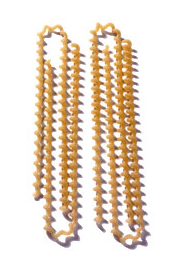
Fusilli bucati. Photo courtesy of SXC. |
FUSILLONI
Giant corkscrew pasta—the oni attached to fusilli means “big” (foo-zee-LOH-nee). They pair well with everything from cream sauces to chunky vegetable sauces.
Continue To The Next Page: Pasta Terms G To L
Go To The Glossary Alphabet Index, Above
© 2005-
|