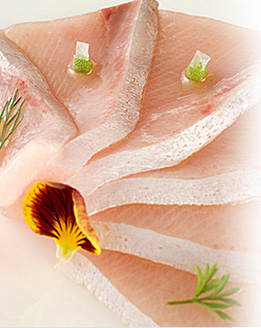
 Yellowtail—hamachi—is a popular fish for both sushi and sashimi. Megu Restaurant.
July 2007
Last Updated May 2026
|
|
Sashimi & Sushi
And A Glossary Of Sushi & Sashimi Terms
Page 4: H, I
If you enjoy this Sushi Glossary, we have a food glossary for almost every category of food. Check out the Seafood Glossary, too. And if you want to know the history of what you eat, take a look at our 1000+ food histories.
| |
Click on a letter to go to the appropriate glossary section.
a b c d e f g h i j k l m n o p q r s t u v w x y z
This glossary is protected by copyright and cannot be reproduced in whole or in part. You are welcome to link to it.
|
|
HAKO SUSHI or HAKOZUSHI
A type of oshi sushi (pressed sushi) made using a rectangular wooden mold. It is the best-known style of pressed sushi, which originated in Osaka. Ric is pressed into the mold lightly, toppings are overlaid, and the “cake” is cut into squares or rectangles. See oshi sushi.
HAMACHI
Hamachi (photo above), or young yellowtail, is a gleaming, unctuous, firm, pink-hued fish, one of the more flavorful. Often served chopped in a roll with scallions (negi-hamachi). Hamachi is called by different names, depending on its maturity. Older hamachi is referred to as amberjack.
HAMACHI-KAMA
Yellowtail collars, which are generally served broiled.
HAMAGARI
A type of Japanese clam, in season in March.
|
HAMAGARI-ZUSHI
A trompe l’oeil style of sushi where egg crêpes are folded into quarters and stuffed with sushi rice and any variety of flavoring ingredients (sesame seeds, ikura, parsley, etc.) The finished product resembles a clamshell (photo at right).
Hamagari-zushi is related to chakin-zushi, where the omelet is wrapped in a bag shape and tied like a beggar’s purse.
HAMO
Pike eel.
|
|

Hamaguri-zushi (photo courtesy Just Hungry).
|
|
HANAKATSUO
This is dried bonito, shaved or flaked; good, but not the top of the line (katsuobushi). The process for creating the flakes is complex: Fillets are simmered, deboned, smoked, and smoked again the following day. They are not katsuobushi, which goes through a final fermentation stage, but are a good substitute at a lower price, called aragatsuo. They are sold shaved and packaged as katsuo-kezuri-bushi or hanakatsuo.
|
|

Hankatsuo, dried bonito. Photo courtesy Uncornered Market.
|
|
HAND ROLL
Rice and fish or vegetables rolled in a sheet of nori, resembling an ice cream cone. Hand rolls are best eaten when sitting at a sushi bar so the nori remains crisp. If it takes a few minutes to get to a table, it picks up moisture from the ingredients and becomes chewy, losing the texture and flavor it should have. Also, see temaki.
HARUSAME
Thin, transparent noodles made of bean gelatin. They are also known as bean thread noodles, bean threads, cellophane noodles, Chinese vermicelli, crystal noodles, and glass noodles. They are made from a starch such as batata starch, canna, cassava, mung bean starch, potato starch, or yam starch, plus water. In China, mung bean starch is used.
Bonus: All these noodles are gluten-free.
|
|
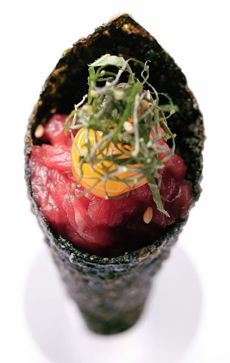
A maguro (tuna) hand roll with a quail egg (uzuri tamago), scallions, and sesame. Photo courtesy Jungsik.
|
|
HASHI
Chopsticks. Hashi is the Japanese word for bridge (those picturesque Japanese footbridges).
While Chinese chopsticks are square and the ends are blunt, Japanese chopsticks are round (like a pencil—see photo) and the ends taper to a point. One reason for this is the nature of the cuisine:
Much Chinese cuisine is cut-up and wok-based, while the Japanese eat a lot of whole fish, and the tapered ends facilitate the removal of bones.
Chopsticks are the world’s second-most-used method of bringing food to the mouth, after fingers. They were invented in China, where they have been traced back to the 3rd century B.C.E.
|
|
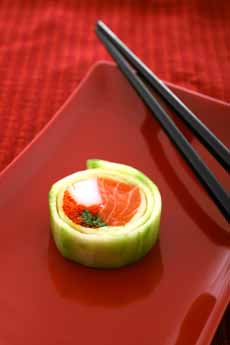
Hashi, chopsticks, with a naruto roll, which uses a cucumber wrap instead of seaweed. Photo Vasko Miokovic | IST.
|
HAWARA
Domestic mackerel tends to be milder and less fishy than saba, Spanish mackerel. Horse mackerel (aji) belongs to a different family. See saba.
HAZUSHI or HASUSHI
See Kaninohazushi.
|
HIJIKI
Black seaweed, which has the appearance of large tea leaves (tea leaves also can be eaten as a vegetable, but are not due to the expense).
While often enjoyed as a salad with a vinaigrette (hijiki no nimono), hijiki can be made into a vegetarian sushi roll as well.
|
|

Hijiki no nimono, a seaweed salad. Here’s the recipe from Japanese Cooking 101.
|
|
HICHIMI TOGARASHI
A mixture of spices for table seasoning. It typically includes black hemp seeds, dried mandarin orange peel, ground sansho pepper pods, nori seaweed bits, red pepper (togarashi), white poppy seeds, and white sesame seeds.
HIKARI MONO
Silver-skinned fish (aji, iwashi, kohada, sanma, and sayori, e.g.) sliced for serving, with the silver skin left on. (See photo at right.) One of the three types of sushi-dane, is the type of meat (flesh) of the fish. The other types are red meat fish, such as tuna, and white meat fish, such as fluke.
he type of “meat” (i.e., fish): white meat, red meat and “shining fish”
Read more at: http://www.thenibble.com/reviews/main/fish/seafood/sushi-glossary7.asp#sushidane
he type of “meat” (i.e., fish): white meat, red meat and “shining fish”
Read more at: http://www.thenibble.com/reviews/main/fish/seafood/sushi-glossary7.asp#sushidane
|
|
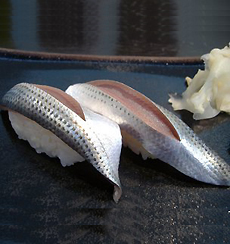
Hikari mono: The fish’s silvery skin is
aesthetically desirable, so it is not removed prior to serving. Photo of kohada © Clare Kleinedler, Rainy Days And Sundays.
|
|
HIRAME (FLUKE)
Hirame is a fluke, although it is often mistakenly translated as halibut (which is ohyo). While some people think that the thin, translucent piece of fluke, flecked with red, is one of the less expensive pieces of fish on the plate because it doesn’t have a lot of flavor, it is actually an expensive fish. The rippled fluke fin, or engawa, is popular with sushi connoisseurs. Fluke is sometimes arranged in the shape of a rose when served as sashimi.
|
|
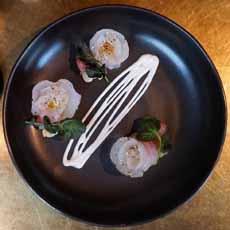
Fluke roses. Photo courtesy Ozuku | NYC. |
|
HOKKIGAI
Surf clam. Farmed in northern Japan and common to the Arctic and the Northeast coast of the U.S. from Delaware to Maine, these sweet, attractive red and white clams frequently appear in sushi bars.
HORSE MACKEREL
See aji.
|
|
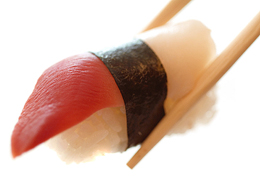
Photo of surf clam at left by Maria Gritcai. |
HOSOMAI
Hosomaki (“thin roll”) is the narrowest roll. A typical diameter is 1inch, and it contains only one filling: cucumber, kanpyō, nattō, tuna, umeboshi paste, etc.
|
HOTARU or FIREFLY SQUID
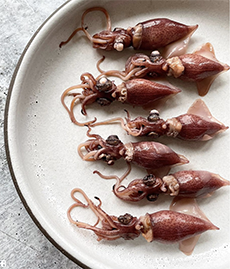
The firefly squid (Watasenia scintillans), is also commonly known as the sparkling enope squid and hotaru-ika (hotaru squid) in Japan. These tiny squid—just two or three inches long—are found on the shores of Japan in springtime during spawning season but spend most of their lives in deeper waters. They are bioluminescent. They are eaten whole, as sushi or sashimi, and multiple squid are also skewered and grilled or roasted. Then, the tiny tentacles crisp up like fried shallots.
|
|
Hotaru (photo © Regalis Foods). |
|
HOTATE
Scallops. Spanish and Latin American cuisines also serve scallops raw, but they’re marinated in citrus juice and called ceviche. For sushi, the scallops can be served plain with wasabi, fried, or mixed with spicy mayonnaise. For sashimi, the smaller bay scallops are often served in a clam or oyster shell or a well scooped out of a cucumber.
Scallops are some of the most treasured sushi delicacies. with a rich, sweet taste and sink-your-teeth-in texture. Once you taste sweet, raw scallops, you may never cook them again!
|
|
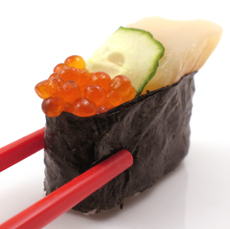
Sea scallops (hotate) with ikura (salmon caviar) and a slice of cucumber. Photo Jeannette Lambert | IST. |
|
IKA (SQUID)
Squid is one of the seafood items that is not served raw—it would be too chewy to be edible. It is blanched and scored before serving. Ika is pronounced EE-kuh.
IKA GESO
Squid legs, or the tentacles. These are tender and delicious, very different in flavor and texture from the body of the squid. It is unusual to find them at American sushi bars.
|
|

Ika sushi is scored for tenderness and is often served with a strip of nori between the fish and the rice to add color to the white-on-white combination. Photo | Sushi Connections. |
|
IKI ZUKURI or IKIZUKURI
Iki zukuri, or live fish sashimi, is exactly that: You are served a fish live from the tank. Often, the fish is carved live and reassembled whole, from head to tail. In New York City, live fish and lobster are served this way, and live octopus and live shrimp are also available. This is not limited to Japan and major world cities: We have seen a live lobster carved at a small Japanese restaurant in northern New Jersey.
IKURA
Salmon roe. It derives from the Persian word for eggs, which became ikura in Russian and was adapted into Japanese.
INARI-ZUSHI
A fried, slightly sweetened bean curd (tofu) pocket stuffed with sushi rice and vegetables or other ingredients. The pocket itself is called aburage (photo at right). In Japanese, when the word sushi is preceded by a modifier, it is pronounced and spelled zushi. Here’s more information on pronunciation.
ITAMAE
The sushi chef (or any Japanese chef) is addressed as itamae-san.
IWANA
Arctic char.
IWASHI
Anchovy.
Continue To Page 5: Definitions K To M
Go To The Alphabet Index Bar Above
|

Ikizukuri, live fish sashimi. Here’s more about it from Uminchup Project.

Inari stuffed with rice and garnished with sea asparagus (photo courtesy Sushi Seki | NYC).
|
|