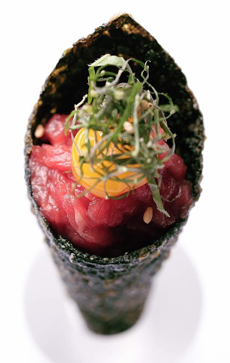
That’s not fish: It’s beef tartare with a quail egg yolk and shredded shiso (perilla leaf). This temaki (hand roll) is from Jungsik | New York City
July 2007
Last Updated July 2025
|
Japanese Sushi & Sashimi
Page 8: Tamago, Tekka-Maki, Tobiko, Toro & Other Types From T to Z
This is Page 8 of an eight-page glossary. If you enjoy this Sushi Glossary, we have a food glossary for almost every category of food. Check out the Seafood Glossary, too.
| |
Click on a letter to get to the appropriate glossary page.
a b c d e f g h i j k l m n o p q r s t u v w x y z
This glossary is protected by copyright and cannot be reproduced in whole or part. You are welcome to link to it.
|
|
TAI (SEA BREAM)
In Japan, this refers to the sea bream. It must be imported to the U.S., so often, according to an item in the Chicago Sun-Times (May 10, 2007), Japanese restaurants in the U.S. have begun referring to tilapia as tai—it is similar in flavor to tai (sea bream, related to porgy and daurade). Previously, U.S. sushi bars had been substituting red snapper for sea bream, but red snapper is not as easy to obtain as tilapia, and the newspaper quotes some sushi chefs as saying that red snapper isn’t well-suited for sushi or sashimi because its flesh is too soft. Real sea bream has a lovely white flesh with a pink hue and red accents. Unless you know your fish, it is easy to confuse it with sea bass, which has a similar coloring (but the red accents are more striped).
|
|
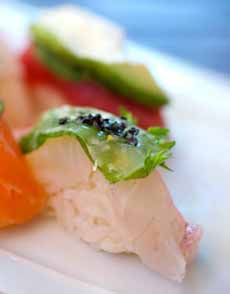
Tai, from Japan, is also called sea bream. Because the flavor is so similar to tilapia, that fish is often called tai at U.S. sushi bars. Here it is garnished with some shiso and black tobiko. Photo courtesy Sushiroku. |
TAKO
Octopus. Much octopus is frozen; it is also blanched because, like squid, it is too chewy to eat raw. Nama tako indicates fresh octopus.
TAKUWAN
Pickled whole daikon, with added color so that it is generally a deep yellow. The whole pickled radish can be purchased at Asian markets and sliced for serving. It is often part of an order of oshinko, and an excellent option for a vegetarian roll.
|
|
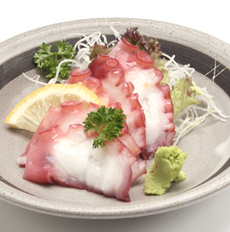
Tako, or octopus, sashimi. Photo courtesy Bento.com. |
TAMAGO-YAKI
Tamago is the Japanese word for egg. Yaki means “grilled.” In sushi, it refers to a sweetened omelet made in a rectangular pan, cut into small rectangles for sushi or sashimi. When a slice of dried nori (seaweed) is wrapped around the slice of omelet, it is known as nori-tama. In Japan, tamago is the “signature dish” of each chef. Often, potential customers will ask for a taste of it in order to judge the chef’s proficiency.
|
|
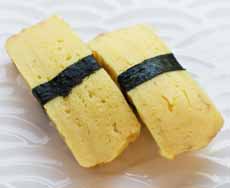
Tamago-yaki, or omelet sushi. Photo courtesy Sushi Connection. |
TARTARE
French for “finely chopped.” Tartare is available as an appetizer at sushi bars, and is also the technique used to chop salmon, tuna, and yellowtail for spicy and other maki (rolls). Also, see the photo at the top of Page 1.
TARAKO
A salted roe, usually made from Alaska pollock; although tara means cod in Japanese, which may have been used originally. It is served:
- Plain for breakfast.
- As a filling for onigiri, rice balls.
- As a pasta sauce, usually with nori.
- In some areas, red chile flakes are added.
|
|
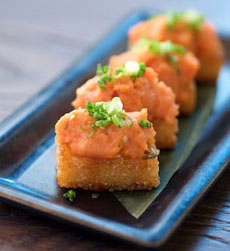
Salmon tartare atop fried tofu blocks from Sushiroku | Katana. |
TATAKI
Tataki is the process of searing thin slices of fish. Tuna tataki is perhaps the most popular. The technique dates to 19th-century Japan in what is now the Kochi Prefecture.
According to legend, it was developed by a samurai, Sakamoto Ryoma, who got the idea from watching Europeans in Nagasaki grill their meat.
|
|
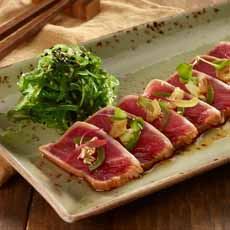
Tuna tataki with seaweed salad at P.F. Chang’s. |
TAZUNA-SUSHI
A maki roll with diagonal strips of different-colored ingredients across the top—red maguro, orange salmon, green avocado, etc., as colorful as a rainbow, and hence given the name “rainbow roll.” See rainbow roll.
TEKKA-DON
Slices of raw tuna over sushi rice (photo at right). This is tuna chirashi-style, except that chirashi implies an assortment of fish.
|
|
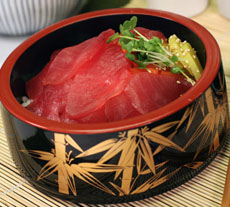
Tekka-don: tuna over sushi rice. Photo courtesy Cardinal Sushi | Palo Alto. |
TEKKA-MAKI
A tuna roll. The reason it is called tekka-maki and not maguro-maki has two derivations. “Tekka” means “iron on the fire,” and in the old days, the red color of the fish looked like the color of a hot iron glowing in the fire. However, if you ordered a maguro maki, you would be understood; and maguro-temaki is the correct way to order a tuna hand roll. Tekka is also the word for Japanese gambling parlors in Japan, where the snack originated as a quick, hand-held food that could be eaten at the gaming table (as the sandwich was, so the Earl of Sandwich could eat without interrupting his card game).
|
|
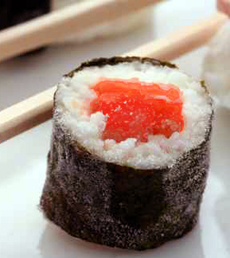
Tekka-maki:tuna roll. |
TEMAKI-ZUSHI
A temaki is a cone-shaped hand roll. Add the name of any fish or vegetable the word before temaki, and you will get that item wrapped with rice in a sheet of toasted seaweed. Maguro temaki is a tuna hand roll, hamachi temaki is a yellowtail hand roll, etc. For a photo, see the photo at the top of the page, as well as the hand roll.
TEMARI SUSHI
Temari literally means “hand ball” in Japanese, a traditional Japanese embroidered ball used for play or decorative purposes. It followed that sushi chefs began to make edible, decorative temari for special occasions, using sushi rice. As you can see in the photo, they are bite-sized works of art.
|
|
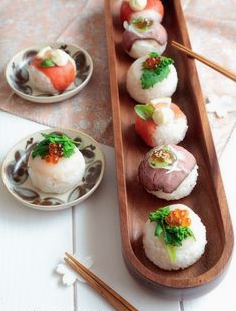
Temari sushi: round balls of rice with toppings. Photo courtesy Ameblo.jp. |
TEMPURA
Tempura is made by battering and deep-frying fish and vegetables. While not a part of classic sushi, modern sushi chefs have created tempura sushi by rolling a piece of tempura with rice and seaweed. Chicken, shrimp, squid, and sweet potato are some of the types of tempura rolls that can be found.
TERIYAKI FISH
See tsukudani, below.
|
|
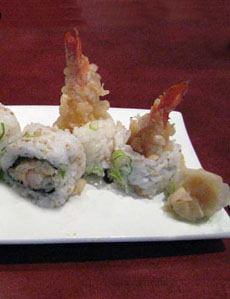
Shrimp tempura sushi. Photo courtesy Osaka-Steakhouse.com. |
TOBIKO or TOBIKKO
Flying fish roe. Orange to red in color, these tiny, pinhead-size eggs are crunchy. They are served as in gunkan-maki (boat-style sushi rolls) and also used to coat the outsides of uramaki, “inside out” rolls or reverse rolls.
One popular gunkan-maki is tobiko topped with an uncooked quail egg yolk (uzura no tamago—photo at right).
|
|
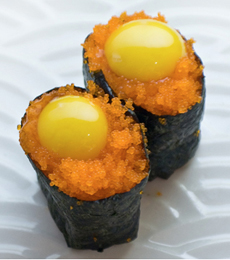
Tobiko gunkan maki topped with a quail egg.
|
TORIKAWA
Torikawa is the Japanese word for grilled, crispy chicken skin, sometimes called kawa for short. The crispy texture of the chicken skin contrasts with the soft rice. of the nigiri, the vinegar of the rice contrasting with the savory, umami-rich flavor of the chickeen skin. Optional garnishes include chopped scallions, lemon zest, or grated daikon. In the photo at right, the luxury garnish is foie gras powder!
For sashimi-style chicken, see torisashi, below.
|
|
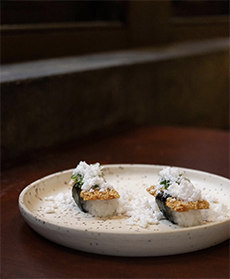
Nigiri of torikawa, crispy chicken skin (photo © O-Ya | Boston).
|
TORISASHI (CHICKEN SUSHI)
The term "sushi" literally means vinegared rice, and any ingredients from fish to vegetables to beef to chicken can grace those pads or rolls of rice. Chicken sushi or sashimi-style is a specific preparation of raw or lightly seared chicken (tataki). It can also be dipped briefly in boiling water.
Torisashi is most commonly eaten with sumiso, a sweeet-and-sour sauce made from miso, vinegar, and sugar. But it may also be eaten with soy sauce and wasabi like other sashimi.
Torisashi is a delicacy, a regional specialty on the island of Kyushu, particularly in the Kagoshima and Miyazaki prefectures. It requires specific preparation and hygiene standards for safety.
|
|
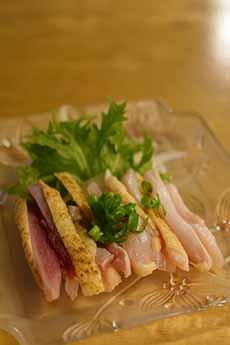
Torisashi, chicken served raw or lightly seared (photo by Fred Cherrygarden | Wikimedia license 4.0).
|
It's important to note that consuming raw chicken in general can pose health risks due to bacteria like Salmonella.
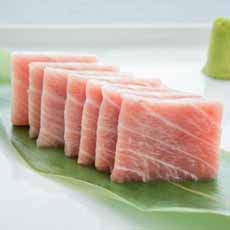
The most tender part of the tuna, buttery, rich toro, comes from the fatty belly portion. It is a smaller area, so a pricier part of the tuna—in fact, the priciest item at a sushi bar. The flesh is rosy in color rather than the typical bright red maguro. Each tuna belly contains two types of toro:
- Chutoro or chu-toro (CHOO-toh-roe), medium fat, the belly area of the tuna along the side of the fish, located between the akami (red meat tuna) and the otoro. It is preferred by some because it is fatty but less voluptuously fatty than otoro.
- Otoro or o-toro (OH-toh-roe), high fat, the fattiest part of the tuna, found on the underside of the fish. It can literally melt in your mouth.
Interestingly, prior to the 1920s, when the Japanese started adopting more Western dining habits, this fatty part of the fish was not considered prime and was used for cat food...similar to how lobster was once considered a trash fish in the U.S. In Colonial times, it was fed to pigs and goats and only eaten by starving paupers.
|
|
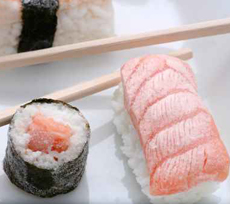
Top: Toro, the most tender part of the tuna, is paler in color than the rest of the tuna flesh. The toro above is particularly pale (photo Fotolia). Below, you can see how toro resembles another pricey delicacy: Kobe beef (photo courtesy Fish For Sushi).
|
|
TORO TAKU
Toro-taku is a roll made with chopped toro, takuan (pickled daikon radish colored yellow), shiso leaf, and goma (sesame seed). The sweet tuna combines with minty shiso, vinegared takuan, earthy sesame, and crunchy nori (the seaweed wrap).
|
|
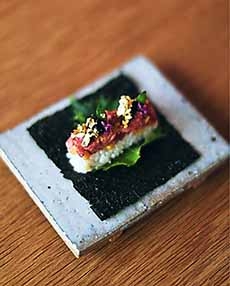
Toro-taku (photo © Nikutei Futago | NYC). |
TSUKEMONO
Tsukemono are vinegared vegetables. The category includes lightly marinated vegetables such as a salad of marinated bean sprouts, as well as pickles ( oshinko), which can include Chinese cabbage, cucumber, daikon, ume, and turnips. Gari is also a type of tsukemono. They are served with rice and can be made into sushi.
|
|
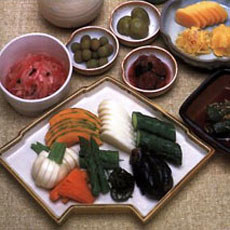
A variety of oshinko, pickled vegetables. |
TSUKUDANI or TSUKUDA-NI
Neither sushi nor sashimi, tsukudani refers to small fish or other food (pieces of meat or seaweed) cooked in a soy sauce, mirin (rice wine), and sugar blend and served as a side dish. This technique originated as a method to preserve fish in the Edo Period, when the shoguns ruled, from 1603 to 1868. The name is taken from the Tsukudajima, a fishing village in the middle of Tokyo (today surrounded by skyscrapers), where it was first made in the Edo period. The sweet and salty taste of tsukudani pairs perfectly with rice and has become a popular dish in Japanese homes. People from outside the country find the taste similar to teriyaki and often refer to it as “teriyaki fish.” The difference is that tsukudani is boiled until the food is very soft. With sardines, for example, the bones become soft enough to eat.
|
|
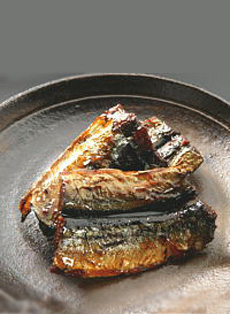
Sardine tsukudani, known as iwashi. Photo courtesy Hiramatsu Seafood Company. |
TUNA (TORO in JAPANESE)
Several varieties of tuna are used for sushi and sashimi, including ahi (yellowfin) and maguro. Bluefin, big eye, and albacore are different species of maguro. See also toro (above) and chu-toro.
UMEBOSHI
A small, bitter, pickled Japanese plum that is made into a paste (neri ume) used in a sushi roll.
UME-SHISO
A tart plum paste (neri ume) and shiso leaf mixture, a popular sushi roll (maki) combination in Japan. Japanese diners feel that ume clears the palate and leaves a pleasant aftertaste, and often order it to conclude a sushi dinner. Many American palates find the flavor too tart.
|
|
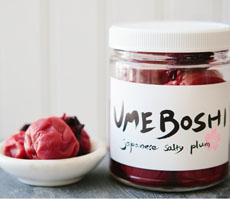
Umeboshi made in the San Francisco area. Photo courtesy Good Eggs | SF.
|
UDON
A thick wheat-flour noodle, similar to spaghetti. It is typically served in a hot broth made of dashi, soy sauce, and mirin, and topped with thinly chopped scallions and optional shiso leaf. Additions can include abura-age, deep-fried, seasoned tofu pockets; kakiage (a type of mixed tempura fritter), kamaboko (fish cake), or tempura; and can be further seasoned with shichimi, Japanese seven-spice.
|
|
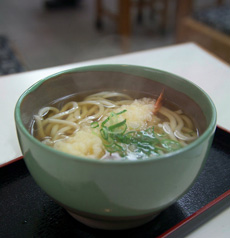
Udon with tempura, garnished with sliced scallions and shiso leaf. Photo courtesy Wikimedia.
|
UNAGI
Freshwater eel, which is richer than salt water or conger eel (anago). Eel is not served raw, but is pre-boiled, freshly grilled prior to serving and brushed with a rich sauce called kabayaki tare.
Most of the American unagi supply is imported pre-cooked from Taiwan and China, but is marinated and re-broiled by the restaurant.
|
|
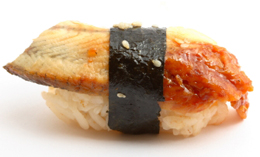
Photo of unagi by Alexander Zhiltsov | IST.
|
UNI (SEA URCHIN)
The gonad of the sea urchin. Sea urchin is one of those foods that people either love or hate. The taste can vary widely—people tend to think it is seasonality, but it is actually geographical. U.S. uni can come from California, the east coast of Canada, Maine and other regions, each with different nuances of flavor and appearance. The California uni tend to be sweeter and more creamy. Maine uni are reportedly less creamy, with a stronger taste. Even if one has a preference, each of these can be attractive as long as they are fresh. (Note: Lobsters love to eat uni!)
|
|
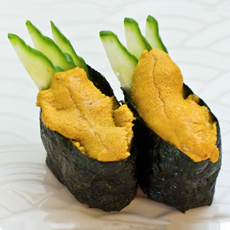
Uni, sea urchin. in a gunkan maki. Photo courtesy Sushi Connections. |
URAMAKI
Reverse roll or “inside out roll,” where the rice is on the outside of the sheet of nori instead of on the inside.
UZURA NO TAMAGO
Quail egg. A raw quail egg is often served on top of tobiko or tuna tartare (see photo above) or uni in a gunkan-maki.
|
|
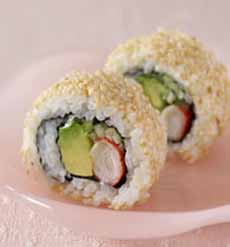
California Roll uramaki (inside out). Photo courtesy Umami-Info.com. |
VEGAN SUSHI
Vegan sushi is a plant-based product that will be growing in response to the desire for more plant-based foods. The pioneer is We recently reported on Ocean Hugger Foods, which has created the first-of-its-kind alternative to raw tuna (more).
WAKAME
A popular seaweed, long strands known as lobe-leaf seaweed, served as a vinegared salad (tsukemono) at sushi bars, as well as in miso soup.
|
|
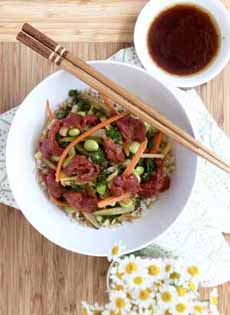
Vegan sushi,called ahimi, . |
YAKUMI
Strongly-flavored seasonings such as grated daikon (daikon oroshi), finely- chopped scallions (negi) and a spice blend such as shichimi togarashi are used instead of wasabi on stronger-flavored nigiri such as aji, iwashi, katsuo and sanma. However, the technique has been expanded by some chefs, who use no wasabi or soy sauce on any of their sushi. In New York City, Sushi of Gari and Sushi Seki season each type of fish individually, ready to eat—white tuna with a concasse of tomato and onions, scallops with curried mayonnaise, and salmon marinated in citrus vodka, for example. The results are spectacular.
|
|
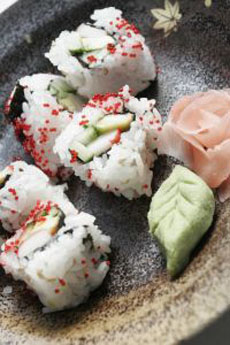
Wasabi artistically shaped into a leaf design. Photo by Lekyu | SXC. |
YELLOWTAIL
See hamachi. Yellowtail (photo at right) is a fish that is called different names depending on its age. Inada is a very young yellowtail, hamachi is medium age, buri an older yellowtail.
ZUKE
Japanese for “marinated.” In the Edo Period, sushi was often served already marinated in soy sauce. Today, some creative sushi chefs serve pieces of sushi already marinated in citrus, saké or vodka, requiring no use of soy sauce.
|
|
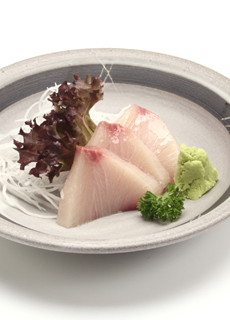
Yellowtail sashimi. Photo courtesy Bento.com.sg. |
ZUSHI
The more correct spelling for sushi; however, the “unvoiced” transliteration has caught on in the U.S., to the chagrin of Japanese-speaking people. A grammatical rule called rendaku governs the voicing of the initial consonant of the non-initial portion of a compound or prefixed word. Thus, the word “sushi” as a standalone noun would be pronounced with the unvoiced “s,” but when it becomes part of a compound noun, it becomes a voiced “z,” e.g., maki-zushi. This is also true with other compound words. Add a modifier to rice wine, saké, for example, sweet rice wine, and it becomes ama-zaké, not ama-saké.
There are also exceptions to the rule—all of which are too complex for non-speakers to follow. Thus, Americans will continue to call everything “sushi” rather than follow the rule for zushi.
Speak To Your Sushi Chef In Japanese
Some basic phrases:
Arigato: Thank you.
Domo/Domo arigato: Thank you/thank you very much.
Dozo: Please.
Gochiso-sama [deshita]: Traditional phrase closing a meal.
Hai: Yes.
Itadakimasu: Traditional phrase opening a meal.
Kanpai: The Japanese equivalent of “cheers,” used when drinking
Konbanwa: Good evening.
Konichiwa: A basic Japanese greeting, equating to “Hello, how are you?”
Oaiso or Okanjo: The check.
Oi ocha: Tea, please.
Oyasumi nasai: Good night.
Sabinuki: No wasabi.
Sumimasen: Excuse me.
Go To Alphabet Index Bar Above
|