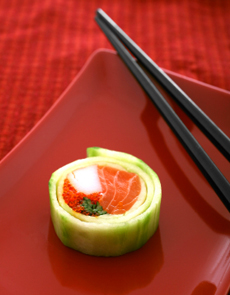
 For some people, heaven is a Kobe steak; for others, it’s exquisite sushi like this tuna tataki (the equivalent of tartare) with ikura (salmon roe), wasabi-flavored tobiko (capelin roe), and nori flakes (seaweed). Photo by Kelly Cline | IST.
July 2007
Last Updated July 2026
|
|
Types Of Sushi With Pictures
Page 5: Kappa Maki, Maki Sushi Other Terms With K, L M
We love to peruse the different types of sushi with pictures. If you enjoy this Sushi Glossary, we have a food glossary for almost every category of food. Check out the Seafood Glossary, too.
| |
Click on a letter to go to the appropriate glossary section.
a b c d e f g h i j k l m n o p q r s t u v w x y z
This glossary is protected by copyright and cannot be reproduced in whole or part. You are welcome to link to it.
|
|
KABAYAKI TARE
Kabayaki tare, or eel sauce, is a thick, savory sauce brushed onto eel sushi. It is made of soy sauce, syrup, eel extract, and mirin (some products include sugar, but this is not a traditional Japanese ingredient). It is often heated prior to serving. Kabayaki tare can also be served with other sushi and non-sushi foods.
KAIBASHIRA
The edible part of the scallop is sometimes called the eye of the scallop. Botanically, it is variously called the posterior adductor muscle, striped muscle, and valve muscle.
|
|
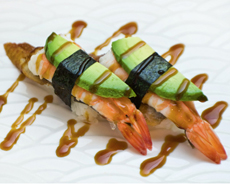
In this creative nigiri sushi, eel, shrimp, and avocado are wrapped in seaweed and drizzled with eel sauce. Photo courtesy SushiConnection.com.
|
KAIWARE
Daikon radish sprouts. They can be used as a garnish for chirashi, sashimi, and sushi, or made into a vegetarian roll.
Like all sprouts, kaiware tastes like the plant it would grow into if planted in the garden. If you like daikon, you’ll like daikon sprouts.
The radish, Raphanus sativus, is a member of the Brassica family—the cancer-fighting cruciferous vegetables.
The Raphanus genus is believed to have originated in Southeast Asia. Many different varieties now grow worldwide.
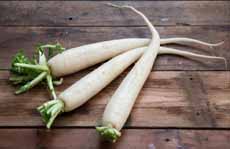
Daikon is Japanese for “big root,” which this long, white winter radish certainly is. In English, it is often called “big white radish.” Some subspecies can grow to 16 inches or more.
|
|
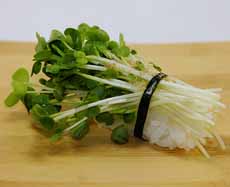
Above, kaiware, daikon sprouts. Photo courtesy Atlanta Sushi Bar. Below, the daikon they would have become, photo courtesy Good Eggs.
|
KAIJIKI
Swordfish. It is not typically found in American sushi bars. It has high levels of mercury (as does tuna, another very large fish and perhaps the most popular item on the sushi menu).

(photo © Sushi Live).
KAKI
Oysters. Traditional Japanese cuisine does not serve oysters on the half shell, but oysters in their shells are garnished with other ingredients to produce delightful oyster sashimi (photo at right).
Oysters are also served raw and fried in maki, with an option to include spicy mayonnaise.
|
|
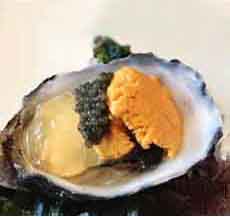
It doesn’t get better than oysters topped with caviar and uni, sea urchin. Photo courtesy Katana Sushi.
|
KAITEN
A conveyor-belt sushi restaurant. Plates of food are placed on a conveyor belt that travels around a long, oval-shaped sushi bar. Newer-style kaiten restaurants (such as New York’s Sakae Sushi) have booth-style seating, so that groups can dine and converse facing each other; the conveyor belt is a long, narrow track with booths on either side (think of a model train track making a long loop with just a few inches between the tracks). Consumers help themselves to whatever looks appealing, or can order from the sushi chef (in the booth system, there are waiters and tableside computer-ordering as well). Plates are color-coded by price, and include not just sushi but salads, soup, udon (noodles), and other hot dishes.
|
|
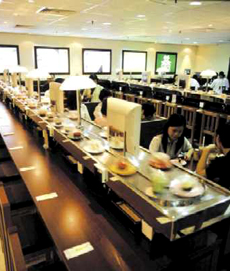
Plates of food circulate around on a conveyor belt at a Sakae Sushi restaurant.
|
KAKOMI SUSHI
Styles of nigiri that use seaweed as a wrap to hold less solid ingredients. Examples include gunkan maki, the “battleship roll” shape that is used to hold semi-liquid ingredients like quail egg, and funamori or “boat wrap” (the terms are virtually identical).
KAMABOKO
Fish cake, made from pounded whitefish mixed with cornstarch, formed into an oval sausage shape, seasoned, and cooked.
|
|
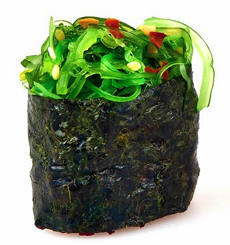
Seaweed wrap (gunkan maki) around seaweed salad. Photo courtesy of Beyond Sushi.
|
|
KAMPYO or KANPYO
A popular vegetarian sushi, long, dried gourd strips the width of fettuccine, marinated in a sweet sauce. Also an ingredient in futomaki. Before the gourd is prepared, it is a light tan color; after marinating, it becomes a translucent brown.
|
|
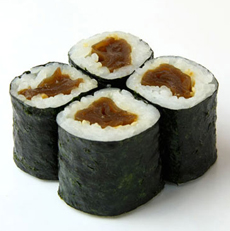
Kampyo is a dried gourd in a sweet sauce. Photo courtesy Sushipoint.info. |
KAMIKAZI ROLL
A kamikaze roll is not a single, standardized sushi roll, but rather a combination of various ingredients chosen by the particular restaurant—unlike California Roll, Spider Roll, and other American inventions, which have a set definition. Elements include spicy tuna, shrimp tempura, cream cheese, and avocado, with additions like mango, eel, tobiko, and various sauces. Many are deep-fried or have crunchy components and are topped with spicy sauces.
- At Escar-Go-Go in Montreal, it includes tuna, crab stick, tempura, avocado, cucumber, and spicy mayonnaise. Anything goes...although the real question is: Why name good sushi after a suicide attack?
- At Amber in New York City, it is crunchy spicy tuna with seaweed. served inside out. At Godzilla Sushi in San Francisco, it is made with yellowtail.
|
KANI
Authentic crab meat, always served cooked (though often cooked and then frozen—ask the sushi chef). If you can get real, fresh crab, it is worth the price. Real king crab is the leg meat of the red king crab, Paralithodes camtschaticus. It is also called kamchatka crab and Alaska king crab.
Compare the real thing at right to the photo of the imitation crab leg, directly below it.
|
|
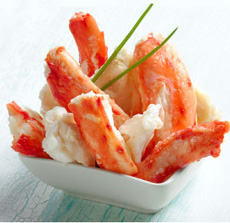
Real king crab. Photo courtesy Phillips Seafood. |
|
KANIKAMA or KANI KAMABOKO
Imitation crabmeat, also called sea leg. It is usually made from pollack or other inexpensive whitefish (hake, tilapia) that has been ground, combined into a paste with starch, egg white, salt, vegetable oil, sugar, and seasonings, and formed, artificially colored and flavored to resemble a more expensive seafood—lobster, shrimp, crab, etc. This type of imitation seafood is known categorically as surimi. Kanikama is primarily used in California rolls, although it can also be served in a salad. Imitation crab does not taste like the real thing—it is just an approximation, as a veggie burger approximates a beef burger.
|
|
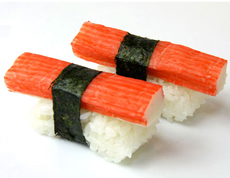
Kani, called crab leg and sea leg, is imitation crab meat. Photo courtesy Sushipoint.info. |
|
KANI-NO-HA-ZUSHI or
KANINOHAZUSHII
Pressed persimmon leaf sushi is a type of pressed sushi that is a specialty of Nara, the capital city of Nara Prefecture in the Kansai region of Japan.
Kaninohazushi is a particular kind of pressed sushi (oshi-zushi), which translates to “pressed sushi wrapped in persimmon leaf.” It is a specialty of Nara, a town in the Ishikawa Prefecture, located on the island of Honshu.
The leaves have a strong antibacterial effect, and are originally used to wrap mackerel (saba), which has particular parasites. The raw mackerel is first cured by salting and marinating, and the leaves themselves are cured in salt. So the persimmon leaf serves as a “multi-process cure” (today, this is not necessary, but the tradition endures).
After the mackerel is cured, it is pressed on top of rice in a wooden box used to make all ozushi-zushi. Individual cut rectangles are then removed and wrapped in persimmon leaves (top photo at right), placed back into the box, topped with a weight, and placed in a cool place to cure some more for a few days. The persimmon leaves are discarded before eating [source].
|
|
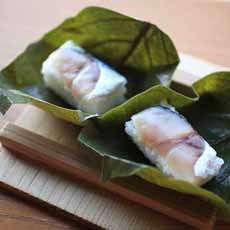
Wrapping mackerel in a persimmon leaf. Photo courtesy Ana Cool Japan.
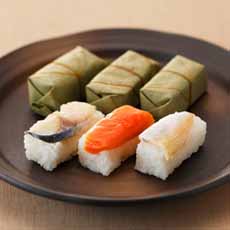
A plate of assorted ozushi, pressed or boxed sushi, with kaninozushi at the rear. Photo courtesy M.Sumally.com.
|
Kaninohazushi is an easy grab-and-go lunch, requiring no utensils to eat. Here’s more about it from Matcha Japan Travel Magazine.
A historical note: Nara was the first capital city of Japan, and received the best produce from all over. Many food historians credit Nara as the origin of “true” Japanese food. Buddhist vegetarian cuisine developed among the religious groups in the area [source].
KANSAI OR OSAKA-STYLE SUSHI
Kansai is a style of sushi that originated around Osaka, in the Kansai region of Japan. It is a type of pressed sushi (oshizushi), made in wooden molds. Kombu-dashi (kelp stock) is used to mix the rice, along with a much higher amount of sugar than is used with regular sushi rice.
|
|

Kansai sushi (photo created by A.I.). |
KANPACHI or KAMPACHI
Very young yellowtail. The fish, Seriola rivoliana, is also called amberjack or kahala. The difference in spelling is due to transliteration from Japanese. Read our review of Kona Kampachi.

Kampachi fillets (photo © Browne Trading).
KAPPA MAKI
Cucumber roll. The word for cucumber is kyuri; Kappa is a water goblin in Japanese mythology who was very fond of cucumbers, which he stole from the fields near his riverbank home. He is always pictured with a saucer on his head that looks like a cucumber slice. According to myth, the saucer must always be kept full of water, or Kappa loses his goblin powers.
|
|

Kappa maki garnished with goma, sesame seeds. |
KAREI
Karei is a marbled Japanese flounder, or flatfish. The flesh is almost transparent, very sweet, and fatty. Engawa, the collagen-rich, chewy part of the flounder located near the fin, is considered a delicacy.
There are several species of flounder in Japanese waters, but “karei” generally refers to the right-eyed flounders. “Hirame” is the term for the left-eyed flounders. In fact, all flatfish have a unique biology. As they mature, they undergo a metamorphosis where both eyes migrate to one side of their head.
|
|

Karei nigiri (photo by A.I.) |

Samegawa karei, or sharkfin founder, from Hokkaido (photo © PGH | Instagram).
KATSUO
Bonito is a type of tuna related to the skipjack. Bonito is the English word; katsuo is the Japanese word. See bonito.
KATSUO-BUSHI or KATSUOBUSHII
Katsuo are bonito flakes, a seasoning made of dried katsuo fish (first photo), called bonito. The dried bonito is shaved or flaked. The process for creating the flakes is complex: Fillets are simmered, deboned, smoked, and smoked again the following day. They then go through a final fermentation stage. A less costly version, but still of good quality, is called aragatsuo. It is sold shaved and packaged as katsuo-kezuri-bushi or hanakatsuo.
It is also served tataki-style (seared), when it is called katsuo-no-tataki.
|
|

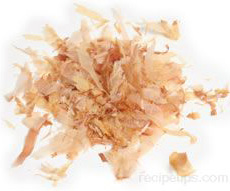
Top: Katsuo, bonito in English. Photo courtesy Web-Japan. Bottom: Katso-bushi, bonito flakes. Photo courtesy Amazon.com.
|
KAZUNOKO
Herring roe. It can be served raw (kazunoko konbu) in sushi or sashimi. The bright yellow roe sacs hold many tiny eggs; the sac is sliced for sushi and sashimi. A salty roe, it is usually served marinated in broth, saké, and shoyu for added flavor.
|
|
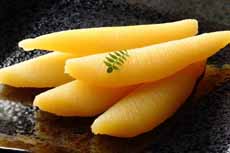
Here’s more about kazunoko from Re-Discovery Japan. |
KINMEDAI
Gold eye sea bream are rarer than regular sea bream, tai.

Kinemedai (photo © Mako | Chicago).
KOBA-SHIRA
Bay scallops (photo at right).
KOHADA
Gizzard shad is known for its shimmering silver skin. See a photo of three shimmering fish, sushi dane (photo at right).
KOI
Saltwater carp.
|
|
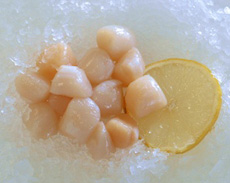
Bay scallops are served as sashimi in a cucumber cup or scallop shell, or in a gunkan-maki. Photo courtesy I Love Blue Sea.

Silvery kohada (photo © © Clare Kleinedler, Rainy Days And Sundays).
|
|
KOMBU or KONBU or KELP
One of the key ingredients in Japanese cuisine (it is one of three ingredients needed to make dashi, the basic Japanese soup stock), it is also eaten fresh as sashimi. (Photo at right.) Kombu is mainly cultivated in the cold current, and grows from 7 to 20 meters in two years. Most kombu is harvested in Hokkaido, the northern island of Japan. There are numerous varieties. Kombu (kelp) and wakame (seaweed) are similar in how they look, but they are quite different. Wakame grows in warm currents. Kombu naturally contains glutamic acid (a component of MSG), which is used to make food tastier. First-year and second-year kombu are quite different in their thickness and nutritive value, and this reflects directly in the price; the difference is obvious when you make the dashi soup with it.
|
|
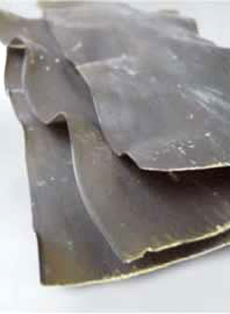
Kombu is kelp. Photo courtesy UmamiInfo.com. |
Kombu will drop off the stalk after its first year, and a new and superior second-year kombu grows on the stump. The most superior kombu is more than 5 times the cost of the cheapest variety.
|
KURODAI
This popular Japanese sport fish is variously called sea bream, blackhead seabream, or Japanese black porgy in English.
It is easily confused with tai, red snapper. One way to distinguish them is that the red stripes on the skin of kurodai are more pronounced. (Or, ask your server!)
KURO GOMA
Black sesame seeds (photo at right).
KURUMA-EBI or TIGER PRAWN
A highly prized shrimp in Japanese cuisine, a showpiece ingredient. The name kuruma (wheel) refers to the prawn’s distinctive curved shape when cooked. Two related ebi (shrimp) are:
- Ama-ebi (sweet shrimp): smaller, deep-pink, melt-in-the-mouth texture, always served raw.
- Botan-ebi (spot prawn): large, sweet shrimp also served raw; generally softer and much sweeter than the savory/salty kuruma ebi.
|
|
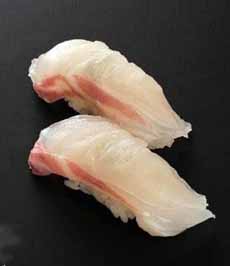
Red sea bream. Photo courtesy SushiConnection.com.

Kuro goma, black sesame seeds (photo © Marietta Spice Mill ).
|

Kurama-ebi (photo © Hokkaido Uni).
|
LIVE SHRIMP
Live shrimp sushi or sashimi is a delicacy in Japan. The shrimp are taken from an aquarium, peeled, and immediately handed to the customer in sushi or sashimi for consumption. The shrimp do squirm as they are chewed (or swallowed, by the more squeamish tourists), which is part of the excitement. See also ikizukuri. In Thailand, live shrimp are eaten in a dish called “dancing shrimp.”
MACKEREL
See saba.
|
|
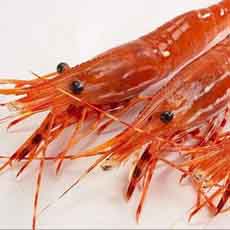
Live spot prawns. Photo courtesy Catalina Offshore.
|
MADAI
Sea bream, a white fish that has red stripes in the translucent, white flesh, and is often mistaken by newbies for fluke, which has random splotches of red (but not stripes) in translucent, white flesh.
MAGURO
Red, beefy maguro, along with ahi, are the leading varieties of sushi tuna, is America’s most popular raw fish. Regular maguro is the leaner part of the tuna, from the sides and back of the fish (toro, the belly, is the fatty “delicacy” portion). With thick, firm flesh, it is one of the most flavorful of raw fish. Lean tuna cut from the back of the fish is called akami.
Different species of maguro run at different times of the year: bluefin tuna (hon-maguro) from September to March, big eye tuna (mebachi maguro) after April. The albacore tuna (shiro-maguro or white tuna) is not considered as choice as these two, or the ahi tuna or yellowfin tuna. Spicy tuna rolls are an Americanization.
Interestingly, tuna, now the most prized fish, was eschewed for most of its history in Japanese cuisine.
Prior to the 1920s, no self-respecting Japanese person would eat any kind of tuna. It had an official term of disparagement, gezakana, “inferior fish,” for its perceived metallic taste! Even after the 1920s, when tuna became accepted as quality cuisine, the toro, the fat belly that today is the priciest cut, was avoided. Only impoverished laborers with no other choice would eat it.
Here’s more about it.
|
|
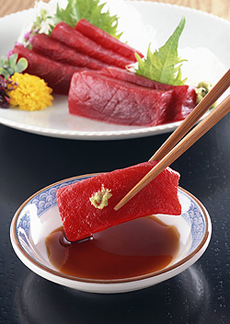
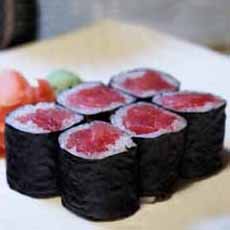
Maguro, the “sirloin” or tuna. Above, sashimi, photo courtesy SushTrainer.com. Below: the popular roll, tekka-maki, photo courtesy Tenzan | NYC.
|
MAKI, MAKI SUSHI, OR MAKIZUSHI
Maki is the Japanese word for “roll,” or rolled sushi. While nigiri-sushi is a relatively recent development, maki sushi originated with Buddhist monks in the 13th century. Maki sushi wraps a sheet of toasted seaweed (nori) and a layer of rice around different fish, vegetables, or other fillings. Sometimes, cucumber, egg crêpe, soy paper (tofu), or shiso leaf is used as the wrapper. Su-maki is a regular roll, futo-maki is a large roll, and te-maki is a hand roll. While some maki have special names, you can order anything in a roll by naming it and adding the word maki (saba-maki, uni-maki, hamachi-maki, etc.), and your wishes will be understood.
MAKISU
The bamboo mat that’s used to roll sushi.
|
|
Maki with a cucumber wrap instead of seaweed (photo © Vasko Miokovic | iStock Photo).

Makisu (photo © Riviera Seafood Club).
|
MASAGO
Smelt or capelin roe. Capelin roe is similar to tobiko but slightly more orange in color.
MASU
Trout. Rainbow trout is nijimasu.
MEJI MAGURO
Young tuna.
MENTAIKO
Mentaiko, the salted roe of Alaska pollock, is a popular culinary ingredient. The roe from Alaska was introduced to Japan after World War II, although it has been enjoyed in Korea for a much longer time. The spicy version of the roe, flavored with cayenne or other red pepper, is called mantaiko. A milder version is called tarako. The roe is combined with scallops (hotate) as sashimi, served in a scallop shell, or in a gunkan maki. Here’s a recipe with spaghetti.
MILT
Sperm sacs of fish and other seafood. See shirako.
MIRIN
Sweet rice wine. Mirin is used for cooking, and a small amount is added to sushi rice along with the vinegar.
|
|

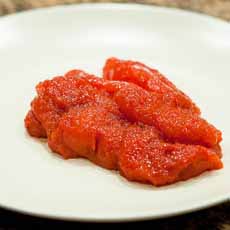
Two types of roe: above, masago sashimi on a shiso leaf. Photo courtesy Catalina Offshore Products. Below: Mentaiko, pollock roe. Photo courtesy San Francisco Food.
|
|
MIRUGAI
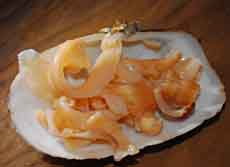
A giant, long-necked clam or horseneck clam, also known as geoduck, pronounced gooey duck (photos at right). It is harvested in the Pacific Northwest. It is slightly crunchy, like other clams used for sashimi, and the meat has a natural sweetness.
The neck meat has a delicately mild flavor with the crisp, crunchy texture of cucumber. The body meat is tender and has a balanced shellfish flavor.
Giant clam can be served as sushi, sashimi, or ceviche; the body can also be sautéed or steamed. One whole, cleaned geoduck averages 1.5 to 2 pounds.
|
|
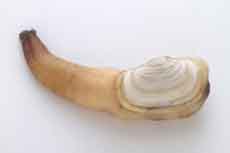
Top: mirugai a.k.a geoduck and giant clam. Top: photo courtesy OKS Food. Bottom photo, the clam sliced as sashimi, courtesy Shizuoka Gourmet.
|
|
MISO SOUP
Often offered as a precursor to a sushi or sashimi meal. A traditional Japanese soup consisting of dashi (stock made from kelp and katsuo-bushi) mixed with miso (soybean) paste. Other ingredients are added depending on regional and seasonal recipes; the soup is often served in the U.S. with bits of green onion and cubes of tofu or strips of aburage.
|
|
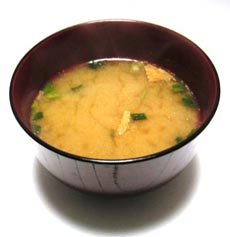
Miso soup. Photo courtesy Wikimedia. |
|
MORIAWASE
Moriawase indicates a plate of assorted sushi. It is mostly nigiri, but can contain maki and gunkan maki as well. It is the choice of the sushi chef, but it typically includes popular items. A deluxe moriawase upgrades the items to include pricier choices.
Moriawase is also known as a mixed sushi platter or plate. See also omakase.
|
|
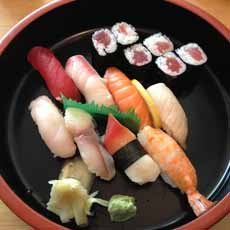
Sushi moriawase Photo courtesy Appetite For Instruction. |
MUSUBI
O-musubi are a type of o-nigiri, the rice balls that are a Japanese snack. Musubi is a block or ball of rice wrapped in seaweed (nori) with a protein: beef, chicken, eggs (tamago), pork, or tofu. Spam musubi has become a popular snack and lunch food in Hawaii. It comprises a slice of grilled Spam atop a block of rice, wrapped together with nori in the tradition of Japanese omusubi. Spam musubi is also served nigiri-style, wrapped with a strip of seaweed like tamago sushi. It can be gussied up, e.g., with a drizzle of eel sauce. August 8th is National SPAM Musubi Day, and July 31st is National SPAM Day. The history of SPAM musubi and 25+ SPAM musubi recipes.
Continue To Page 6: Definitions N To P
Go To Alphabet Index Bar Above
|
|

Spam musubi. Photo © SPAM Brand Institute. |
|