August 2008
Last Updated March 2026
|
|
All Types Of Bread
Page 3: Ciabatta, Croissant, Crostini & Other Bread Types With C
This is page 3 of a 9-page glossary of all types of bread. Click on the links below to visit other pages. You can also return to the overview and the history of bread or select from many more food glossaries.
Click on a letter to go to the appropriate glossary section:
a b c d e f g h i j k l m n o p q r s t u v w x y z
This glossary is protected by copyright and cannot be reproduced in whole or in part. You are welcome to link to it.
CALZONE
Calzone, the Italian word for “stocking,” is a turnover made from pizza dough, stuffed with mozzarella and ricotta cheeses (different cheeses and other ingredients such as meat and vegetables can be added), and deep-fried. In the U.S., it is often served with a marinara sauce for dipping.
CARTA DI MUSICA or MUSIC BREAD
A Sardinian flatbread. See Pane Carasau
CHALLAH
Challah is a braided, sweetened egg bread that is part of the celebration of the Jewish Sabbath. The word refers to a tithe of bread that was given to the priests, who had no income; a portion of the dough was sanctified and tithed, and the remainder was given over for ordinary consumption. Jewish custom requires that Sabbath and holiday meals begin with challah. Here’s the challah recipe for the bread in the photo at right.
CHAPATI
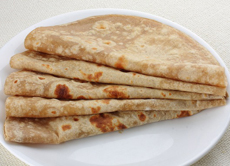
A type of roti, chapati is a staple flatbread of North and Western India. It is made from whole-grain durum wheat (atta flour), water, and salt, rolled into discs of approximately five inches in diameter, cooked on a hot grill, and served with ghee (clarified butter). It is generally eaten with lentil soup and curry dishes. In the U.S. and elsewhere, they are also used for fast food wrap sandwiches, not dissimilar to the tortilla becoming a burrito wrap.
|
|
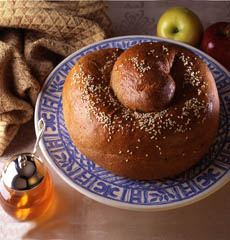
This challah is made “Sephardic style” in a swirled loaf rather than the traditional long braided style (photo courtesy National Honey Board). Below: chapati, a staple Indian flatbread (photo courtesy VegKitchen.com).
|
CIABATTA
Pronounced cha-BOT-a, it’s an Italian wheat loaf with a porous crumb, made with yeast. It is baked in a variety of styles, depending on the region—the crispness of the crust and the density of the crumb will vary. Some are seasoned with marjoram or rosemary, some are made with olive oil or milk. The unusual elongated, flat shape gives it its name—ciabatta means carpet slipper—and it can be recognized by the dusting of flour on the top. It is a popular sandwich bread, used for panini. Some artisan bakers make the “carpet slipper” in a ring form.
COB
See boule.
|
|
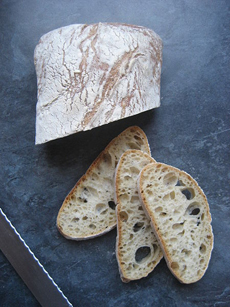
Ciabatta. Photo by Vincent Talleu | Wikimedia. |
COBURG
A cob or boule with a large cross slashed across the top.
COLOMBA DI PASQUA
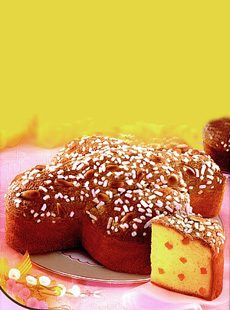
An Italian Easter bread, made in the shape of a dove. The classic colomba is a soft yeast dough with candied fruit (including orange peel), topped with icing, whole almonds, and granulated sugar (see photo at the top of the page). Colomba di Verona, shown in the photo, is a variation without candied fruit.
|
|
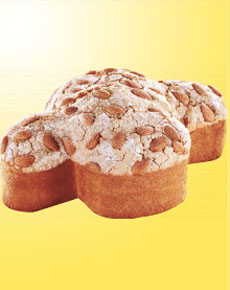
Colomba di Verona, a dove-shaped Easter bread (photo © Bauli). |
CONCHA
Mexican concha rolls are a beloved pan dulce (sweet bread) with a soft, brioche-like dough (similar to King’s Hawaiian). The sweetest version has a distinctive crunchy, sugary topping scored to resemble a seashell (concha means seashell in Spanish). These are enjoyed at breakfast or as a snack. Without the sugar topping, they can also be used for sandwiches, creating a sweet-and-savory contrast, especially for breakfast sandwiches with fillings like eggs, bacon, sausage, avocado, and cheese. They also work for heartier fillings like brisket or pulled pork, and with other salty, spicy, or rich savory ingredients.
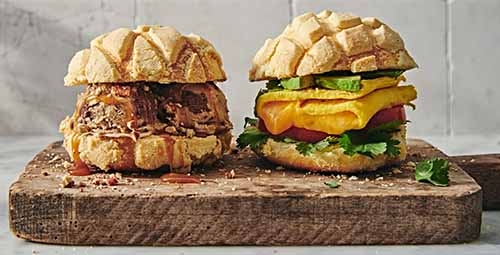
Here’s a concha recipe (both photos © King Arthur Baking).
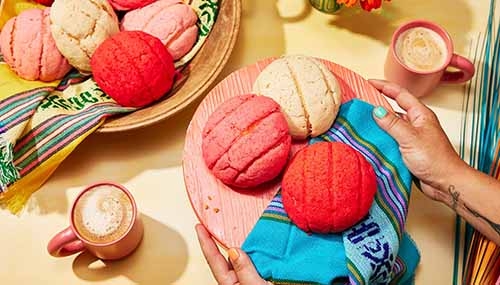
The recipe for the sugar-topped sweet version.
CORNBREAD
Corn, a grain indigenous to America, is milled into cornmeal, which can be baked into bread. There are several types of cornbread. The earliest is a skillet bread (also known as hoecake), made from cornmeal, egg, and buttermilk, and fried in fat, then baked in the oven. The result is a cake-like bread with a large, dense crumb and a crunchy crust. This bread will tend to be dense, meant more as an accompaniment than as a bread meant to stand on its own. Corn pone is a cornbread made of a thick cornmeal dough that is baked or fried. Johnnycakes are batter-based, skillet-fried cornbread similar to pancakes. Cornmeal is also used to make standard bread loaves.
CORN PONE
See cornbread.
|
|
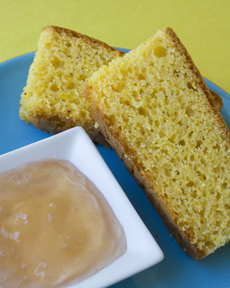
Cornbread with corn jelly. Photo by Claire Freierman | © THE NIBBLE. |
COTTAGE BREAD
A large, round bread with a smaller round placed on top. It looks less like a cottage than a chignon hairdo.
COTTAGE BREAD
A rustic style of bread. See peasant bread.
CRACKER
A small, crisp bread-like product. The cracker is an American invention; the first cracker-like product was made in 1792 by John Pearson of Newburyport, Massachusetts, who mixed flour and water into “pilot bread.” The long shelf life was popular with sailors, who called it hardtack and sea biscuits. The name “cracker” evolved from the crackling noise when another Massachusetts baker, Josiah Bent, burned a batch of biscuits in his oven in 1801. Years later, he sold his business to the company that became Nabisco. Crackers are made of flour, water, and salt; some have other seasonings, but unlike bread, there is no leavening. There are many styles, which include cheese crackers, oyster crackers for soup, saltines, and matzoh-like water biscuits. See reviews of our favorite gourmet crackers.
|
|
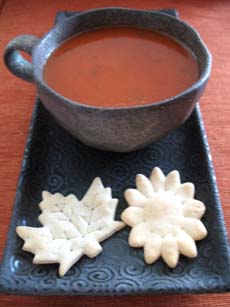
Why serve soup and crackers with ordinary crackers? See these and other gourmet crackers. Photo by Melody Lan | THE NIBBLE.
|
CRISPBREAD
Crispbread was invented in Scandinavia in medieval times, baked in Sweden and Finland to preserve the wheat crop over the long, cold winters. Originally from rye flour, salt, and water, today there are varieties made from all the major grains. Some are available in large, decorative rounds, good for parties; most are available in cracker-size portions. Crispbreads are also called flatbreads, but this confuses the term with the many soft flatbreads (pita, tortillas, etc.); so, crispbread is the preferred term. Read our review of Wasa crispbread and crispbread recipes.
|
|
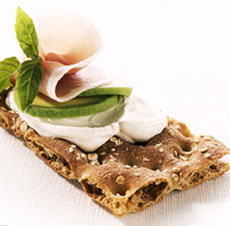
Versatile crispbread can be the base for an easy hors d’oeuvre. See Wasa crispbread recipes.
|
CROISSANT
A rich, buttery, crescent-shaped roll made of puff pastry that layers yeast dough with butter (known as laminating). Stories of the roll being made in the shape of the crescent of the Turkish flag, after the defeat of the Turks in the Siege of Vienna in 1683, are a perpetuated myth. Recipes for croissants do not appear in recipe books until the early 1900s, according to The Oxford Companion To Food, and the earliest French reference is in 1853. The croissant is a descendant of the Austrian kipfel, a crescent roll that was brought to Paris in 1938 or 1939 by August Zang, an Austrian military officer. The kipfel was ultimately interpreted into puff pastry by the French, where it achieved immortality as the croissant. You can read this history in Jim Chevallier’s book, August Zang and the French Croissant: How Viennoiserie Came To France (Kindle edition).
Traditionally, a breakfast bread served with jam and butter, two variations include the almond croissant, filled with frangipane and topped with sliced almonds, and the “chocolate croissant,” correctly called pain au chocolat, baked with a piece of dark chocolate in the center. In the early 1970s, croissants became sandwich substitutes as they evolved from their two traditional fillings, chocolate and almond paste, into many savory variations, from broccoli to ham and cheese, as well as additional sweet varieties.
|
|
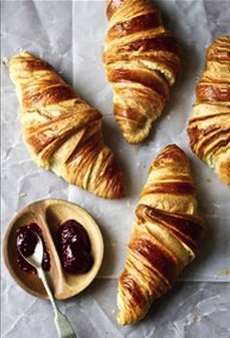
Croissants. Photo courtesy Vermont Creamery.
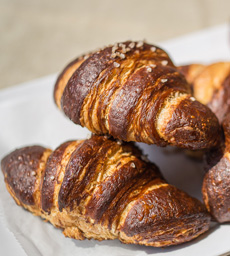
A Bavarian croissant is made of pretzel-like dough. Photo courtesy Gracious Bakery.
|
Bavarian Croissant or Pretzel Croissant: A croissant made of pretzel-like dough—a combination of bread flour and whole wheat flour. It is not puff pastry, but a soft pretzel-type dough in a triangle wrap, like a croissant (photo above).
CROSTINI
Crostini are small toasts or large croutons—thin slices of lightly-toasted bread, that are used for spreads like paté, as a base for canapé toppings, or as a bread with soups and salads. They can be made from round baguette slices, sliced from rectangular loaves, sliced into diagonals, etc. In Europe, slices of garlic bread would be referred to as crostini.
CROUTON
Crouton has two meanings. The first is a small cube (no more than half an inch) of rebaked bread, often seasoned, that is added to salads, soups, and other dishes for flavor and texture. The word derives from the French croûte, crust. The second is a small slice of toasted bread, such as a baguette, used as a base for canapés, spreads, and dips, and as a bread accompaniment to soups and salads.
|
|
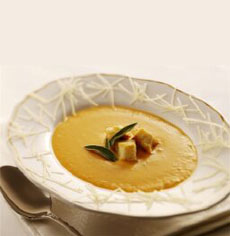
Croutons. Photo by Koos Swans | SXC. |
CRUMB
The crumb is the technical term for the interior, soft part of the bread that comprises the interior texture, gluten network, tenderness, and general feel. The crumb texture and size vary based on each style of bread. Kneaded breads generally have fine, even crumbs (although sourdough starters may create large bubbles); batter breads have a more coarse crumb. “Crumb” is a different reference from “crumbs,” small pieces of the crumb or crust that break off from the loaf, slice, or roll.
CRUMPET
British crumpet is often compared to an American English muffin. The two look alike, and both are toasted and spread with butter and jam. But crumpet dough is more like a thick pancake batter. The resulting texture is more rubbery than the “breadier” English muffin, but in a tasty way. Second, crumpets are traditionally cooked on a griddle on only one side, so air bubbles appear at the top. English muffins are toasted on both sides, and the air bubbles (their “nooks and crannies”) are trapped in the middle.
CRUST
The outer, hard portion of bread. The inside is called the crumb.
|
|
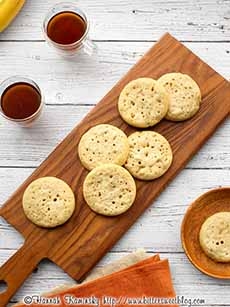
Crumpets (photo & copy: Hannah Kaminsky | Bittersweet Blog). |
|
|
|
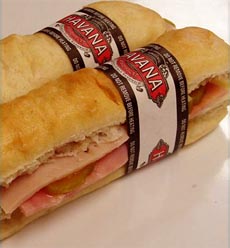
Cuban sandwich. Photo courtesy Havana Roadhouse. |
|