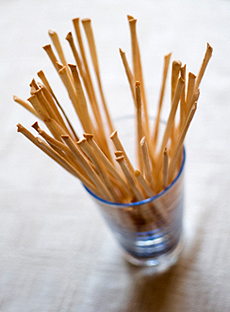
 Classic Italian grissini (the singular form of the word is grissino). Photo by Martin Brink | IST.
August 2008
Last Updated January 2026
|
|
What’s Your Favorite Type Of Bread?
Page 5: Glossary Of Bread Types ~ G To L
You’ll find your favorite type of bread in this Bread Glossary. This is page 5 of a 9-page glossary of the many different types of bread. Click on the links below to visit other pages. You can also return to the overview and the history of bread or select from many more food glossaries.
Click on a letter to go to the appropriate glossary section:
a b c d e f g h i j k l m n o p q r s t u v w x y z
This glossary is protected by copyright and cannot be reproduced in whole or in part.
You are welcome to link to it.
GARBAGE BREAD
Garbage bread is a snack based on pizza dough that’s filled with assorted leftovers (“garbage”) like cooked meats, cheeses, and veggies, a way to clean out the fridge. It’s similar to a calzone or stromboli or calzone but often rolled like a pinwheel. While its exact origin is unclear, it is thought to be mid-to-late 20th century, with online recipes appearing in the early 2000s. It emerged from home cooks finding creative ways to repurpose food, and then, of course, went viral. It’s a tasty party or game day food.
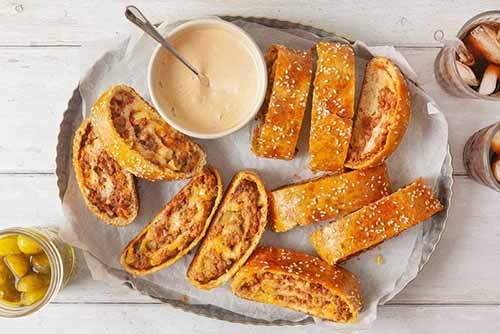
Here’s a recipe for garbage bread (photo © Taste Of Home).
|
GARLIC BREAD
Garlic bread is toasted bread—typically slices of baguette or other crusty loaf—spread with garlic butter. It is an excellent use for stale bread. A quick recipe: blend 4 cloves of crushed garlic into 4 tablespoons softened butter, olive oil, or a combination of the two. Spread on toasted bread. Alternatively, slice a long loaf of bread on the diagonal, cutting almost to the bottom but leaving enough to keep the loaf attached. Spread slits with garlic butter and wrap the loaf in foil. Bake in the oven at 350°F for 5 minutes; open the foil and bake for another 5 minutes. Recipe variations:
- Garlic Cheese Bread: Mix 3 tablespoons grated Parmigiano or Romano cheese into the butter/oil and microwave for 1 minute prior to spreading.
- Garnish: chopped flat-leaf parsley and/or browned minced garlic.
|
|
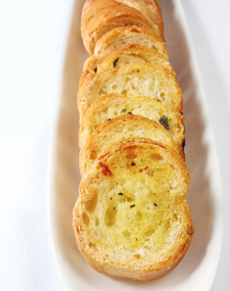
Garlic bread (photo © Robyn Mac | iStock Photo). |
|
GENESIS 1:29 BREAD
This bread has a cornucopia of seeds and grains. It’s named after Genesis 1:29: “Then God said, ‘I give you every seed-bearing plant on the face of the whole earth and every tree that has fruit with seed in it. They will be yours for food.’ ” While each baker can create his/her own recipe, one recipe from Food For Life includes: amaranth and chia from Central and South America, barley from Israel, black quinoa from the mountains of Peru, brown rice and spelt from the Far East, corn from Mexico, flax and rye from Northern Europe, kamut from Egypt, teff from the highlands of Ethiopia, millet and sorghum from the plains of Africa, pumpkin seeds from the Mediterranean, sesame seeds from the Near East, soy from China, spring wheat and Unprocessed Bran from Montana and sunflower seeds from the Dakotas. As you can imagine, it’s a highly nutritious loaf. See also Ezekiel bread.
|
|
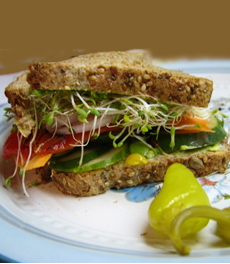
Genesis 1:29 bread from Food For Life (photo © Organic Gardens Network). |
|
GIRAFFE BREAD
Giraffe bread or Dutch crunch bread is the British name for tiger bread (Dutch: tijgerbrood), a soft white bread with a unique, crackly, mottled brown crust, created by applying a fermented rice flour paste before baking. The paste dries and cracks as the bread rises, creating a crunchy exterior that contrasts with the fluffy interior. The name “giraffe” was bestowed after a young customer suggested it looked more like a giraffe than a tiger. Here’s more about it.
|
|
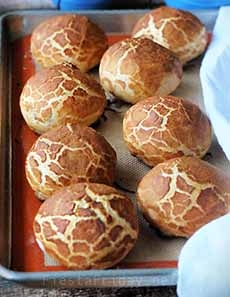
Giraffe bread, also called Dutch Crunch bread. Here’s a recipe (photo © Fiesta Friday). |
GRISSINI
A particular type of Italian breadstick that is very slender and about 12 inches in length (see photo at top left of page). National Breadstick Day is celebrated on the last Friday in October.

Grissini are the thinnest of breadsticks (photo © Martin Brink | iStock Photo).
LEAN BREAD or LEAN DOUGH
Lean bread/lean dough is one of the two main classifications for yeast-leavened dough; the other is rich dough. It’s defined by its minimal ingredients, only the four essential components of bread making: flour, water, yeast, and salt. It has little to no added fat (butter, oil, lard) and very little to no added sugar. The lack of fat and sugar creates a very chewy crumb (the inside texture) and a hard, crisp crust.
The classic example is a baguette; others include breadsticks, ciabatta, and most Italian-style breads, many pizza doughs, and sourdough.

Want to bake ciabatta? Here’s the recipe (photo © Taste of Home).
HOECAKE
See cornbread.
HOKKAIDO MILK BREAD
See Japanese Milk Bread, below.
|
HOT CROSS BUN
A sweet yeast bun made with raisins or currants. The top is decorated with a cross made of icing (or more simply, by knife cuts in the dough). The cross symbolizes the crucifixion, and the buns are traditionally eaten on Good Friday; although they are believed to predate Christianity, eaten by Saxons in to honor the goddess Eostre (the cross is believed to have symbolized the four quarters of the moon; Eostre is probably the origin of “Easter”). The first recorded use of the term “hot cross bun” appears in 1733.
INDIAN BREAD
India is a large country with many regions; each has its preferred breads (all flatbreads), and different grains and blends are used in different regions. The styles vary from moist to dry, and leavened to unleavened. Some are discussed further here: chapati, dosa, naan, and paratha.
|
|
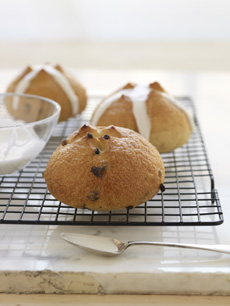
Hot cross buns—delicious even at room temperature (photo © Amy’s Bread). |
INJERA
A flatbread staple of Ethiopia, Eritrea, northern Kenya, Somalia, and the Sudan, injera is a fermented sourdough bread that bakes into a spongy texture. It is baked in large, round pancake-like pieces and used instead of both plates and utensils. The Ethiopian way of eating includes scooping with injera. Stews and salads are placed upon the bread; pieces are torn up for eating.
|
|
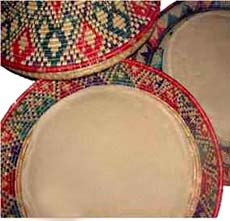
A plate of injera in a traditional woven Ethiopian server (photo © AfricanMarket.com). |
ITALIAN BREAD
Italian bread is a generic term. In general, Italian bread is similar to French bread (also a generic term), but the loaves are shorter and plumper, while French loaves are longer and narrower. Here’s a discussion of the differences between Italian and French bread.
IRISH SODA BREAD
A variety of white and brown soda breads are popular in Ireland, often containing raisins. See soda bread.
|
JAPANESE MILK BREAD
Also referred to as Chinese milk bread, Hokkaido milk bread, Korean milk bread, and shokupan in Japanese, which translates to “eating bread” because it is a simple, white bread that can be eaten anytime. Hokkaido milk bread is made from milk from Hokkaido, which is known for its high-quality dairy products. Japanese milk bread is soft and airy thanks to a simple technique involving a roux “starter” called tangzhong in Japanese. The loaves can be baked in open loaf pans to create a golden-brown crust or baked in Pullman loaf pans for a rectangular shape that’s perfect for sandwiches. Bread flour, which has a higher protein content for more gluten development, is imperative for baking milk bread.
|
|
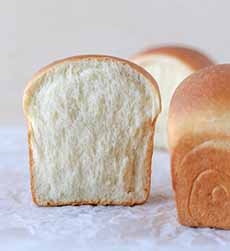
Japanese milk bread is light and airy. Here’s a recipe (photo © Bread By Elise). |
|
JEWISH RYE BREAD
Jewish rye is a light rye bread, a mix of wheat and rye flours. Often, caraway seeds are included for extra flavor.
JOHNNYCAKE or JONNYCAKE
A specialty from the Southern U.S., corn batter fried on a hot griddle or skillet and served with butter and jam. See cornbread.
|
|
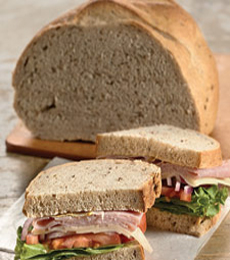
You can put anything on Jewish-style rye bread—including ham and cheese (photo © King Arthur Baking). |
|
KHACHAPURI
A Georgian (Russian) cheese bread that's a variation of an Italian calzone. An oblong, individual portion of bread is filled with cheese and baked until the dough is cooked and the cheese inside is melted. For a hearty breakfast, eggs can be added. Here's a recipe from Simply Home Cooked.
KIPFEL
A kipfel is a crescent- or horn-shaped roll that is the progenitor of the croissant; Kipf is the German word for horn-shaped. There is also a crescent-shaped Jewish yeast pastry by the same name, filled with chopped nuts or fruit preserves, also called kipferl or rugelach.
|
|
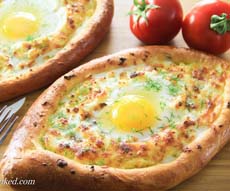
Khachapuri: Russian cheese bread, served here with eggs (photo © SimplyHomeCooked. com).
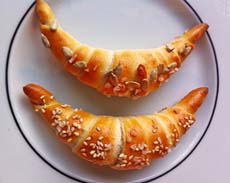 Kipfel (photo © ChefKoch.de). Kipfel (photo © ChefKoch.de).
|
|
KNACKEBROD
Swedish for crispbread, this rye-based thick cracker bread is a staple in Scandinavia and other northern European countries. Crispbread has been baked in Sweden since 500 C.E. It was made in large round wafers with a hole in the middle to store the bread on sticks and later, rods. They were baked just twice a year: following the fall harvest and again in the spring. Modern brands such as Ry-Krisp and Ryvita are made in individual rectangles, but beautiful artisan rounds, textured with a carved rolling pin, are still made.
|
|
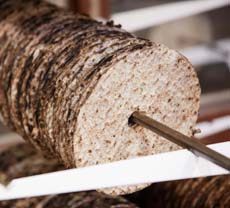
Traditional Swedish flatbread was round with holes for stacking (photo © VisitSweden.com). |
|
LAMINATION or LAMINATED
DOUGH or LAMINATED PASTRY
Laminated dough is used to make Viennoiserie—brioche, croissants, danish, and other buttery, flaky breakfast pastries. It is a time-consuming and expensive dough to make, owing to the large quantity of butter used. First, a yeast dough is made, called the détrempe (from the French verb, “to soak,” as the dry ingredients soak in liquid): milk, dry yeast, brown sugar, bread flour, and sea salt, kosher salt are kneaded together. Some recipes use starter dough from a prior batch. The dough is chilled and then rolled out into a rectangle. A smaller rectangle of rolled out and chilled butter, called the beurrage (from the French word for butter, beurre), is placed on top of it. Then the construction of the pâton, or dough roll, begins. The rectangle is folded into thirds, as if folding a letter (in fact, this first fold is known as a “single letter fold”).
|
|
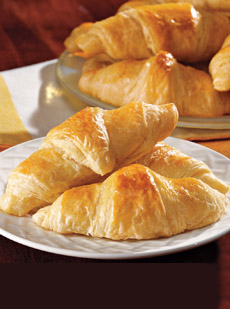
Croissants are perhaps America’s favorite form of laminated pastry. The croissants are available from Wolfermans.com. |
The pâton is then refrigerated for an hour, rolled, and folded again. The rolling and folding continue, usually for four turns.
|
LAVASH or LAHVASH or LAHVOSH
Lavash is an Armenian flatbread made with wheat flour, water, and salt. In the U.S., it is topped with toasted sesame seeds, poppy seeds, garlic and other seasonings. When fresh, lavash is soft and thin like a tortilla, and is used as a sandwich wrap for kebabs and other foods. It hardens into a crunchy cracker consistency, which is how it is most often found in the U.S.
LEAVENING or LEAVENING AGENT
Leavening is the process of adding gas to a dough to produce a lighter, airier, more easily chewed bread. Most breads consumed in Europe and America are leavened; Middle Eastern and African breads tend to be unleavened flatbreads. There are two types of leavening agents: chemical agents and yeast. Chemical agents are used to produce quick breads and soda breads. Baking powder and baking soda are the chemical agent choices; baking soda requires an acidic ingredient, such as buttermilk, to create the chemical reaction that produces gas. Yeast is a natural leavening agent.
|
|
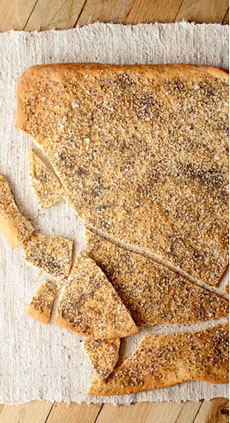
Lavash is a Middle Eastern flatbread that has become popular in the U.S. (photo © HotBreadOven.org). |
|
LEVAIN
Levain is a leavening agent or bread starter, also known in the U.S. as sourdough starter. Its purpose is to develop the flavor of the bread. (While there is levain in sourdough bread, not all levain-based breads are “sourdough.” While “levain” means leavening, not all leavings are levain. There are cultivated (commercial) yeast leavenings and chemical leavenings such as baking powder and baking soda.) Levain is used instead of yeast to raise the dough in certain types of bread. The technique—and the starter—were developed in France in the 1600s. Levain is made from wild yeasts and is less predictable than “foolproof” commercial yeasts. The latter can be relied upon to raise bread within a couple of hours, whereas starters take several days to make, and another two to three hours to raise the bread. Despite the lengthier time involved, artisan bakers prefer the results.
|
|
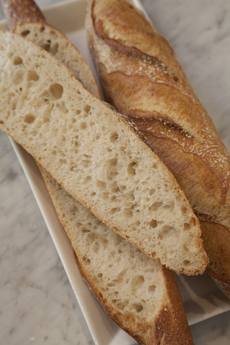
A baguette from Maison Kayser. Great pains are taken to prepare the homemade levain and ferment the bread (photo © Maison Kayser). |
To make levain, a mixture of water and flour is set out in the open for several days. This exposes the “starter” to the bacteria, fungus, and yeast in the air. The fungus or yeast inhibits the growth of harmful bacteria, making the levain safe to use as a food.
|