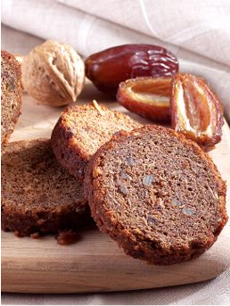
If you don’t have time to bake it, date nut bread is hard to find ready-made. You can buy it at VermontCountryStore.com.
August 2008
Last Updated October 2025
|
|
Bread Type: A Guide To The Many Types Of Bread
Page 4: Glossary Of Bread Types ~ D To F
Looking for a particular bread type? This is page 4 of a 9-page glossary of the many different bread types. In this section, you’ll find breads such as dosa, focaccia, and ficelle. Click on the links below to visit other pages. You can also return to the overview and the history of bread or select from many more food glossaries.
Click on a letter to go to the appropriate glossary section:
a b c d e f g h i j k l m n o p q r s t u v w x y z
This glossary is protected by copyright and cannot be reproduced in whole or in part.
You are welcome to link to it.
DATE NUT BREAD
A quick bread made with chopped dates and either walnuts or pecans, plus butter, an egg, and baking soda. A rich bread like raisin bread, it is often made into tea sandwiches with cream cheese. Dates and nuts can be added to the cream cheese as well. See also fruit bread.
DIPLOMAT
A diplomat is a small Parisian breakfast bread (actually a pastry). Flaky croissant pastry surrounds creamy custard dotted with raisins. Like a chocolate croissant or a Danish, they are considered bread ( viennoiserie) rather than a pastry. As with the financier pastry, Parisian bakers named some of their work after important people. Compare that to the American shoo-fly pie and brown Betty!
DOUGH
Dough, the base for most bread, is made by grinding a grain or legume into flour and mixing it with enough water or other liquid to form a paste. Leavening may or may not be added to cause the dough to rise; salt and other seasonings may be added, as well as inclusions—herbs, fruits, and nuts, for example.
|
|
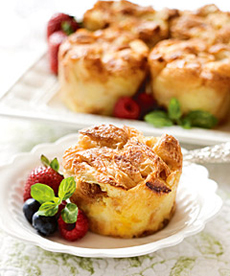
These diplomats are available from MackenzieLtd.com. |
There are two types of bread dough:
- Lean dough, made with minimal ingredients to create a dense crumb and thick crust. Example: baguette.
- Rich dough, enriched with fats and sugar to create a tender crumb and a nicely browned crust. Example: brioche.
DOSA
There are five different types of dosas, from thick to paper dosa (shown in the photo), the thinnest, a Southern Indian flatbread, similar to a crêpe, made with a variety of fillings. Typically, it is dipped in sambar, a spiced lentil dipping sauce, and one or more chutneys. The classic masala dosa is filled with spiced potatoes, onions, and cashews.
|
|

A paper dosa. Photo courtesy Dosamatic.com. |
DUTCH CRUNCH BREAD
Dutch Crunch bread is a San Francisco Bay Area incarnation of Dutch tijgerbrood, tiger bread. The top crust of a white bread bloomer loaf is brushed with a paste made of rice flour, sugar, oil, water, and yeast. When heat is applied (i.e., during baking), these ingredients create a much crunchier crust and form the pattern as well. Here’s more about Dutch Crunch bread.
|
|
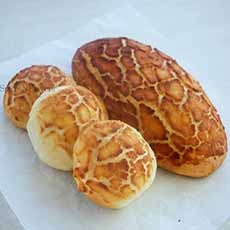
Dutch Crunch bread and rolls. Here’s a recipe (photo © Spices N Flavors). |
EASTER BREAD
Bread is a metaphor for the resurrection of Christ, and several cultures have a celebratory Easter bread—often a rich, sweet yeast style baked with eggs, fruits, and nuts. Examples include English hot cross buns, Italian Colomba di Pasqua baked in the shape of a dove, Greek tsoureki, plaited with nestled red Easter eggs (symbolic of the blood of Jesus), and Russian kulich, a cake-like yeast loaf filled with candied fruit and often iced.
|
|

A festive Ukrainian holiday bread. Photo © Fotosergio | Dreamstime. |
EGG BREAD and EGG WASH
When mixed into a recipe, eggs provide added leavening, yellow color, softness, and richness to sweet breads and other recipes, such as brioche and challah. When mixed with water or milk and brushed on the outside of the bread prior to baking, an egg wash gives a glossy sheen and deeper color to the bread.
EMPANADA
Bread (pastry dough) stuffed with a filling, then fried or baked. The name comes from the Spanish verb empanar, meaning to wrap or coat in bread. Spanish empanadas are usually pie-shaped, made with a broad variety of fillings (including pork, sausage, cod, and sardines), and served in wedges; Latin American empanadas are typically made in individual, half-moon-shaped portions and filled with minced, seasoned meat. Some Mexican restaurants serve dessert empanadas as well, and “gourmet” empanadas are interpreted by fine chefs.
|
|
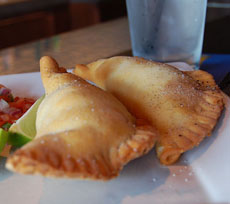
Latin American-style empanada. Photo by Stu Spivack | Wikimedia. |
ENGLISH MUFFIN
A fork-split yeast roll related to the crumpet, popular as a breakfast bread and as the base for dishes such as Eggs Benedict. English muffins were originally made by cooking dough in a circular form on a griddle. Read the history of the English muffin and a review of our favorite English muffins, Wolferman’s, a NIBBLE Top Pick Of The Week (photo at right).
ÉPI
A French wheat bread shaped to resemble a sheaf of wheat. To those who don’t know what wheat looks like, it may look like a tree.
|
|
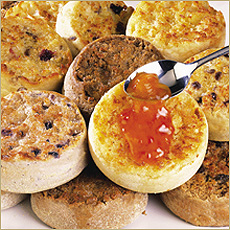
Wolferman’s English Muffins. Photo courtesy Wolferman’s. |
EZEKIEL 4:9 BREAD
Ezekiel 4:9 Bread is a trademarked name for a healthy bread made from a combination of barley, beans, lentils, millet, spelt, and wheat. The recipe comes from Ezekiel 4:9 in the Old Testament, specifically: “Take also unto thee wheat, and barley, and beans, and lentils, and millet, and spelt, and put them in one vessel, and make bread of it....” Rich in protein, vitamins, minerals, amino acids, and natural fiber with no added fat, it is very flavorful and enjoyed by people who pursue a healthy diet. Ezekiel bread is exceptionally nutritious: When the six grains and legumes are sprouted and combined, a complete protein is created that closely parallels the high-quality protein found in milk and eggs. In fact, it is 84.3% as efficient as the highest-recognized source of protein. See also Genesis 1:29 bread. And read our review of Food For Life’s Ezekiel bread, a NIBBLE Top Pick Of The Week.
|
|

Whole-grain, sprouted Ezekiel 4:9 bread. Photo by Elvira Kalviste | THE NIBBLE. |
FLATKAKA
This Icelandic flatbread (the word means flat cake) is soft and thin like a tortilla, but is made from dark rye flour and/or whole wheat flour. Here’s a recipe from The House By The Sea. It is fried in a cast-iron pan; then eaten with the country’s staples, pickled herring, and smoked salmon. Butter and fold it with sliced cucumbers, salt, pepper, and fresh dill.
|
|

Flatkaka is fried in a skillet(photo courtesy TheHouseByTheSea Wordpress.com). |
FAIRY BREAD
An Australian specialty for children’s birthday parties, sliced white bread is spread with butter and covered with sprinkles.
FICELLE
A long, slender French loaf, thinner than a baguette (one to two inches wide). The word is French for “string.”
|
|
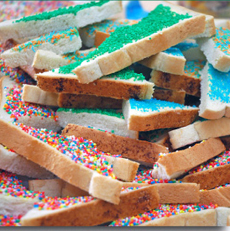
Fairy bread. Photo courtesy CheapFlightsCo.Uk. |
FLATBREAD
Flatbreads are the simplest breads, requiring no leavening, although some are leavened (made with a chemical agent that adds gas to the dough to produce a lighter, airier, more easily chewed bread). They can be extremely thin, like a tortilla, one millimeter or so in thickness, to a few centimeters thick, like focaccia. Examples include the arepa (South America), chapati (India), injera (Ethiopia), jonnycake (U.S.), lavash (Persia), matzoh (Israel), naan (India), oatcake (Scotland), pita (Middle East), pizza (Italy), roti (India), tortilla (Mexico) and sangak (Persia). Some other breads called flatbreads are not completely flat but use yeast and are partially risen, such as focaccia (Italy).
|
|

Pita is one of the best-known flatbreads in the U.S. Tortillas and matzoh are also flatbreads. Photo courtesy National Pork Board |
FLÛTE
A flûte is a long loaf, thicker than a baguette. In the United States, it is also called a Parisienne. See the photo below.
FOCACCIA
A rich, thick Italian snack bread. Olive oil is brushed over the dough prior to baking to retain moisture. While it uses yeast to rise, it is not kneaded and is a relatively flat bread, often an inch or so in height. Focaccia is served with meals and used as a base for pizza and as sandwich bread. A basic focaccia is simple, sprinkled with salt; it can be topped with fresh herbs and ingredients as elaborate as any pizza, including sauteed onions and mushrooms, diced tomatoes, prosciutto, cheese, or anything that appeals to the maker. The word is derived from the Latin focus, fireplace.
|
|

Focaccia with beautiful heirloom cherry tomatoes. Photo courtesy HotBreadOven.org.
|
|
FOUGASSE
A raised flatbread from southern France. The recipe and flavor are similar to focaccia, brushed with olive oil; but the top is styled with elongated slashes, which create the shape of an evergreen tree.
FRENCH BREAD
French bread is a term that applies to a variety of different-shaped loaves that have a crusty exterior and a chewy crumb. French bread is typically made from wheat flour, water, yeast, and salt. Some of the shapes include baguette, bâton, boule, ficelle, and flûte. In the photo at right on the top shelf, slender ficelles appear to the left of large batards. On the lower shelf, smaller bâtons can be seen next to a basket filled with baguettes. Here’s a discussion of the difference between French bread and Italian bread.
|
|
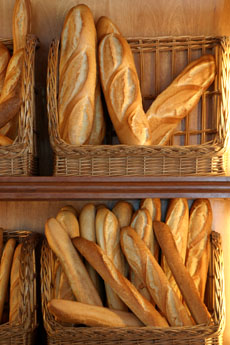 French bread: bâtard at top and flûte below. Photo by Lalito | CSP. French bread: bâtard at top and flûte below. Photo by Lalito | CSP.
|
FRENCH TOAST
Slices of bread are dipped in a mixture of beaten eggs and milk, and pan-fried in butter. It is a popular main dish at breakfast, garnished with confectioner’s sugar, syrup, jam, and/or fresh fruit. Sweeter, light breads, such as brioche, challah, and white bread, make the best French toast.
|
|
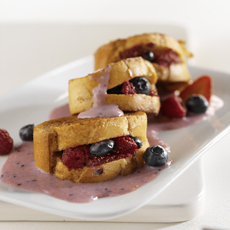 Not your grandmother’s French toast: Here, slices of French bread are cut with deep pockets. After the toast is fried, the pockets are stuffed with fresh berries and served with a fruit yogurt sauce. Photo courtesy DairyInfo.com. Not your grandmother’s French toast: Here, slices of French bread are cut with deep pockets. After the toast is fried, the pockets are stuffed with fresh berries and served with a fruit yogurt sauce. Photo courtesy DairyInfo.com. |
FRUIT BREAD
Fruit bread is a cake-like quick bread (a non-rising bread typically made in a loaf pan) that contains bits of dried fruit (such as cranberry bread or raisin bread) or blends the fruit into the dough (as with banana bread and pumpkin bread). Read our review of fruit breads from the St. Lucia Bread Company.
FRYBREAD
The Navajo created frybread in 1864, but the recipe has spread far beyond. Frybread is made from regular white flour mixed with water, baking powder, or yeast, plus salt. It is then deep-fried in oil or lard. It can be eaten alone or with powdered sugar, honey, or other toppings, sweet and savory. Frybread is also used in Indian-style tacos with beef, cheese, lettuce, and beans on top of the flat, fried bread. November 17th is National Homemade Bread Day
|
|
 Cranberry bread. Photo courtesy BellaBaker.com. Cranberry bread. Photo courtesy BellaBaker.com. |

Navajo fry bread. Here’s the recipe (photo © Jodi Lea Stewart).
Continue To Page 5: Terms From G To L
Go To The Glossary Index Above
|