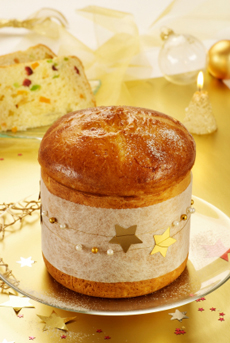
Panettone, a yeast bread filled with candied fruit, is a popular holiday food and gift (photo © Vikif | iStock Photo).
August 2008
Last Updated May 2026
|
|
A Guide To The Different Breads
Page 8: Glossary Of Breads ~ Q To S
This is page 8 of a 9-page glossary of the many different types of breads. Click on the links below to visit other pages. You can also return to the overview and the history of bread or select from many other food glossaries.
Click on a letter to go to the appropriate glossary section:
a b c d e f g h i j k l m n o p q r s t u v w x y z
This glossary is protected by copyright and cannot be reproduced in whole or in part.
You are welcome to link to it.
QUICK BREAD
A light, airy bread made with a chemical leavening agent (baking powder or baking soda). The name refers to the fact that since they are made without yeast, they don’t need time to rise before baking; the quick chemical leaveners activate as soon as they are moistened; no kneading or rising is required. Biscuits, cornbread, muffins, popovers, soda breads, and sweet breads such as banana bread fall into this category. Banana bread (and other nut and fruit loaves), many coffee cakes, pancakes, and waffles are also quick breads. You will also come across the compound noun, quickbread, but quick bread is preferred.
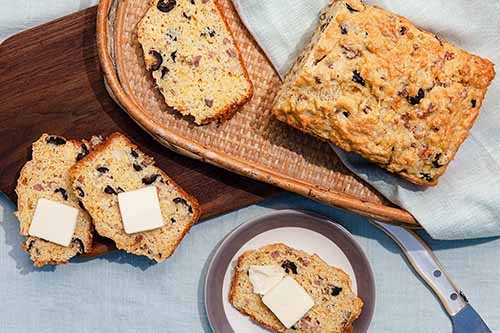
Savory olive quick bread (photo © Colavita Recipes).
RICH DOUGH or RICH BREAD or ENRICHED DOUGH
Rich dough is the opposite of lean dough/lean bread. It contains a significant amount of additional ingredients that “enrich” the dough, including a high fat content (butter, oil, or eggs) and a high sugar or dairy content (sugar, cream, or milk). The amount of these ingredients creates a soft, tender, and cake-like crumb and a soft crust that often browns easily due to the sugar content. Examples include brioche, challah, cinnamon rolls, and most soft dinner rolls.
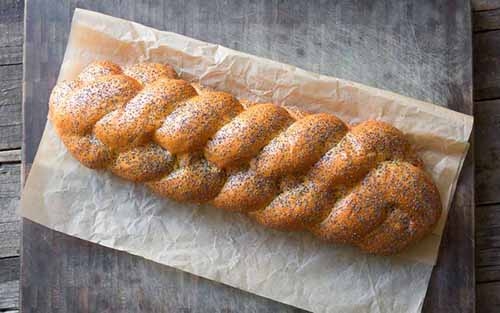
Challah, a classic rich bread (photo © ).
RING
Numerous breads are baked in ring shapes; they tend to be artisan breads, such as ciabatta, and holiday breads, such as Easter bread rings baked with colored eggs. Exceptions are the everyday bagel and bialy.
ROLL
A roll is an individually portioned bread, often a smaller version of a larger loaf. It differs from a biscuit in that it is made with yeast as a leavening agent rather than baking powder or baking soda. There are numerous types of rolls, reflecting national and regional specialties. Examples of the different types of rolls include brioche, clover leaf, club rolls, crescent, dinner rolls, finger rolls, kaiser, knot, Parker House, pistolet, and twist. Hamburger and hot dog rolls are referred to as buns.
|
|
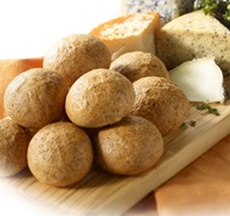
Organic rolls from French Meadow Bakery, a NIBBLE Top Pick Of The Week.
|
ROLL-UP
See wrap.
ROSETTA or MICHETTA
Called rosetta di pane (bread rosette) in Italian, the rosetta (plural rosette) is one of the most recognizable breads in Italy. Flower-shaped, it has a hard crust and a very soft crumb inside. These days, it is most often used as a sandwich bread, typically filled with slices of prosciutto or other cold cuts. It is easy to pull out the crumb ( mollica in Italian) to add more sandwich ingredients. Here’s a recipe.
|
|
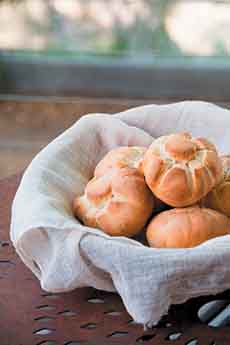
Rosetta rolls (photo © SBS | Australia).
|
|
ROLL-UP
See wrap.
ROTI
Roti is the word for bread in Hindi, Urdu, and many languages in India and Pakistan. A flatbread similar to a tortilla, it is an Indian bread, normally eaten with curries and cooked vegetables. Each region of India has its own version of roti, with varying names. Different flours are used—while most roti are wheat-based, others are made from pearl millet, maize, gram flour, and other grains and flour blends.
|
|
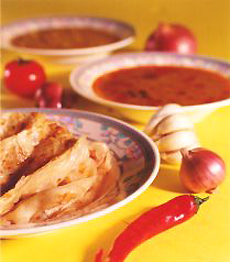
Roti canai (pronounced ROW-tee CHA-nye and variously spelled chanai) is a regional variation. The term may derive from Chennai, the pre-colonial name for the Madras region of India. Photo by Su Yin Khoo | SXC.
|
RYE BREAD
A bread made from rye flour, which is higher in fiber and denser than wheat bread, and stronger in flavor. The bread is usually made with a sourdough starter and may be baked with caraway seeds for additional flavor. There are light and dark rye breads, depending on the flour (which is classified according to the level of extraction of fiber), and added ingredients, such as molasses for flavor or caramel for color. Artisan loaves can include ground spices such as anise, coriander, and fennel. Marble rye is a swirl of dark pumpernickel rye and light rye dough and is a festive sandwich bread. See also pumpernickel. Origin: Britain. Around 500 C.E., the Saxons and Danes settled in Britain, bringing rye. Dark rye bread became a staple food in the Middle Ages. See Jewish rye bread.
|
|
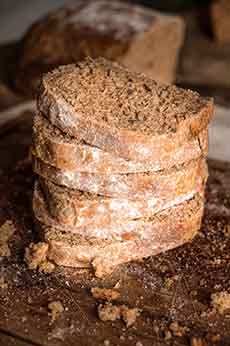
Dark rye bread (photo © Delfina Cocciardi | Unsplash).
|
|
SANDWICH
While slices of bread with meat and cheese had been eaten since the dawn of the loaf of bread, the term “sandwich” originated in the 18th century, after John Montagu, the fourth Earl of Sandwich (1718-1792), called for such a dish to be served to him at his club, in order that he could remain at the gaming table without breaking for supper. It is said that he was inspired by diplomatic trips to the Mediterranean, where he observed Greeks and Turks stuffing pita bread with meats and other fillings. The practice of serving “sandwiches,” including elaborate presentations of poached fillet of pheasant and guinea hen, soon became a popular late-night meal at society balls.
|
|
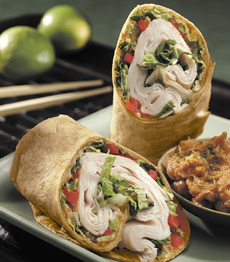
Turkey wrap. Photo courtesy National Turkey Federation. |
During the 19th century, lunch (called midday dinner) was the main meal of the day; dinner (then called supper) was a lighter meal where the leftovers from lunch were often made into sandwiches. After Victorian author Charlotte Mason wrote the first cookbook recipes for sandwiches—recommending that the crusts be removed from the bread—sandwiches began to be served at tea and picnics. They were common fare at taverns and train stations; the “club sandwich” was developed at a private club. In the U.S., a sandwich on a long, narrow roll became variously known as a grinder, hero, hoagie, poor boy, torpedo, and submarine, with ingredients varying regionally. Hot sandwiches came to the fore with the rise of the luncheonette in the 1920s, and today have evolved beyond standard loaves to breads of all kinds, from bagels and croissants to “wraps” or “roll-ups” in tortillas. On the world stage, they range from the original “inspiration,” stuffed pita, to Mexican tortas to Vietnamese bánh mì.
See our Sandwich Glossary for the many different types of sandwiches.
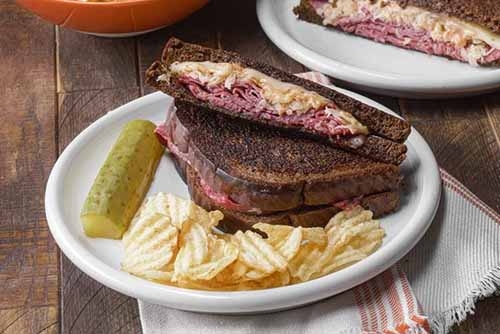
A Reuben sandwich. Here’s the recipe (photo © Taste Of Home).
|
SANDWICH LOAF
See Pullman Loaf.
SCONE
Scones are quick bread, similar to American biscuits. They are traditionally made with wheat flour, sugar, baking powder or baking soda, butter, milk, and eggs, and baked in the oven—both in the traditional wedge form and in round, square, and diamond shapes. This recipe produces a hard, dry texture. “Cream scones,” which use heavy cream in the recipe, produce a moister scone. Read the history of the scone and a review of our favorite cream scone mix, Iveta Scones, moist wonders, and a NIBBLE Top Pick Of The Week.
|
|
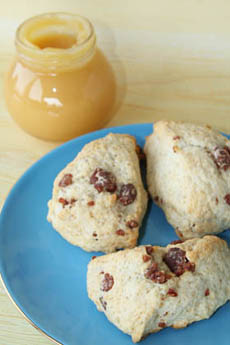
Moist, creamy Iveta Scones (here, cranberry scones) are a NIBBLE Top Pick Of The Week. Photo by Claire Freierman | THE NIBBLE. |
|
SIMIT
Simit is an individual portion circular bread (like a bagel), garnished with sesame seeds. It is very common in Turkey and other parts of the Balkans and the Middle East: Bulgaria, Lebanon, Macedonia, and Serbia. The size, crunchiness/chewiness, garnish or seasoning, and other characteristics vary by region. It has been called the predecessor of the bagel; it is sometimes called the Turkish bagel. Simit is generally eaten plain, as street food, and for breakfast with tea, jelly/jam, or cheese.
|
|
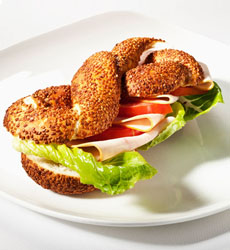
Fusion food: turkey and Jarlsberg on simit. Photo courtesy Simit + Smith. |
SOCCA
Socca is a traditional flatbread from Nice, France, similar to a crêpe but thicker. Made with chickpea flour, it’s gluten-free. It’s served as a snack. As a street food, it’s cooked on a grill and served in a paper cone, usually sprinkled with salt, pepper, or other delicious toppings. At home, with beer, wine, or cocktails, serve it with an assortment of toppings: fresh herbs, olives, roasted vegetables, and/or cheese. For a heartier snack, add thin slices of lamb.
|
|
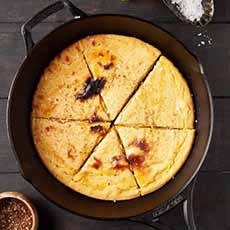
Socca is a chickpea-flour flatbread from Nice, France. Here’s the recipe.(photo © Taste Of Home). |
|
SODA BREAD or IRISH SODA BREAD
A chemically-leavened quick bread made with baking soda instead of yeast. Baking soda produces a lighter, airy crumb. While the traditional ingredients are flour, baking soda, salt, and buttermilk, soda breads are often sweet breads. Raisins and nuts can be added. Soda bread dates back to approximately 1840 when bicarbonate of soda was introduced to Ireland; it reacted better with the soft wheat grown in that climate and replaced yeast as the leavening agent.
|
|
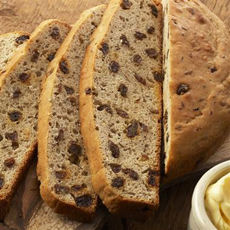
Soda bread. Photo courtesy McCormick. This and other recipes are available at McCormick.com. |
SOUR BREAD
Sour bread has a sour flavor caused by either a natural leaven fermentation, such as sourdough, or through the addition of souring agents such as sour salt, vinegar, or yogurt. Not all sour bread is sourdough bread; sourdough must be leavened by a sourdough culture of wild yeast and lactobacilli.
|
SOURDOUGH
Sourdough is a method of baking using lactic acid-producing bacteria (lactobacillus) that produce a characteristic sour taste and aroma. The sour taste comes from the lactobacillus, which lives in symbiosis with the yeast, feeding on the byproducts of the yeast fermentation. Until science uncovered the leavening process in the 19th century, all yeast-leavened breads were sourdough. Sourdough starter from a prior batch is used to create the new batch. Sourdough starters are different from other starters; while regular starters can live for several years, sourdough starters can live for generations. Here’s the history of sourdough bread.
|
|
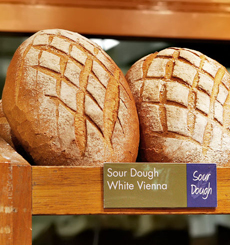
Sourdough loaves. Photo courtesy Wikimedia.
|
|
SPELT
Spelt (also known as farro, and called Dinkel in German) is a subspecies of wheat that was enjoyed by the ancient Romans and was an important staple in parts of Europe from the Bronze Age to medieval times. It has a mild, nutty flavor. Spelt has slightly more protein than wheat; while it does contain gluten, the type of gluten is more easily tolerated by people who are sensitive to wheat gluten.
SPLIT-TOP ROLL
A hot dog-style roll is used for a variety of goodies, including lobster rolls. A New England specialty.
|
|
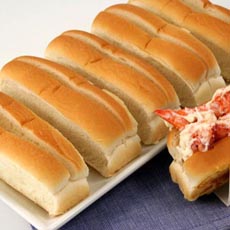
Split-top rolls are available from HancockGourmetLobster.com. |
SPOONBREAD
A Southern specialty said to have originated in Virginia, spoonbread is a type of soufflé, rather than an actual bread. It is made with cornmeal rather than wheat flour, baked in a casserole or soufflé dish, rises like a soufflé, and is served immediately. Like a soufflé, it must be eaten with a spoon, but because it has a cornmeal base (not an egg-white base, like a soufflé), it is heavier, like a pudding. Recipes include a wide variety of savory flavors, from simple herbs to cheese, meat, and vegetables. In addition to savory soufflés, its closest relatives are corn pudding, popovers, and Yorkshire pudding. In older cookbooks, you may see spoonbread written as two words—spoon bread—but today that’s considered archaic.
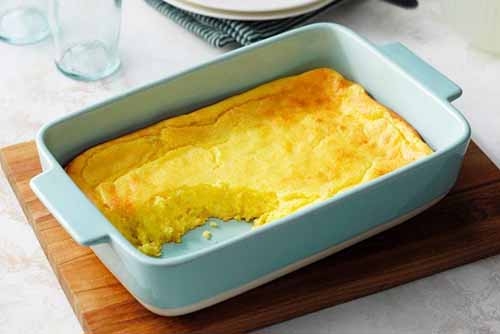
Spoonbread. Here’s the recipe (photo © Taste Of Home).
STARTER
A small amount of uncooked, leavened dough, retained from a previous batch, is used to “start” the new batch of dough. The yeast or bacteria in the old dough start the fermentation of the carbohydrates in the fresh batch of dough.
STUFFING
Bread stuffings are typically made from day-old (or older) bread or breadcrumbs, mixed with fat and vegetables, including onion, celery, mushrooms, and chestnuts. Stuffings are cooked in the body cavity of birds and fish, into cuts of meat that have been deboned (or into which a pouch has been cut). Vegetables are stuffed as well, although bell peppers, cabbage, grape leaves, tomatoes, and other vegetables tend to be stuffed with rice and/or meat rather than bread stuffing. In some regions, such as the South, stuffing is referred to as dressing, a term coined in Victorian England.
|
|
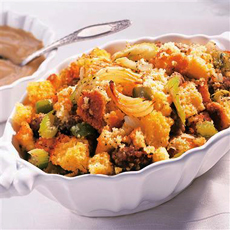
Sage cornbread stuffing. This and other recipes are available at McCormick.com.
|
There are numerous fillings that are not bread-based. One example is forcemeat, a mixture of finely ground raw meat, fish, or poultry that is highly spiced and bound with butter and eggs. As with bread stuffing, it can include any variety of other ingredients, from mushrooms and onions to nuts and truffles.
SWEET BREAD
Sweet breads are popular in many cultures and can be found as loaves or rolls with a slightly sweetened dough, topping, and/or filling. Often they are made in decorative shapes, such as a dove for Easter. The sweeteners can be barley malt, brown sugar, honey, maple syrup, molasses, and white sugar. Also see Easter bread and Quick Bread, above.

Pani di Pasqua is one of the numerous sweet Easter breads. Here’s the recipe (photo © DeLallo).
Continue To Page 9: Terms Beginning With T To Z
Go To The Glossary Index Above
|